

O'Hare Summer Flight Cuts Raise Booking Risk
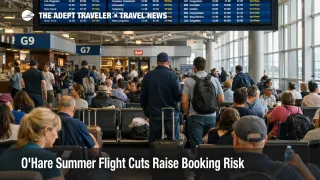
Chicago O'Hare International Airport (ORD) summer planning has moved from warning stage into a more serious schedule fight. The Federal Aviation Administration has resumed talks with airlines on a cap of 2,608 daily operations for the Summer 2026 season, down from the 2,800 level it floated earlier, below the more than 3,080 daily operations airlines scheduled on peak days, and even below last summer's roughly 2,680 daily operations. For travelers booked from late March into summer, the immediate risk is not that every ORD flight disappears, but that published schedules may still be trimmed, retimed, or left with much less recovery room than they appear to have today.
O'Hare Summer Flight Cuts: What Changed
What changed this week is the number now actively in play. The FAA's March 18 Federal Register notice says the agency no longer considers the current Summer 2026 schedule sustainable and wants ORD limited after further review of historical performance and the proposed summer build up. Reuters reported on March 16 that the resumed hearing centers on 2,608 daily flights, not the earlier 2,800 level, which makes this a materially tighter target than the one travelers and airlines were looking at earlier in March.
That matters in practical terms because this is no longer just a debate over slowing aggressive growth. The FAA says ORD's published summer schedule would exceed 3,080 daily operations on peak days, while last summer peaked around 2,680. The agency also says O'Hare construction and capacity constraints remain in place, and that overscheduling at ORD can trigger wider delays across the National Airspace System. In other words, the regulator is arguing that a normal weather day can still unravel when the schedule itself is too dense.
Which Travelers Face the Most Disruption
The biggest exposure sits with travelers using O'Hare as a connection machine, not necessarily with simple local nonstops. Domestic to international connections, separate ticket itineraries, last bank departures of the day, same day cruise joins, tours, weddings, and business trips with hard start times all become more fragile when backup frequencies thin out. A flight can still operate and still become a bigger problem if the surrounding options disappear.
Airlines most exposed to schedule changes are the ones that expanded the most. Reuters says United planned about 780 daily ORD flights this month, up from 541 last year, while American's summer daily departures were set to rise to 526 from 484 last summer after a major growth push. If the FAA holds close to the proposed cap, those increases are the clearest place where carriers may need to pull frequencies back or retime banks. Spillover pressure would not stay inside Chicago. Fewer workable O'Hare banks can push travelers toward Chicago Midway International Airport (MDW) and other Midwest hubs, while also reducing same day reaccommodation options systemwide.
In an earlier Adept Traveler article, O'Hare Summer Flight Cuts Move Toward Hard Limits explained the first step in this tightening process, and FAA pushes O'Hare summer cuts deeper into peak season outlined how deeper reductions could hit peak summer banks.
What Travelers Should Do Now
Travelers booked from March 29, 2026, through the core summer season should treat current ORD schedules as provisional, especially if they were purchased for June through August. The safest near term move is not automatic rebooking, it is reducing dependence on a perfect same day chain. Earlier departures, longer connections, and refundable or low fee fares matter more here than they would in a normal summer booking cycle.
The main decision threshold is how much failure your trip can absorb. If a one to three hour retime, a longer layover, or even an overnight would be inconvenient but manageable, waiting for the final FAA order and airline timetable updates may be reasonable. If a missed connection would break a cruise embarkation, wedding, guided tour, or long haul departure, the safer choice is to add margin now, shift to a nonstop where possible, or arrive the night before. Travelers who can use Midway instead of O'Hare should also price that option, because a tighter ORD schedule could push some demand and fare pressure across the Chicago market.
Why the FAA Is Pushing Deeper Cuts, and What Happens Next
The FAA's mechanism is straightforward. It plans to assign reductions proportionally using final Summer 2025 schedules as the baseline, which is intended to spread cuts without choosing winners and losers. The agency also set half hour reduction targets across the day to keep overscheduled banks from creating delay cascades that roll through the rest of the operation. That is a more structural intervention than a vague request for airlines to behave better.
What happens next is the key traveler decision point. After the resumed scheduling reduction meeting and review of submitted information, the FAA says it will publish a final order in the Federal Register for Summer 2026. Until that order lands and carriers adjust their timetables, the schedule in an app or booking engine may still overstate how much flexibility O'Hare will really have. The real booking risk for April through summer is not simply cancellation, it is a thinner, less forgiving schedule at one of the country's biggest hubs.
Sources
- Operating Limitations at Chicago O'Hare International Airport, Notice of Meeting and Request for Information, Federal Register
- FAA to resume hearing Thursday on plan to reduce flights at Chicago O'Hare, Reuters
- Chicago says FAA should not cut daily flights below 2,800, Reuters
- O'Hare Summer Flight Cuts Move Toward Hard Limits, Adept Traveler
- FAA pushes O'Hare summer cuts deeper into peak season, Adept Traveler