

TSA Shutdown Delays Deepen at U.S. Airports
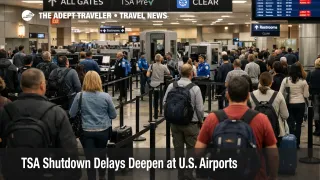
TSA shutdown delays at U.S. airports have moved beyond a bad spring break weekend into a broader network risk as the partial Department of Homeland Security shutdown continues on March 20, 2026. The latest change is not just longer lines at a few big airports. Overall TSA absences rose back to 10.2 percent on Wednesday, with much higher rates at some hubs, while federal officials are now warning that some small airports could face checkpoint shutdowns if another missed paycheck on March 27 pushes more officers to stay home. Travelers should build more buffer, avoid tight same day connections, and treat smaller departure airports as less resilient than usual.
TSA Shutdown Delays: What Changed
What changed since the March 10 line surge is that the disruption has become more structural. U.S. Travel and Airlines for America were initially warning about multi hour waits in places such as Houston, Atlanta, Charlotte, and New Orleans. Now the national absenteeism rate is still running at about five times normal, according to Reuters, and Transportation Secretary Sean Duffy has publicly warned that next week could look materially worse as another paycheck is missed.
That matters because checkpoint problems do not stay contained at the checkpoint. A two or three hour screening delay can break the whole day even when the flight is still operating, especially for travelers connecting onward to a cruise embarkation, an international departure, or a smaller domestic airport with only a few later rebooking options. The TSA passenger volume page shows more than 2.57 million travelers cleared on March 18 alone, which means the system is already carrying heavy spring demand while staffing remains unstable.
The operational seriousness is now higher than a simple inconvenience story. Reuters reported that 366 TSA officers have left during the shutdown, some airports have already closed checkpoints, and senior officials say lightly staffed airports could be forced to stop screening altogether if the standoff drags on.
Which Travelers Face the Most Disruption
The most exposed travelers are the ones who have the least slack in the itinerary. That includes families flying on peak spring break mornings, travelers booked on the first leg out of a smaller airport, passengers with checked bags and short hub connections, and anyone trying to link an airport trip to a fixed time event such as a cruise sailing, wedding, tour pickup, or long haul international departure.
Large hubs are still the most visible pressure points, but not always the most fragile ones. Reuters said absentee rates on Wednesday reached 38 percent at Hartsfield Jackson Atlanta International Airport (ATL) and at George Bush Intercontinental Airport (IAH), while John F. Kennedy International Airport (JFK) and San Juan also posted far above normal absence levels. Big hubs can sometimes consolidate lanes and absorb pain through longer waits. Small airports often cannot. When there is only one checkpoint, the problem can shift from slower screening to no viable screening operation at all.
This is also why the story is no longer only about passenger frustration. U.S. Travel said it has launched a live tracker showing how many days Transportation Security Officers have gone without a paycheck, and Geoff Freeman said the industry is pushing for immediate action and lasting protections after a second shutdown driven pay crisis in less than six months. In practical terms, the staffing problem is becoming a retention problem, and retention problems are harder to reverse quickly than a single bad line day.
What Travelers Should Do Now
Travelers flying in the next several days should leave more buffer than they normally would, especially at airports already reporting strain or on routes that depend on a hub connection. For most domestic trips, the safer move is to treat the airport like a disruption day even if the weather is clear and the airline app shows the flight on time. A clean flight status does not protect you from a screening bottleneck.
The rebooking threshold is also shifting. If the trip has a hard deadline and starts at a small airport, changing to an earlier departure, a larger airport, or an overnight before a long haul segment can be the smarter choice than waiting to see whether local screening holds together. If the trip is flexible and your airport has multiple same day frequencies, waiting can still be reasonable, but only if you monitor both the airport and airline closely. In an earlier Adept Traveler article, U.S. TSA Shutdown Delays Ease, Risk Still Rising tracked the slight improvement on March 18 that proved too small to solve the broader traveler problem. In another earlier Adept Traveler article, U.S. Shutdown Airport Closure Risk Hits Small Fields explained why smaller airports are the next threshold to watch.
What to monitor next is straightforward. Watch for airport specific guidance about reduced checkpoint hours, closed lanes, or earlier arrival recommendations. Watch for another rise in national absenteeism. And watch March 27, when a second missed paycheck could turn an already stretched system into something much less predictable.
Why the Disruption Is Spreading, and What Happens Next
The mechanism is simple. TSA officers are still legally required to work, but unpaid federal workforces do not operate like normal ones for long. More callouts mean fewer open lanes, fewer open lanes mean slower throughput, and slower throughput pushes missed flights, broken connections, and longer airline service lines even when aircraft and crews are otherwise ready. The second order effect is that a checkpoint problem becomes an itinerary recovery problem across airlines, hotels, cruise terminals, car rentals, and airport ground transport.
That is why the travel industry response has broadened. A4A has called the current waits unacceptable, U.S. Travel says current screening rates and spreading delays could cost the economy nearly $1 billion, and the wider industry coalition is now framing the issue as both a traveler security problem and a workforce protection problem.
What happens next depends less on airline schedules than on whether Congress ends the DHS funding lapse before the next pay shock lands. Until that happens, travelers should assume TSA shutdown delays can worsen quickly, unevenly, and airport by airport. The immediate risk is more long lines at big hubs. The more serious risk is that some smaller airports lose screening resilience altogether just as spring travel volume keeps building.
Sources
- Travel Industry Stands United: Pay TSA Now
- Missed Pay for TSA Leading to Lengthy Security Lines
- A4A Statement on Extraordinarily Long TSA Lines at Some U.S. Airports
- US says TSA absences rose slightly to 10.2% Wednesday
- US official warns small airports could soon shut over TSA absences
- TSA Checkpoint Travel Numbers