

U.S. Shutdown Airport Closure Risk Hits Small Fields
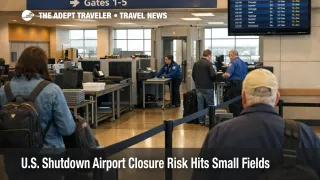
The U.S. shutdown airport closure risk has moved from long security lines and checkpoint strain to an explicit warning that some smaller airports may have to stop screening operations if TSA staffing worsens. That matters now because the threat is landing during spring travel, while the Federal Aviation Administration's March 18 daily report is still flagging weather pressure in the Northeast and Midwest that can make fragile regional schedules even less forgiving. Travelers using smaller airports should treat same day departures as less resilient than usual, check both airport and airline advisories before leaving home, and be ready to shift to a larger airport if the trip cannot absorb a missed first leg.
The new angle since our prior coverage is the explicit closure warning itself. Reuters reported on March 17 that a senior U.S. official said some smaller airports may have to shut if the federal funding impasse continues, after TSA absenteeism reached 10.2 percent nationally and 366 officers had already left during the shutdown. In other words, this is no longer only a big hub inconvenience story. It is now a regional access story, because a lightly staffed airport can hit a hard operating limit much faster than a large hub with multiple checkpoints and more room to consolidate lanes.
U.S. Shutdown Airport Closure Risk: What Changed
What changed is the threshold. Earlier coverage focused on unpaid screeners, long waits, and spring break pressure. The latest warning says some smaller airports may have to close outright if staffing keeps eroding. Reuters reported that large airports may be able to reduce operations by limiting checkpoints, but smaller airports with only one checkpoint are the ones most directly exposed to a full screening failure. That is the practical line travelers should watch, because once a one checkpoint airport cannot staff security safely, the schedule on paper matters far less than whether anyone can get through the checkpoint at all.
The timing is worse because the FAA's March 18 daily air traffic report is still flagging morning wind in Boston, New York, and Philadelphia, plus light snow in Indianapolis and Chicago. Weather at major hubs does not close a regional airport by itself, but it does remove recovery margin. A traveler who loses a feeder flight from a small airport on a clear day may still salvage the trip. A traveler who loses that same feeder while bigger hubs are already under weather pressure has a much harder rebooking path, especially on mixed itineraries or trips with cruise embarkations, tours, or nonrefundable first night hotel bookings.
Which Travelers and Airports Are Most Exposed
The first airports that look vulnerable are not necessarily the busiest. Based on Reuters' description, the highest risk group is smaller commercial airports with one checkpoint, thin local staffing, limited replacement depth, and only a few departures a day. Reuters has not published a list of airports at greatest risk, and TSA has not publicly identified which fields would be cut first. That uncertainty matters on its own, because regional travelers may not get a long runway between "operations are stressed" and "the checkpoint schedule is being reduced."
The most exposed travelers are people starting at regional airports and connecting onward to larger hubs for long haul flights, cruises, or tightly timed domestic trips. First order, a checkpoint staffing failure can wipe out the first leg. Second order, that missed feeder can break the entire itinerary, because the substitute options at small airports are usually fewer, later, and more expensive. Families on spring break, travelers checking bags, and anyone booked on the last practical flight of the day should assume the risk is higher than a typical March operations day.
This is also why same day schedules at regional fields need to be read differently right now. "On time" in an airline app only means the aircraft is expected to operate. It does not guarantee the checkpoint experience will be normal, or that staffing will hold through the entire departure bank. Travelers should read the schedule together with airport social feeds, airport websites, and any TSA or airline advisory language, especially if the airport has a single screening point and no close same carrier backup departure.
What Travelers Should Do Now
For immediate departures, the safest move is to protect the first leg. If you are flying from a smaller airport in the next 24 to 72 hours, check the airport website and your airline app the night before, then again before leaving home. Add more buffer than usual at security, and do not assume a regional field will be faster simply because it is smaller. On a stressed day, less infrastructure can mean less slack, not less delay.
The key decision threshold is how much damage a missed departure would cause. If missing the flight would only mean arriving a few hours late, waiting may be reasonable. If missing the first leg would break an international connection, a cruise embarkation, a wedding, or a nonrefundable tour sequence, start pricing the drive to a larger airport now. That tradeoff is ugly, but it is often better than betting the trip on a one checkpoint field with limited recovery options. Adept's earlier pieces, U.S. Shutdown Threatens Smaller Airport Closures and U.S. Shutdown Pressure Grows on TSA as Airlines Warn, remain useful for travelers comparing how this risk has escalated, while How a government shutdown could affect travel gives broader planning context.
What to monitor next is straightforward. Watch for any airport specific notice about reduced checkpoint hours, longer than normal arrival guidance, or staffing related screening delays. Watch for another rise in TSA absenteeism or further attrition. And watch the FAA status pages and daily report, because the U.S. shutdown airport closure risk becomes more damaging when weather is already disrupting hub recovery. A small airport problem and a hub weather problem are manageable separately. Together, they can break the itinerary.
Why the Risk Is Spreading Through the System
The mechanism is blunt. TSA screening is a federally staffed choke point with minimum staffing needs. Local airports and airlines cannot simply substitute their own workers when officers call out. Airlines for America said on March 13 that tens of thousands of TSA employees received zero dollar paychecks, and on March 8 it warned that some U.S. airports were already seeing security lines stretch to two and three hours. Once that pay disruption starts producing more callouts and resignations, the system loses throughput first at checkpoints, then reliability across entire airport departure banks.
Large hubs usually absorb that pain as slower screening, fewer open lanes, and uglier queues. Smaller airports have less room to absorb anything. That is why the explicit closure warning matters more than another headline about long lines at Atlanta or Houston. A big airport can often degrade. A small airport may simply stop functioning for a period if its only checkpoint cannot be staffed. Even after funding is restored, the recovery may not be immediate because replacing trained screeners is slower than passing a bill. For travelers, the lesson is simple: this is now a live regional airport risk, not just a Washington political fight.