

U.S. Airfare Hikes Spread as Fuel Costs Double
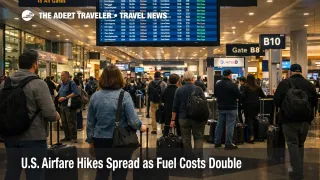
U.S. airfare hikes are moving from warning sign to active pricing behavior, and travelers booking spring and early summer trips now face a more expensive, less forgiving market. Reuters reported on March 20, 2026 that United Airlines said recent fare increases were running 15 to 20 percent and that it was cutting some lower performing routes, while Delta Air Lines and American Airlines each projected about a $400 million first quarter fuel hit. The practical consequence is straightforward: on strong demand routes, carriers are proving they can pass more of the fuel spike into fares, and on weaker routes they have more incentive to trim flying instead of protecting cheap inventory. Travelers with fixed dates, short layovers, or small airport origins should expect fewer low fare fallback options and less slack if something goes wrong.
U.S. Airfare Hikes: What Changed
What changed is the operating response. Earlier in the month, the main story was that U.S. airline demand was holding up even as fuel got more expensive. Now Reuters reports that carriers are leaning harder into fare increases and selective cuts, with United openly describing a 15 to 20 percent rise in pricing and a willingness to reduce weaker flying to protect margins. That is a sharper traveler facing signal than a vague warning about higher fuel costs, because it means the pass through is already happening on routes where airlines think demand will hold.
The fuel side has also worsened fast. Reuters and the Associated Press both reported that U.S. jet fuel prices climbed to about $3.93 per gallon by March 17, 2026, up from roughly $2.50 before the war began in late February. Reuters described that move as fuel prices nearly doubling since the conflict started, which helps explain why airlines are acting more aggressively now instead of waiting for second quarter guidance.
Which Travelers Face the Most Pressure
Travelers on high demand nonstop routes are likely to feel the fare pressure first, especially where corporate demand, premium demand, or spring and summer leisure demand is already strong. Reuters reported that analysts and airline executives see pricing strength holding because demand remains resilient across segments, which gives carriers more room to raise fares without losing as many passengers as they would in a softer market. That points to higher risk on large hub to hub routes, major business corridors, peak leisure departures, and late booking windows where airlines can reprice fastest.
The other vulnerable group is travelers on thinner or more marginal flying. When airlines cut selectively rather than broadly, the pain is uneven. A route that loses one or two daily frequencies may still exist on paper, but it becomes much less useful in practice because reaccommodation options narrow, same day rebooking gets harder, and missed connections are more likely to turn into overnight costs. That risk is highest for travelers coming from secondary airports, travelers building tight hub connections, and anyone relying on the last flight of the day.
What Travelers Should Do Now
Book sooner rather than later if your trip depends on a specific departure day, a specific airport, or a tight connection chain. The main decision threshold is flexibility. If you can move your trip by a day, compare options now and hold the most workable itinerary before inventories tighten further. If you cannot move, paying a little more for a better timed flight or a longer connection may protect the trip better than chasing the cheapest fare in a market where schedule resilience is thinning.
Travelers should also treat fewer frequencies as a hotel and ground transport issue, not just an airfare issue. When airlines pull weaker flights, the second order effect is that a weather delay, crew issue, or airport flow program leaves fewer ways to recover on the same day. That can mean extra hotel nights, missed cruise embarkations, lost tour bookings, or a forced airport change after a misconnect. For trips with onward rail, ferry, cruise, or event timing, the safer move is to build more buffer than usual and avoid the final bank of departures where there is no clean fallback.
Over the next 24 to 72 hours, watch for three signals. First, whether more carriers start talking publicly about capacity discipline instead of only fuel pressure. Second, whether airfare increases spread from strong trunk routes into mid market connecting itineraries. Third, whether travel waivers or schedule changes begin appearing on marginal routes, which would suggest airlines are moving from pricing defense to deeper network reshaping.
Why Airlines Are Acting This Way, and What Happens Next
The mechanism is simple, even if the outcome will not be uniform. Most major U.S. airlines do not hedge fuel heavily, so a sharp rise in jet fuel feeds into costs quickly. When demand is strong, carriers can push more of that cost through higher fares. When demand is weaker, they often defend profitability by trimming flying instead of selling too many cheap seats that no longer cover the cost base. Reuters said that is exactly the split now appearing between U.S. airlines and some overseas peers, with U.S. carriers still leaning on stronger domestic demand while European and Asia Pacific airlines face more visible rerouting and margin pressure.
In an earlier Adept Traveler article, U.S. Airlines See Spring Demand Beat Fuel Shock the focus was whether strong bookings would let carriers absorb part of the shock. In an earlier Adept Traveler article, Jet Fuel Shortages Spread as Hormuz Risk Deepens the focus was the broader supply and pricing pressure in jet fuel markets. The new March 20 shift is that pass through pricing and selective cuts are now more explicit. If fuel stays elevated, the next step is likely not one blanket fare jump across the whole system. It is a more uneven market where strong routes get pricier, weaker routes get thinner, and travelers pay more for certainty.
Sources
- US airlines lean on demand, fares as Iran war rattles overseas peers
- Strong travel demand lifts US airlines despite fuel price surge
- Jet fuel prices and airfares are rising. Travelers are still booking flights, US airlines say
- Prices for oil, fuel cargoes smash record highs as Iran war chokes Middle East supply
- JP Morgan Industrials Conference, American Airlines transcript
- Delta Air Lines, J.P. Morgan Industrials Conference transcript