

Flight Delays and Airport Impacts: March 21
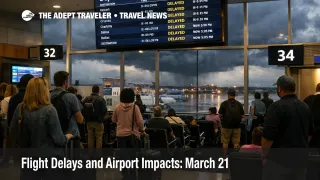
March 21 flight delays are shaping up as a manageable but fragile U.S. operating day, not a coast to coast breakdown. The FAA's most current Saturday operations plan flags wind around Boston, New York, and Philadelphia, thunderstorms around Atlanta and Charlotte, low ceilings near Seattle, and heavy Florida snowbird traffic, with possible later traffic controls in South Florida, ski country, Atlanta, and Charlotte. Travelers flying this afternoon and evening should not assume a light morning means an easy finish, especially if their itinerary depends on a tight connection or a one flight per day route.
March 21 Flight Delays: What Changed
The clearest change is that the FAA's real time command center view for Saturday is more cautionary than the still posted public daily air traffic page, which was last updated for Friday, March 20 when checked. Saturday's operational plan showed no active terminal delay programs at that moment, but it did show multiple live en route constraints, including Florida and Caribbean flow controls, Texas to Northeast traffic pressure, ski country programs, and a route closure tied to thunderstorms. That points to a system that is still moving, but with less spare capacity than the headline airport status pages alone suggest.
That distinction matters for travelers. FAA airport status pages for General Edward Lawrence Logan International Airport (BOS), Hartsfield-Jackson Atlanta International Airport (ATL), Charlotte Douglas International Airport (CLT), Seattle-Tacoma International Airport (SEA), Orlando International Airport (MCO), and San Diego-Lindbergh Field Airport (SAN) were all showing general arrival and departure delays of 15 minutes or less when checked. In practice, that means the main risk on March 21 is not a universal airport shutdown, but a later day slide from light delay into missed turns, thinner rebooking options, and weaker recovery at the hubs the FAA is already watching.
Which Airports and Itineraries Face the Most Risk
The most exposed travelers are the ones moving through weather sensitive or connection heavy banks later on March 21. That includes passengers transiting Boston Logan, Atlanta, Charlotte, and Seattle, plus travelers bound for or connecting through Florida and Caribbean leisure markets where the FAA is already managing flow. A nonstop into one of those airports is still easier to absorb than a same day two segment trip that depends on the second leg leaving on time.
The pressure is not only at the airport named on your boarding pass. Wind in the Northeast corridor can slow arrival rates at several linked airports at once, while thunderstorms around Atlanta and Charlotte can interfere with one of the most important connection complexes in the country. First order, that means later departures and airborne holding. Second order, it can break onward connections, narrow same day reaccommodation, and push stranded passengers into higher hotel and ground transport costs in markets that were not the original source of the weather problem.
What Travelers Should Do Now
Travelers flying on March 21 should treat the afternoon and evening as the main decision window. Check the inbound aircraft for your flight, not just the status of your own segment, and build more buffer before departure if you still need to clear security, check bags, or reach the airport through weekend traffic. If you are connecting through Atlanta, Charlotte, Boston Logan, or Seattle on a short layover, a preemptive switch to a longer connection is more valuable than waiting for a formal waiver that may arrive after the network has already compressed.
Travelers should also separate a tolerable delay from a broken itinerary. Waiting may be reasonable if your flight is nonstop, your arrival time is flexible, and the airport is still posting only minor FAA delays. Rebooking earlier makes more sense if you are connecting to the last flight of the day, a cruise embarkation, a long haul international departure, or a fixed event where a one to two hour slip destroys the value of the trip. March 21 is the kind of day where many travelers get through fine, but the ones with no slack are the ones most likely to feel the full cost of a moderate disruption.
Why the FAA Picture Could Worsen Later
The FAA plan shows why the day could get tougher even without a dramatic national headline. The agency flagged possible ground stop or delay program action later for Boca Raton area traffic and ski country demand, and it also said Atlanta and Charlotte ground stops were possible after 2100 UTC, which is late afternoon in the U.S. Central time zone. The command center also noted staffing triggers in Florida airspace and active airspace flow programs tied to broader network demand. That is the mechanism travelers need to watch, because once demand, weather, and staffing all start trimming arrival rates at the same time, the system can move from small delays to larger rolling disruption quickly.
In an earlier Adept Traveler article, Flight Delays and Airport Impacts: March 18 the FAA picture was narrower, with a more defined set of weather trouble spots. In another earlier Adept Traveler article, TSA Shutdown Delays Deepen at U.S. Airports we noted that airport side resilience was already thinner than usual. Those are separate problems from FAA traffic flow management, but they stack badly on a day like this. The March 21 flight delays outlook is still more warning than collapse, yet the next decision point is obvious, watch the afternoon and evening hub banks closely, because that is where a mostly normal day can stop looking normal.
Sources
- FAA Daily Air Traffic Report | Federal Aviation Administration
- Current Operations Plan Advisory | FAA ATCSCC
- National Airspace System Status | FAA
- General Edward Lawrence Logan International Airport (BOS) Real-time Status | FAA
- Hartsfield-Jackson Atlanta International Airport (ATL) Real-time Status | FAA
- Charlotte Douglas International Airport (CLT) Real-time Status | FAA
- Seattle-Tacoma International Airport (SEA) Real-time Status | FAA
- Orlando International Airport (MCO) Real-time Status | FAA
- San Diego-Lindbergh Field Airport (SAN) Real-time Status | FAA