

Flight Delays and Airport Impacts: March 18
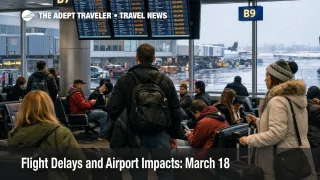
March 18 flight delays are a selective hub risk story, not a systemwide collapse. The Federal Aviation Administration said Wednesday's main pressure points were morning wind in Boston Logan International Airport (BOS), the New York airports, and Philadelphia International Airport (PHL), light snow in Indianapolis International Airport (IND) and the Chicago airports, and low clouds in Seattle Tacoma International Airport (SEA). For travelers, that means the smartest move is still to protect connections through the Northeast and Chicago even though many airport status pages were only showing general delays of 15 minutes or less when checked late morning.
The new wrinkle is that the FAA's text only national airport summary was still listing active Ground Delay Programs for Denver International Airport (DEN), Newark Liberty International Airport (EWR), John F. Kennedy International Airport (JFK), LaGuardia Airport (LGA), and Philadelphia on Wednesday morning. That matters because a day can look manageable in the airport snapshots while traffic management programs are still slowing the flow into key hubs. FlightAware was also showing 1,237 delays and 221 cancellations within, into, or out of the United States when checked, which is far below the worst of the earlier storm period, but still high enough to break tight same day itineraries.
March 18 flight delays are therefore more about flow control than headline level collapse. Flight Delays and Airport Impacts: March 17 captured Tuesday as a recovery day after the broader storm wave, and Wednesday's FAA outlook shows that the recovery has narrowed further into a smaller set of airports and weather types instead of spreading across the whole network.
March 18 Flight Delays: What Changed
What changed for Wednesday is that the FAA's daily report got more specific and smaller in scope. Instead of a coast to coast disruption map, the agency flagged three distinct operating problems, Northeast wind, Chicago and Indianapolis snow, and Seattle low clouds. The command center plan matched that picture, listing terminal constraints for BOS, the New York area, and Philadelphia because of wind, IND, Chicago O'Hare International Airport (ORD), and Chicago Midway International Airport (MDW) because of snow, and Seattle because of low ceilings.
The Chicago and Indianapolis issue looks most like a lagging recovery problem. National Weather Service forecasts for the Chicago area and Indianapolis both pointed to light snow tapering during the morning, which suggests the worst weather may move out before the operational effects fully do. That is common in air travel, because even modest morning snow can still slow deicing, turn aircraft late, and compress the rest of the day's schedule.
The Northeast problem is different. Wind does not always create spectacular cancellation totals, but it can reduce arrival rates and stretch spacing at high volume airports that are already tightly banked. That is why the FAA's national status summary showing Ground Delay Programs in Philadelphia, Newark, JFK, and LaGuardia matters more than a single late morning airport snapshot showing only modest delays.
Which Travelers Face the Most Disruption
The most exposed travelers on March 18 are people connecting through the Northeast airport chain, Chicago bank structures, and any itinerary that depends on an early inbound aircraft arriving on time. A nonstop into Boston, Philadelphia, Chicago, or Seattle may still operate with only a moderate delay. A two segment trip that depends on one of those airports working cleanly is where the real fragility sits.
Same day cruise embarkation, international departures fed by domestic legs, and last flight of the night itineraries remain the weakest setups. The tradeoff is straightforward, waiting may preserve your original routing, but rebooking earlier can preserve the trip itself if your layover is thin or your second flight has few backups. Travelers using New York, Philadelphia, Chicago, or Seattle as connecting points should read Wednesday as a buffer day, not a gamble day.
This is also a day where airport choice can matter. A carrier app may show your specific flight as on time while the wider hub is still under flow restrictions. That gap is exactly why flight specific status and national traffic management status need to be read together, not separately.
What Travelers Should Do Now
Travelers flying on Wednesday should protect the connection first. Rebook early if your itinerary runs through Philadelphia, Newark, JFK, LaGuardia, Chicago O'Hare, Chicago Midway, or Indianapolis with a short layover, a hard appointment, or a same day onward commitment you cannot miss. Waiting makes more sense when you hold a nonstop, a long layover, or multiple later departures that do not all pass through the same constrained airport family.
You should also separate "airport looks okay" from "network is okay." ORD, PHL, SEA, JFK, LaGuardia, Newark, and Denver were all showing general delays of 15 minutes or less in individual FAA status pages when checked late morning, but the FAA was simultaneously listing active Ground Delay Programs at several Northeast airports and Denver in the national summary. That means the better decision rule is to watch for creeping inbound delay, aircraft reassignment, and gate changes, not just outright cancellation.
Over the next 24 hours, monitor three things, FAA status changes, airline waiver language, and whether the Chicago and Indianapolis snow layer clears cleanly enough to stop the knock on effects. Related recent coverage that may help includes U.S. Storm Flight Delays Stretch Into March 17, and for the structural backdrop behind these kinds of slowdown days, U.S. Air Traffic Control Privatization: Reality Check.
Why March 18 Flight Delays Are Staying Sticky
The reason March 18 flight delays can stay sticky even on a smaller disruption day is that hub flying is a sequence problem, not just a local weather problem. Wind in the Northeast cuts arrival efficiency at some of the country's densest airports, morning snow in Chicago and Indianapolis can slow turns and deicing, and low clouds in Seattle can reduce operating flexibility on the West Coast. Once those three pressure points exist at the same time, delays spread through aircraft rotation, crew timing, and missed connection banks.
That mechanism is why Wednesday is not a panic story, but it is still a decision story. First order, passengers can see rolling departure and arrival delays. Second order, travelers miss onward flights, lose same day backup options, and arrive too late for cruise check in, tours, or hotel plans that assumed a clean hub transfer. The right reading of March 18 is not "the system is broken." It is that a narrower set of hubs still has enough friction to punish thin margins.
Sources
- FAA Daily Air Traffic Report
- Current Operations Plan Advisory
- ATCSCC National Airport Status, Text Only
- Chicago OHare International Airport (ORD) Real-time Status
- Philadelphia International Airport (PHL) Real-time Status
- Seattle-Tacoma International Airport (SEA) Real-time Status
- John F Kennedy International Airport (JFK) Real-time Status
- La Guardia Airport (LGA) Real-time Status
- Newark International Airport (EWR) Real-time Status
- Denver International Airport (DEN) Real-time Status
- Live Airline Flight Cancellations Info & Statistics for Today
- 7-Day Forecast 41.84N 87.68W
- 7-Day Forecast 39.77N 86.16W
- 7-Day Forecast 47.44N 122.27W