

Kuwait Embassy Shutdown Raises Trip Exit Risk
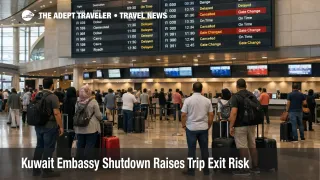
Kuwait is still a difficult trip to justify or manage, even without a fresh airport closure headline. The U.S. State Department says the U.S. Embassy in Kuwait suspended operations on March 5, 2026, including routine consular services, while warning of an ongoing drone and missile threat and serious disruption to commercial flights. For travelers, that shifts Kuwait from a normal Gulf planning question into an exit planning problem. Anyone still considering travel should assume weaker on the ground support, less reliable air service, and a higher chance that a workable itinerary turns into a rebooking and lodging problem fast.
Kuwait Embassy Shutdown Risk: What Changed
The key change is not a new airport shutdown. It is that Kuwait now combines two separate operational pressures at the same time, reduced U.S. consular access, and unstable regional aviation. The State Department's Kuwait page says the embassy suspended operations on March 5 and tells U.S. citizens to use State Department emergency numbers for help. The embassy's own services page says it is not open for normal consular services and that neither U.S. passports nor visas to the United States are being issued there at this time.
That matters most for travelers who assume a functioning airport means the trip is manageable. Kuwait International Airport is still publishing departures and arrivals, but the official U.S. travel information page also says commercial flights have been seriously disrupted, and Reuters continues to document airline suspensions touching Kuwait in late March and into April. Reuters reported that IndiGo suspended Kuwait flights through March 28, Pegasus through April 13, Flynas through March 31, and Turkish Airlines canceled Kuwait service through March 19 in its latest update. A posted schedule board is no longer the same thing as a stable onward plan.
Which Kuwait Trips Now Carry the Most Risk
The travelers with the highest exposure are not only tourists already in Kuwait. Short stays, business trips with fixed return dates, family visits that depend on one specific outbound carrier, and any itinerary built around a tight connection elsewhere in the Gulf now carry more downside than they did a normal month ago. The main problem is that a delay in Kuwait can spill into a larger regional network that is already flying around conflict zones and operating under carrier specific suspensions.
This is also harder on travelers who may need normal consular processing while abroad. If you were counting on routine passport handling, visa related help, or ordinary embassy walk in support, that assumption is no longer safe. The current official posture is narrower, emergency contacts remain available, but the embassy is not open for normal consular work. That is a meaningful difference for anyone whose travel plan depends on replacing documents, resolving paperwork quickly, or getting standard in person help before departure.
The practical threshold is simple. If the trip is discretionary, deferral now looks more rational than hoping the regional system stabilizes in time for your dates. If the trip is essential, travelers should treat Kuwait as a market that may still operate, but only with extra buffer, backup routing logic, and enough money and time to absorb an unexpected hotel stay or last minute onward change.
What Travelers Should Do Now
Travelers already in Kuwait should build an exit plan around redundancy, not optimism. Keep your passport, residency papers if relevant, airline records, and alternative routing options organized before you go to the airport. Use the State Department emergency numbers if you are a U.S. citizen who needs urgent help, and monitor your carrier directly rather than relying on a single airport status page. The best buffer now is time, especially for same day international connections.
For travelers booked to arrive in the next several days, the decision point is whether the trip can survive a sudden outbound change. Rebook or defer if your itinerary depends on one carrier, one short layover, or a time sensitive meeting, cruise, or tour on arrival elsewhere. Wait only if the trip is essential, the ticket rules are flexible, and you have a clear fallback if your original flight disappears or shifts outside the same day.
Over the next 24 to 72 hours, watch three things. First, any change in embassy operating posture. Second, whether major carriers restore or extend Kuwait suspensions. Third, whether broader Gulf airspace advisories tighten again. Those signals will tell travelers more than a single "on time" departure line.
Why Kuwait Remains Operationally Risky
Kuwait's risk is structural, not cosmetic. The State Department says there is an ongoing threat of drone and missile attacks following the February 28 onset of hostilities between the United States and Iran, and it points travelers to FAA warnings tied to civil aviation risks in or near the Persian Gulf and Gulf of Oman. The FAA still lists an active advisory for that overwater airspace, and EASA's current Middle East and Persian Gulf conflict zone bulletin remains active through March 27 after its March 18 revision. Even when airports stay open, those safety restrictions change how airlines route, how long flights take, and how much slack remains in the system when something goes wrong.
That is why Kuwait should be judged as an exit reliability story as much as a destination story. In an earlier Adept Traveler article, Kuwait Advisory Raised, FCDO Says Essential Only tracked how official advice had already hardened around non essential travel. In an earlier Adept Traveler article, Middle East Reroutes Stretch Europe Asia Flights showed how the wider network was still absorbing route detours and timing stress. Kuwait now sits inside both problems at once, thinner local support, and a regional air system that can still unravel faster than a traveler can fix a booking.
Sources
- Kuwait International Travel Information, U.S. Department of State
- Travel Advisory: Kuwait, U.S. Embassy in Kuwait
- Services for U.S. and Local Citizens, U.S. Embassy in Kuwait
- Prohibitions, Restrictions and Notices, Federal Aviation Administration
- Airspace of the Middle East and Persian Gulf, EASA
- Airlines Cancel More Flights as Middle East Conflict Escalates, Reuters
- Kuwait International Airport Flight Status