

Middle East Reroutes Stretch Europe Asia Flights
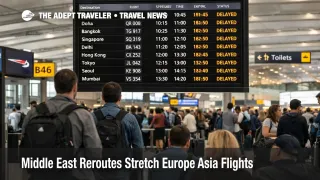
Middle East rerouting delays are still driving longer Europe to Asia flight times on March 4, 2026, because multiple Flight Information Regions remain closed or constrained, and airlines are continuing to route around the central corridor rather than through it. The practical result for travelers is not just cancellations to Gulf hubs, it is late arrivals into connection banks in Europe and Asia, higher misconnect rates, and more day of departure changes even when a specific airport says it is operating.
The update versus the past 48 hours is that industry risk summaries and safety guidance are treating the restrictions as largely unchanged, while repatriation flying resumes in limited pockets. That combination matters because it can look like "service is coming back" at the airport level, while the en route constraint is still forcing detours that stretch schedules and break the math of tight connections. EASA extended its Middle East and Persian Gulf conflict zone bulletin through March 6, 2026, without changing the underlying risk framing, which is a strong signal that the next several days remain a routing problem, not a one day disruption.
Middle East Rerouting Delays: What Changed for Travelers
The biggest traveler facing change is the persistence of a forced split in viable routings for long haul traffic that normally crosses the Gulf and Iraq. Operators are broadly detouring either north, via the Caucasus and Afghanistan, or south, via Egypt, Saudi Arabia, and Oman, because central FIR closures and restrictions still block the shortest paths.
For travelers, that translates into longer block times and less reliable arrival sequencing into banks at hubs. A 20 to 60 minute delay is often survivable. A longer detour plus flow control, plus late gate availability at the arrival hub, is where you start missing onward flights, trains, and hotel check in windows. When airlines do manage to restart specific routes, they are doing it under continuous safety review, which means the schedule can still change quickly if corridors tighten again.
Which Itineraries Are Most Exposed Right Now
The highest risk itineraries fall into three buckets. First are Europe to Asia trips with a single tight connection, particularly if the itinerary assumes historically stable block times and you are connecting onto the last departure of the day. Detours increase late arrival probability, and the last wave has the least recovery capacity.
Second are Gulf hub connections, especially where the connection is the whole point of the itinerary, such as a Europe to South Asia or Europe to Southeast Asia trip routed through the Gulf. Even if your outbound is operating, a hub that is running capped movements, exceptional flights, or rolling restarts can still break your onward segment because the bank does not rebuild cleanly. If you are using the Gulf as a connection machine, prior guidance on lodging support and the reality of staggered restarts still applies, even when flights begin to reappear in timetables. UAE, Qatar Cover Hotels for Stranded Airspace Closures
Third are itineraries involving self evacuation or government assisted departures, where routing is being shaped by what airspace is dependable enough to accept charter or recovery flying. Recent reporting has described Muscat, Oman, as a staging point for some evacuation and repatriation activity, which can pull passengers onto non intuitive routings and compress available seats on specific days.
Across all three buckets, travelers on separate tickets are more exposed than travelers on a single protected itinerary. If your long haul arrival is late, a separate ticket onward segment behaves like a missed flight, not a protected connection, even when the disruption cause is far away.
What Travelers Should Do Now
Start by treating connection time as a safety feature, not an optimization. If you are connecting between continents in the next 72 hours, aim for a longer buffer than you would normally accept, and avoid same terminal assumptions. When detours and flow programs hit, arrival gates move, inbound aircraft park remote, and terminal transfers get slower, especially at peak banks.
Use a clear decision threshold for rebooking. Rebook sooner if you have a hard constraint, such as a cruise embarkation, a wedding, an event, or a work start, and your itinerary depends on a single tight connection. Waiting can make sense if you are on one ticket, your airline is actively reaccommodating, and you have time to absorb an overnight without breaking the purpose of the trip.
Monitor primary sources, not rumor loops. The traveler relevant signal is whether NOTAM expiries are being extended, and whether safety bulletins are being renewed without material easing. EASA's extension through March 6, 2026 is one such signal. Flightradar24's rolling airspace status reporting has also been tracking closures and expiry windows, which is useful for seeing whether the central corridor is truly reopening or just cycling extensions.
If you are already in the region and weighing departure timing, do not treat "airport open" as "network stable." The State Department style guidance and airline advisories are being shaped by the same constraint, airspace can tighten faster than schedules can refresh. State Dept Depart Now Alert Hits Gulf Hub Connections
Finally, plan for baggage to lag behind you if you misconnect. Pack one change of clothes and essentials in your carry on, and keep receipts if you need to buy basics during a delay, because misrouted bags are a predictable second order effect when the itinerary is being rebuilt in real time.
Why the Split Routing Breaks Connection Banks
The mechanism is straightforward, and it is why the disruption shows up far from the conflict zone. When the central Middle East corridor is closed or constrained, flights must take longer paths around it. Longer paths consume aircraft time, burn fuel, and most importantly, compress schedule slack.
Once slack disappears, hubs lose their ability to absorb small shocks. A late arrival into a European hub can miss its planned departure slot for the onward segment. If that onward segment is crewed by the inbound aircraft's crew, extended block times can push the crew toward duty limits, which triggers a cancellation that looks unrelated to the original airspace problem. This is how a Middle East reroute turns into a same day cancellation on a later rotation in Europe or Asia.
There is a second layer: flow control and corridor management. Even when a FIR is partially open, it may be open only via specific waypoints and controlled lanes, which creates airborne metering and queueing behavior. When many carriers are forced into the same few corridors, delay risk rises because the system becomes capacity constrained in the sky, not just at airports.
The practical traveler takeaway is that "mostly resumed" service can still be "structurally fragile" until the central corridor becomes predictably usable again. Until then, the north or south split remains the governing constraint, and it will continue to stretch flight times and increase misconnect risk on both sides of the Eurasia network.
Sources
- EASA extends duration of CZIB for Middle East and Persian Gulf
- Airspace of the Middle East and Persian Gulf, CZIB 2026-03-R1
- Airspace closures following Israeli and US strikes on Iran, Flightradar24
- Middle East Airspace Update, OPSGROUP
- Safe Airspace conflict zone update
- Virgin Atlantic resumes London flights to Dubai and Riyadh, Reuters, March 3, 2026
- UK will charter flights from Oman to evacuate Britons, The Guardian, March 3, 2026