

Kuwait Advisory Raised, FCDO Says Essential Only
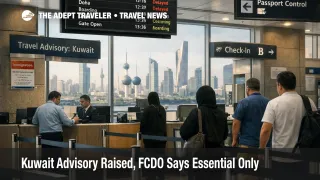
The Kuwait travel advisory changed materially on March 5, 2026, when the U.K. Foreign, Commonwealth & Development Office, FCDO, moved Kuwait to "against all but essential travel" and told British nationals already in the country to register their presence for direct updates. That matters because this is not just another regional caution headline. It is a formal risk posture change that can affect whether leisure trips still make sense, whether employer travel approval survives, and whether some travel insurance remains usable if you go anyway.
For travelers already in Kuwait, the FCDO's advice is more practical than abstract. The page tells people to stay away from areas around security or military facilities, follow local authority instructions, monitor local and international media, and be prepared to shelter if advised. It also says travel within or out of Kuwait is at your own risk, which is an important threshold for anyone deciding whether to stay put, move to the airport, or build a land exit backup.
This is also a real update from earlier Gulf coverage, not a recycled warning. The FCDO's Kuwait page was updated on March 5, 2026, and the broader Foreign Office update now lists Kuwait among the affected countries where British nationals can register their presence to receive direct messages.
Kuwait Travel Advisory: What Changed
The operative change is simple, but consequential. FCDO now advises against all but essential travel to Kuwait, and the same page warns that your travel insurance could be invalidated if you travel against that advice. For leisure travelers, that is often the point where a trip stops being a normal risk management question and becomes a cancellation, deferral, or reroute question instead.
For travelers already in country, the new signal is the registration instruction. British nationals in Kuwait are now being told to register their presence with the U.K. government so FCDO can send direct updates, while still following local authority guidance and country specific travel advice. Registration is not the same thing as a guaranteed assisted departure, but it does move travelers from passive monitoring into an official contact stream.
The practical reason this matters now is that Kuwait is no longer just part of a broad Gulf caution zone in British guidance. It now carries a clearer formal label that many insurers, employers, and risk teams use as a trigger for internal decisions. That does not automatically mean every claim is denied or every work trip is canceled, but it usually raises the bar sharply for any travel that is discretionary.
Which Travelers Need To Reassess Fastest
The clearest fit is leisure travel. If your Kuwait trip is optional, or easily deferred, the new advisory changes the logic from "monitor closely" to "justify why you are still going." Travelers with refundable bookings, flexible points reservations, or nonessential meetings should review cancellation and postponement options now, before fare conditions tighten or hotel penalties change.
Business travelers sit in a more mixed category. Some trips will still qualify as essential under an employer's policy, especially for in country operations, infrastructure, or government linked work. But many corporate travel programs treat an official "against all but essential travel" warning as an approval gate, not a suggestion. In practice, that means travel managers and road warriors should expect more escalation, more documentation, and more last minute denials even if flights or hotels are technically available.
Travelers already in Kuwait face a different decision tree. Their question is not whether to start a trip, but whether staying is safer and more workable than trying to leave during a volatile regional window. The FCDO advice is careful here. It points to direct registration, shelter guidance, and local authority instructions, while also noting that if travelers judge it safe to leave Kuwait, two land border crossings into Saudi Arabia were open as of March 3, 2026.
What Travelers Should Do Now
Start with paperwork, not movement. If you are a British national in Kuwait, register your presence first, make sure your passport is valid, and confirm whether you would need a visa or other onward entry permission before attempting any border move. The FCDO specifically warns travelers to ensure they have the correct paperwork for Saudi Arabia or they may be denied entry.
Then make an explicit insurance decision. The FCDO page says insurance could be invalidated if you travel against advice, which means this is the moment to stop assuming your existing policy will respond the way it would under normal disruption. Travelers trying to preserve the trip should read the policy terms, ask the insurer which benefits still apply, and document the answer before making large nonrefundable purchases. For a related regional insurance angle, see UAE Travel Insurance Questions Surge as Flights Disrupt.
If you are considering leaving overland, treat it as a legal and logistical operation, not a casual fallback. The FCDO says the Al Salmi, Ar Ruqi crossing and the Al Nuwaisib, Al Khafji crossing were open as of March 3, and it adds a detail many travelers miss, if you are traveling by car, the vehicle must be wholly owned and registered in your name. That requirement alone can break an improvised departure plan involving rentals, borrowed vehicles, or informal drivers.
For travelers elsewhere in the region, this Kuwait travel advisory is also a useful signal. Once one Gulf market is formally reclassified, travelers and advisors often start rechecking nearby itineraries, insurance assumptions, and onward routing plans. If your trip still depends on unstable Gulf connections, it is worth reviewing broader regional context such as State Dept Depart Now Alert Hits Gulf Hub Connections and Muscat Relief Flights Become Qatar Airways Exit Route.
Why The Advisory Ripples Beyond Kuwait
A travel advisory is not an airport closure, but it still changes the system. First order, it affects traveler behavior, cancellations rise, employer approvals tighten, and insurers get more coverage questions. Second order, those shifts move demand toward substitute gateways, flexible tickets, and short notice rebooking inventory, which can raise costs and reduce options even for travelers who are not headed to Kuwait directly.
The mechanism is mostly administrative, not operational. Official warning levels become decision triggers inside corporate risk systems, insurer coverage reviews, and traveler booking behavior. That is why a simple line change on an FCDO page can matter so much. The Kuwait travel advisory now carries a stronger formal warning, registration guidance for British nationals in country, and a limited overland exit framework, all of which give travelers a clearer, more actionable planning signal than a generic regional caution.