

Spain Parked Aircraft at Teruel Slow Recovery
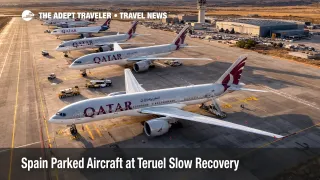
Teruel aircraft parking in Spain has become a visible sign of how far the airline network has drifted from normal operations. Reuters reported on March 20 that Teruel Airport expected about 20 aircraft by the end of Saturday, March 21, including 17 from Qatar Airways, as airlines pulled jets away from Middle East disruption and into standby or storage space in Europe. For travelers, the immediate issue is not the sight of parked jets itself. It is that aircraft sitting in Teruel are no longer where the published schedule expects them to be, which can leave airlines with less flexibility to restore service quickly, cover delays, or rebuild connection banks when conditions improve.
Teruel Aircraft Parking: What Changed
What changed is that the disruption has moved from cancellations and reroutes into physical fleet displacement inside Europe. Reuters showed Qatar Airways aircraft already parked at Teruel on March 20, and reported that roughly 10 widebody jets were due to arrive that day alone, mostly from Qatar Airways. That makes Teruel more than a background aviation detail. It is now an operational holding area for aircraft that carriers cannot use normally while Gulf airspace, schedules, and fuel planning remain unstable.
Teruel matters because it is built for this job. The airport is an industrial maintenance and storage platform, not a passenger hub, and its operator says it has space for at least 250 long term parked aircraft. Reuters reported broader capacity figures of up to 250 widebody and 400 narrowbody aircraft, which helps explain why airlines can move significant assets there on short notice. In practice, that gives carriers somewhere to preserve aircraft safely, but it also confirms that parts of the fleet are temporarily out of the normal flying pattern that supports European, Gulf, Asia bound, and Africa linked schedules.
Which Travelers Face the Most Exposure
The travelers most exposed are the ones relying on fast network recovery rather than just a single rebooking. That includes passengers connecting through Doha, Dubai, and other Gulf gateways, travelers booked on long haul itineraries that depend on aircraft rotations across several continents, and anyone flying on a carrier that may need those parked widebodies back in service quickly once routes reopen or stabilize.
The first order effect is weaker airline flexibility. A parked aircraft cannot cover a delayed inbound, rescue a broken rotation, or step into a schedule gap at short notice. The second order effect is slower normalization after the headline disruption eases. Even if airspace restrictions loosen or airport operations improve, airlines still have to move aircraft back, position crews legally, check maintenance status, and rebuild a timetable that works across multiple stations. That is why a network can look partly reopened on paper while still performing badly for several days afterward. Reuters has already documented broader Middle East disruption on that scale, including thousands of canceled Emirates flights since late February and repeated reroutes that turned ordinary trips into 20 hour journeys.
What Travelers Should Do Now
Travelers booked over the next several days should treat the risk as a recovery and resilience problem, not only a cancellation problem. If your itinerary depends on a Gulf connection bank, a same day onward long haul departure, or the last flight of the day into a smaller market, more buffer has become more valuable. The tradeoff is straightforward, rebooking early may cost more, but waiting can leave you with fewer protected alternatives if displaced aircraft and crews slow the recovery.
A good decision threshold is whether your trip can absorb a missed rotation. If a delay on the first leg would leave you with no later connection, no same day onward flight, or a fixed event such as a cruise embarkation or tour departure, this is the kind of disruption window where a tighter itinerary stops being worth the savings. Travelers who must be somewhere on time should favor nonstop options, longer layovers, or earlier departures where available. Those with more flexibility can wait, but they should monitor airline app changes closely because schedule repair may lag behind formal announcements that service is resuming.
Why Teruel Matters to What Happens Next
Teruel shows that the imbalance is now physical, not just digital. Airlines can cancel flights instantly in the reservation system, but they cannot instantly put aircraft, crews, maintenance slots, and spare capacity back where they belong. That is the bigger meaning of jets moving into storage or standby space in Spain. Recovery is no longer only about whether a route is technically open. It is also about whether the fleet can be reassembled fast enough to restore dependable service.
That also connects this story to the wider pressure already building across the industry. In an earlier Adept Traveler article, Middle East Airspace Closures Halt Dubai, Doha Flights tracked the initial hub shock, and Jet Fuel Price Shock Hits Global Travel Planning showed how the same conflict is pushing up costs. Now Teruel aircraft parking adds a third layer, asset displacement. Over the next 24 to 72 hours, travelers should watch for three signals, aircraft leaving storage and returning to service, fewer ad hoc cancellations on Gulf linked routes, and airlines shifting from emergency waivers to more normal schedule management. Until those signals appear together, schedule normalization is likely to stay slower than travelers would want.
Sources
- Remote Spanish airport again becomes parking lot for planes, this time due to Iran war
- Phantom flight: Iran war creates 9,100-km round trips to nowhere
- Introduction, Teruel Airport
- General Plan, Teruel Airport
- Tarmac Aragón, Teruel Airport
- Middle East Airspace Closures Halt Dubai, Doha Flights
- Jet Fuel Price Shock Hits Global Travel Planning