

Jet Fuel Price Shock Hits Global Travel Planning
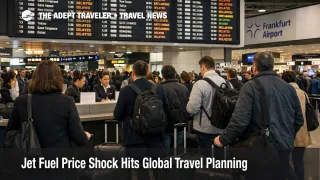
Jet fuel price shock is now a traveler planning problem, not just an energy market headline. Reuters reported on March 19 that physical jet fuel prices in northwest Europe climbed to about $220 per barrel, far above the move in benchmark crude, as war related disruption removed major Middle East supply and tightened flows through the Strait of Hormuz. For travelers booking now, the practical shift is that airlines have less room to absorb costs, which raises the odds of higher fares, fewer marginal flights, and a more fragile recovery when something else goes wrong.
Jet Fuel Price Shock: What Changed
What changed is the severity of the squeeze in the physical fuel market, where airlines and refiners ultimately have to secure real barrels, not just watch futures prices on a screen. Reuters reported that physical crude and fuel cargoes across Asia and Europe have been rising faster than headline benchmarks, with an estimated 12 million barrels per day of crude and condensate flows disrupted and northwest Europe jet fuel hitting record levels around $220 per barrel. That helps explain why carriers have moved from talking about volatility to taking concrete operating actions on fares, schedules, and policy demands.
The immediate traveler effect will not look the same everywhere. In the United States, large carriers are still leaning on strong demand, with United saying booked fares rose 15 percent to 20 percent in the past week and executives signaling they can trim weaker flights rather than flood the market with cheap seats. In Europe, airlines have warned of higher fares, possible fuel shortages, and more operational stress as reroutings and scarce supply compound the cost problem. In Asia Pacific, the pressure is broadening from import and export disruptions into fare action and schedule risk, including Air New Zealand cutting about 5 percent of flights through early May and Virgin Australia saying it will adjust fares to reflect rising cost pressures.
Which Travelers Are Most Exposed
The travelers most exposed are the ones who depend on price sensitive or frequency dependent itineraries. That includes domestic flyers in competitive markets, long haul passengers relying on one stop connections, and travelers headed to leisure destinations where airlines can cut off peak or weaker frequency without abandoning the market entirely. When fuel gets this expensive, airlines do not usually remove their strongest flights first. They cut around the edges, which means the cheapest departures, the thinnest days of week, and the fallback options that normally rescue a disrupted trip become more vulnerable.
The regional pattern already shows that split. U.S. network carriers still have more pricing power because capacity was already relatively tight, which means travelers may see more fare pain than outright schedule collapse at first. Europe looks more operationally exposed because carriers are dealing with both fuel inflation and longer routings around unstable airspace, while hedge protection will weaken as contracts expire. Parts of Asia face a different risk mix, where fuel availability and regional export controls can turn a pricing issue into an actual flight reliability issue, as seen in earlier Adept Traveler articles, Jet Fuel Shortages Spread as Hormuz Risk Deepens and China Fuel Export Ban Raises Asia Travel Risk.
What Travelers Should Do Now
Travelers booking in the next several days should assume the market is moving against late planners. If your trip depends on a specific flight bank, a self connect, or a same day handoff to a cruise, tour, or remote hotel transfer, paying more now for a cleaner itinerary may be cheaper than trying to repair a broken one later. The main buffer to add is not only money, but resilience, meaning fewer separate tickets, longer layovers, and one less dependency on the last flight of the day.
Rebooking early makes more sense when your route already has one or more warning signs, limited daily frequency, a Gulf airspace detour, an airline that has already announced cuts, or a destination that depends on domestic feeder service after a long haul arrival. Waiting can still make sense if you are flying a dense U.S. trunk route where carriers are so far recovering costs through fares rather than large cancellations. The threshold to act is simple: if losing one flight would force an overnight stay, a missed sailing, or an expensive separate ticket fix, build the protection now rather than counting on abundant reaccommodation later.
Over the next 24 to 72 hours, watch three things. First, whether more airlines start copying Virgin Australia and Qantas with broader fare action. Second, whether European carriers move from warning language into published schedule trims as hedges roll off and reroutings continue. Third, whether Asia fuel supply stories spread beyond isolated national warnings into more regulator or airport level advisories. Those are the signals that this remains a systems squeeze rather than a brief price spike.
How the Fuel Squeeze Spreads Through Travel
The mechanism is straightforward. Airlines do not buy "oil," they buy refined jet fuel delivered into a real logistics system, and that system is tighter than the headline crude charts suggest. Reuters reported that refiners and traders across Asia and Europe are scrambling for substitute barrels as attacks, export halts, and constrained passage through the Strait of Hormuz remove supply that cannot be quickly replaced. Europe is especially exposed because it relies on the Middle East for both jet fuel and diesel, while Asia is also feeling refinery cutbacks and export restrictions.
That is why the first order effect is not only more expensive tickets. It is also weaker schedule durability. Once airlines start pulling low margin flights, grounding aircraft, or adding longer routings, the whole travel system gets less forgiving. Missed connections become harder to repair, hotel and tour providers see more late arrivals and no shows, and destinations that rely on affordable domestic feed can lose traffic even if no airport formally runs out of fuel. What happens next depends on whether the physical supply shock eases quickly. Right now, the more honest assumption for travelers is that this is a structural change in operating conditions, at least for the near term, and not just a bad headline cycle.
Sources
- Prices for oil, fuel cargoes smash record highs as Iran war chokes Middle East supply
- US airlines lean on demand, fares as Iran war rattles overseas peers
- European airlines warn of higher fares, fuel shortages due to Iran war
- Virgin Australia to adjust fares to reflect cost pressures
- Jet Fuel Shortages Spread as Hormuz Risk Deepens
- China Fuel Export Ban Raises Asia Travel Risk