

Central Europe Fuel Limits Hit Cross-Border Drives
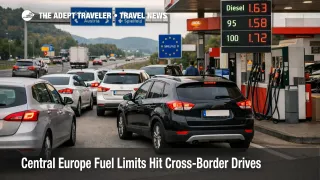
Central Europe fuel limits have turned a fuel shock story into a practical road trip problem. Slovenia is now capping purchases at 50 liters per day for private vehicles and 200 liters for legal entities, while Slovakia has authorized stations to restrict diesel sales and charge foreign registered cars more for diesel for 30 days. For self drive travelers crossing the region in the next several days, the main change is that refueling can no longer be treated as a routine stop. Build more buffer, cross borders with a larger reserve than usual, and avoid planning hotel arrivals or airport handoffs around a last minute fuel stop.
Central Europe Fuel Limits: What Changed
What changed on March 22 is that Slovenia moved from company level rationing to a national, government announced limit. Reuters reported that Prime Minister Robert Golob said private vehicles are limited to 50 liters per day and legal entities, including farmers, to 200 liters, with the restrictions in force until further notice. Reuters also reported that the Slovenian army will help transport fuel, while Golob said the issue is pump shortages and logistics strain rather than a lack of national reserves. That distinction matters for travelers. A logistics bottleneck can still leave specific stations dry, create long lines, and make one side of a route much harder to refuel than another, even if the country is not physically out of fuel.
Slovakia's measure is narrower, but it can still bite road travelers hard near the border. Reuters reported on March 18 that Slovakia approved a 30 day resolution allowing service stations to limit diesel sales to a full tank plus 10 additional liters, restrict exports, and charge foreign registered cars different diesel prices based on nearby market averages in the Czech Republic, Austria, and Poland. The measures do not apply to gasoline. In practical terms, that means diesel rental cars, vans, and road trip vehicles entering from Poland or passing through northern Slovakia face more direct friction than private gasoline cars on the same loop.
Which Road Travelers Are Most Exposed
The highest exposure is not every driver in Central Europe. It is travelers on cross border, self drive itineraries that depend on cheap refueling close to the next border or just before returning a rental car. Slovenia is the broader risk point because its cap applies to private vehicles nationally and remains in force until further notice. Slovakia is more targeted, but foreign plate pricing and diesel limits can still disrupt plans for travelers driving a diesel rental across northern routes or using Slovakia as a lower cost fuel stop.
That makes some itineraries more vulnerable than others. A short city to city drive with a half full tank is manageable. A loop that links Slovenia with Austria, Italy, Croatia, or Hungary, or a northern Slovakia drive tied to Poland, is less forgiving if a station is crowded or dry when you arrive. The first order effect is obvious, longer queues, capped volumes, and more uncertainty about where you can refuel. The second order effect is what breaks trips, delayed border crossings, missed hotel check in windows, tighter airport or rail transfer timing, and more pressure on travelers trying to return a vehicle with fuel already planned to the minimum. Broader Adept reporting on the fuel shock has already shown how localized supply stress is moving from an aviation problem into a wider transport planning problem. In an earlier Adept Traveler article, Jet Fuel Price Shock Hits Global Travel Planning and Jet Fuel Shortage Risk Spreads Beyond Asia documented that wider pattern.
What Road Travelers Should Do Now
For Slovenia linked trips, the safest assumption is that your next convenient station may not be your next available station. Cross into Slovenia with more fuel than you normally would, and treat one quarter tank as too low for comfort on cross border days. A sensible operational buffer is at least 90 to 120 minutes of extra driving margin on any day that includes a border crossing, airport handoff, or fixed hotel arrival, because the delay risk is not only the cap itself, it is the queue that forms before you reach the pump.
For Slovakia, the decision point is vehicle type and route. If your rental is diesel and your route touches the Polish border or northern districts, do not plan on topping up cheaply at the last stop. Refill earlier, accept that a foreign plate may face a higher diesel price, and do not assume a quick in and out stop before a timed transfer. If you are driving a gasoline car, the direct restriction is lower, but you should still watch for spillover queues at mixed fuel stations if diesel demand remains concentrated.
The tradeoff is simple. Waiting to refuel later may save a little money, but refueling earlier may save the itinerary. That is the right choice when the day includes a flight, a rail connection, or a fixed check in deadline.
Why This Is Happening, and What Happens Next
The mechanism is not just expensive fuel. Slovenia's government said it had to reduce duties to soften price increases linked to the Middle East conflict, and Reuters reported that the new purchase caps were driven partly by cross border fueling and stockpiling as pump shortages spread. In Slovakia, Reuters tied the measures to supply pressure after damage interrupted Russian crude deliveries through the Druzhba pipeline in Ukraine, while officials also pointed to "fuel tourism" by foreign drivers crossing in for cheaper diesel. In both countries, the common thread is that price gaps and disrupted supply chains are pushing too much demand onto specific stations, especially near borders.
What happens next depends on whether logistics improve faster than cross border demand. Slovenia's wording is the more open ended risk because its limits last until further notice, while Slovakia's resolution is explicitly temporary at 30 days. Travelers should watch for three signals over the next 24 to 72 hours, whether Slovenia reports shorter queues and station recovery, whether other countries adopt similar border area controls, and whether rental car companies or local tourism bodies begin issuing route specific fuel guidance. Until then, Central Europe fuel limits are best treated as a routing problem, not a price comparison problem.
Sources
- Slovenia limits fuel purchases as pumps run dry, Reuters, March 22, 2026
- Slovakia allows stations to set higher diesel prices for foreigners, limit sales on supply concerns, Reuters, March 18, 2026
- The Government will further reduce duties and mitigate the increase in the prices of petroleum products, Government of Slovenia, March 18, 2026
- Jet Fuel Price Shock Hits Global Travel Planning
- Jet Fuel Shortage Risk Spreads Beyond Asia