

Jet Fuel Shortage Risk Spreads Beyond Asia
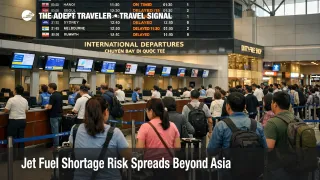
Jet fuel shortage risk is no longer only an Asia Pacific watch item. It is now showing up across the travel system in different forms, direct flight threat in Vietnam, emergency reserve use in Australia, airport and tourism strain in Cuba, fare pressure in India, and broader transport warning language in Pakistan. The signal is not a uniform global runout. It is a widening pattern in which physical fuel stress, pricing pressure, and weaker transport buffers are starting to appear in more places at once. For travelers, that shifts the problem from a regional energy story to a broader trip planning problem, especially where itineraries depend on domestic feeders, remote transfers, or thin recovery options.
Jet Fuel Shortage Risk, Where Pressure Is Showing
The current evidence shows a pattern that is broadening, but still uneven. In an earlier Adept Traveler article, Vietnam Jet Fuel Warning Puts April Flights at Risk, the signal moved from higher costs to possible schedule cuts after Vietnam's regulator warned of shortage risk from early April. In China Fuel Export Ban Raises Asia Travel Risk, the problem widened further when China's export halt tightened one of the region's main backup supply channels. Those two pieces together show the clearest aviation side of the signal, imported jet fuel is harder to replace, and domestic networks are often the first place that stress becomes visible.
But the spread no longer stops at Asia's airline networks. In Australia Fuel Reserve Move Flags Regional Travel Risk, the pressure appeared as emergency reserve use and concern over regional supply resilience rather than a confirmed airport shutdown. In Cuba Fuel Shortages Hit Airport Operations, Tourism, the signal looked different again, airport refueling risk, weaker resort and transfer reliability, and more brittle destination logistics. In Air India Fuel Surcharge Raises India Trip Costs, the stress showed up as an airline pricing response, not an immediate fuel outage. That range matters. A wider signal often spreads first through different operational channels before it starts to look like one unified crisis.
This is why the signal is stronger now than a simple "Asia fuel shortage" headline. The common thread is not that every market is short of jet fuel today. It is that more travel systems are being pushed into protective behavior, schedule review, reserve release, rationing logic, surcharge action, or warning language that assumes normal fuel slack can no longer be taken for granted. That is a real change in operating conditions, even where airports and airlines are still functioning.
Which Travelers Could Feel This Next
The most exposed travelers are the ones whose plans depend on thin margins. That includes domestic feeder flights into long haul gateways, island or remote leisure itineraries, multi city trips built on separate tickets, long road transfers before departure, and regional trips where the fallback is not another departure in two hours, but another departure tomorrow, or later. Vietnam's domestic network risk, Australia's regional supply concerns, and Pakistan's transport warning language all point to the same practical rule, the edges of the system are more vulnerable than the core.
Travelers in major hub markets can still feel the signal, but usually in a different way. India is a good example. Adept's Air India piece shows how fuel stress can widen travel exposure through surcharges before it produces outright cancellations. That means some trips still operate on time, but become more expensive, harder to change, and less forgiving if a traveler needs to reprice a multi segment itinerary. Cuba shows the other side of that equation. A destination can remain bookable while fuel stress quietly weakens airports, road transfers, and tourism infrastructure at the same time.
The next group to watch is travelers who assume a country level fuel warning is only about road transport and not aviation. That assumption is too comfortable. In several of Adept's recent pieces, the earliest official language focused on transport disruption, conservation, or reserve management before the traveler facing aviation risk became clearer. Once countries start protecting core supply, tourism transport and thin route networks usually have less cushion than essential services. That does not guarantee broad flight cuts. It does mean travelers should stop treating fuel as an invisible background input.
What Travelers Should Watch Now
Right now, this is still a monitoring first signal for most travelers, not an automatic cancel signal. The strongest exception is any itinerary that depends on April domestic flying inside Vietnam or a tightly sequenced chain of low frequency segments in markets already showing official fuel stress. For most other trips, the smarter response is to simplify where possible, build more ground transport buffer, and avoid assuming that a published timetable still has its old recovery margin behind it.
The main thresholds to watch are straightforward. First, government language shifting from mitigation to preservation, such as reserve releases, rationing, route review, or explicit conservation measures. Second, airline actions that move from pricing to operations, surcharges, schedule trims, reduced frequencies, or route specific advisories. Third, destination level signs that transport systems are becoming less reliable even if airports remain open, weaker transfer availability, hotel logistics strain, or road access warnings. If those signals stack in the same market, the risk has usually moved from manageable friction to itinerary fragility.
For travelers booking now, the tradeoff is simple. Waiting may preserve a lower fare or better schedule on paper. Reworking early may preserve the trip. The better choice depends on how much slack the itinerary has, whether the traveler can absorb a last minute overnight, and whether the plan depends on surface transport or domestic lift in a market already under fuel pressure. The jet fuel shortage risk becomes a real traveler problem when one small delay breaks the rest of the chain. That is the threshold worth respecting.
Why This Pattern Could Spread Beyond Asia
The mechanism is broader than one shortage at one airport. Adept's recent reporting shows several linked channels. One is direct jet fuel scarcity, as seen in Vietnam. Another is the loss of swing supply and backup export capacity, as seen in the China export ban story. Another is emergency supply management, as seen in Australia. Another is downstream traveler cost pressure, as seen in India. Another is destination level transport weakening under wider fuel and infrastructure strain, as seen in Cuba and Pakistan. These are different expressions of the same structural issue, travel systems work best when fuel supply is cheap, replaceable, and operationally boring. That condition is no longer holding consistently.
That does not mean a single global fuel shortage is inevitable. It means the risk is now propagating outward in ways that travelers can already feel. Some markets will absorb it through higher fares. Some will absorb it through emergency stock use. Some will see local transport reliability weaken before published flight schedules do. Some may stabilize if supply routes reopen or governments manage to cushion the shock. The right judgment today is that the signal is strengthening and spreading, but still uneven. That is exactly why it belongs in Travel Signals.
The next proof point is not whether one dramatic headline appears. It is whether more countries move from warning language to protective action, and whether more airlines turn fuel stress into timetable or fare changes that travelers can see directly. If that happens, jet fuel shortage risk will no longer be confined to Asia Pacific and Oceania. It will be a wider travel planning signal with different regional faces, but one common consequence, less slack across the system, and less room for brittle itineraries to survive.
Sources
- Jet Fuel Shortages Spread as Hormuz Risk Deepens
- Vietnam Jet Fuel Warning Puts April Flights at Risk
- China Fuel Export Ban Raises Asia Travel Risk
- Australia Fuel Reserve Move Flags Regional Travel Risk
- Cuba Fuel Shortages Hit Airport Operations, Tourism
- Air India Fuel Surcharge Raises India Trip Costs
- Pakistan Fuel Shortage Warning Hits Travel Planning