

Santiago Airport Closure Forces Galicia Reroutes
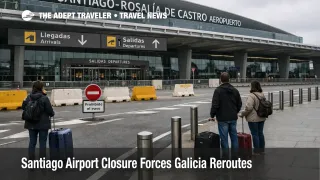
The Santiago airport closure is now a fixed planning problem for spring Galicia travel, not a hypothetical risk. Aena says Santiago-Rosalía de Castro Airport (SCQ) will close to all air traffic from April 23, 2026, to May 27, 2026, for runway resurfacing works, with no takeoffs or landings during that 35 day window. That changes the math for anyone flying into or out of Santiago de Compostela, Spain, especially Camino travelers, tour groups, and visitors using tightly timed hotel, rail, or transfer chains. Travelers with flights in that period should revisit tickets now, before alternate airports and ground links absorb more displaced demand.
Santiago Airport Closure: What Changed
What changed is unusually blunt. This is not a reduced schedule or overnight maintenance pattern. Aena has posted a full closure notice for SCQ from April 23, 2026, through May 27, 2026, tied to runway resurfacing and renewal work. During that period, the airport will not handle arrivals or departures at all.
For travelers, that means existing bookings do not just face delay risk. They face a hard operating constraint. Airlines will need to cancel, retime, reroute, or shift passengers onto other gateways. The practical consequence is that Galicia trips built around a simple nonstop or one stop into Santiago will start behaving more like multimodal itineraries, with a flight plus rail, bus, taxi, rental car, or private transfer.
This also lands in a sensitive part of the Galicia calendar. Late April and May sit inside a strong shoulder season for Santiago arrivals, Camino finishes, escorted tours, and spring city breaks. Waiting for the market to sort itself out is the wrong move if your trip depends on same day hotel check in, a tour start, or a timed Camino transfer. Availability pressure usually shows up first in the ground segment, not only in the air ticket. A related recent Galicia planning example appeared in an earlier Adept Traveler article, A Coruña Bus Strike Disrupts Airport Buses Jan 23.
Which Galicia Travelers Need To Rework Plans First
The most exposed group is travelers whose trip starts or ends in Santiago itself. That includes Camino walkers planning to fly home from Santiago, inbound visitors booked into the old town, and package travelers whose transfer assumptions were built around SCQ being the obvious arrival point. Once SCQ closes, those passengers get pushed toward A Coruña Airport (LCG) and Vigo Airport (VGO), with a longer ground leg layered on top.
A Coruña is usually the cleaner substitute for Santiago bound trips because the onward rail leg is shorter. Published journey data shows direct rail service from A Coruña-San Cristovo to Santiago de Compostela running from about 29 minutes, while Vigo Urzáiz to Santiago takes from about 52 minutes. That does not include the extra time to get from each airport into its city rail station, clear baggage claim, or recover from a late inbound flight, so the true door to door penalty is higher.
Vigo can still work, especially when fares or seat availability are materially better, but it is the less forgiving choice for a tight same day arrival into Santiago. The longer rail leg raises the odds that one small slip, a late bag, a missed train, a slow car pickup, turns into a hotel arrival problem or a lost evening connection. Travelers who only looked at flight price before should now compare the whole chain, including ground transfer cost, arrival time, and how much slack remains after the airport substitution.
What Travelers Should Do Now
Start with the ticket logic. If you already hold flights to or from SCQ inside the closure window, check whether the carrier has proactively rebooked you, offered an alternate airport, or left the reservation unchanged pending schedule cleanup. Do not assume silence means your original routing survives. The airport itself will be closed.
For new bookings, choose the replacement airport based on the trip's real endpoint, not the cheapest fare headline. A Coruña makes more sense for many Santiago stays and Camino finish itineraries because the onward rail segment is shorter. Vigo can be reasonable for southern Galicia itineraries or when flight choices are better, but it is a weaker option for tight same day Santiago plans. If the trip is high consequence, a guided tour, cruise connection, wedding, or fixed walking start, build in an overnight near the arrival point rather than trying to thread a same day rescue.
Also revisit car rental and lodging assumptions now. The second order effect of the Santiago airport closure is not just displaced air traffic. It is compressed demand for transfers, rentals, and last mile lodging around alternate gateways. Travelers with flexible bookings should use that flexibility before the cheapest rooms and easiest transfer slots disappear. For broader European disruption logic, Europe Transport Strike Dates 2026 for Flights and Trains remains a useful reminder that once a transport layer fails, the ground side usually tightens next.
Why The Disruption Spreads Beyond The Runway
The mechanism here is simple, but the fallout is wider than the closure notice makes it look. When one airport disappears for more than a month, the traffic does not disappear with it. It redistributes across nearby airports, rail lines, rental fleets, hotel arrival patterns, and tour pickup schedules. Galicia still remains reachable, but the routing becomes less direct and less forgiving.
That matters most in the Camino corridor because Santiago is not just another city break airport. It is a common endpoint, a regrouping point, and a departure point for travelers finishing on a fixed day after a long walking itinerary. A closure there shifts the burden onto recovery logistics. Instead of a short airport exit and hotel check in, some travelers will need an extra rail leg, a longer road transfer, or a rebooked departure from another Galician city.
What happens next is predictable even if airline specific schedules are still moving. Some carriers will cancel outright, some will rebook passengers via LCG or VGO, and some travelers will build their own replacements. The decision window is now, not in late April, because once the Santiago airport closure starts, the remaining capacity around Galicia becomes the scarce asset.
Sources
- Santiago-Rosalía de Castro Airport, Aena closure notice
- A Coruña Airport, Aena official page
- Vigo Airport, Aena official page
- Renfe timetables
- A Coruña-San Cristovo to Santiago de Compostela journey times
- Vigo Urzáiz to Santiago de Compostela journey times
- A Coruña Bus Strike Disrupts Airport Buses Jan 23
- Europe Transport Strike Dates 2026 for Flights and Trains