

A Coruña Bus Strike Disrupts Airport Buses Jan 23
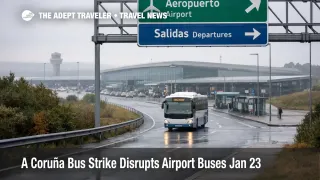
A multi day road passenger strike in A Coruña province is disrupting bus service used for airport transfers in Galicia, including access to A Coruña Airport (LCG) and Santiago-Rosalía de Castro Airport (SCQ). Travelers are most affected on strike days when published schedules thin out and remaining departures fill faster, pushing more people toward taxis, rental cars, and private transfers. If you have a flight during a strike window, treat any bus itinerary as a lower reliability option, build extra time, and have a fallback plan you can execute quickly if your first departure does not run.
The Xunta de Galicia set minimum service rules for strike days on January 12, 13, 16, 19, 20, and 23, 2026, and flagged that the dispute can become indefinite from February 2, 2026. The minimum service framework allows reduced operations on shorter routes and limits long distance links to a small number of trips, which preserves some mobility but often breaks "tight" airport transfer plans built around precise departure times. This is why the practical risk is not just fewer buses, it is also longer average waits, more crowding, and less ability to recover if you miss the last workable departure for your check in time.
Who Is Affected
Flyers using A Coruña Airport (LCG) who normally rely on the city to airport bus are exposed because the airport link is explicitly bus based, and the service is operated as a scheduled line rather than a high frequency metro style link. Aena lists the A Coruña to Airport connection as Line 4051 A4, and also lists additional airport links such as the Sada to Airport lines, which means any strike day reduction can directly translate into a missed check in window if you were planning to arrive with minimal slack.
Travelers using Santiago-Rosalía de Castro Airport (SCQ) face a broader "network" problem because the airport sits inside the province affected by the strike, and Aena lists multiple airport bus products that can be hit in different ways. That includes the city bus Line 6A between the airport and Santiago, and an intercity Airport to A Coruña service, along with other regional airport routes. If you are connecting from A Coruña city to SCQ for a flight, your risk compounds because you may depend on an intercity bus to the airport, plus an onward urban connection that is also running under reduced conditions.
Local ground plans that depend on timed rail or tour departures are also exposed. When airport arrivals shift later, rail connections out of A Coruña, Santiago, and nearby hubs get missed, tours lose participants, and hotel check ins bunch into a narrower window. On the departure side, reduced airport buses increase taxi queues and road congestion near terminals, and those delays can create a second wave of missed flights and last minute rebooking, even though the original disruption started on the roads, not in the air.
What Travelers Should Do
If you are flying on January 16, 19, 20, or 23, 2026, plan to leave earlier than usual and assume the first bus you want may not run or may fill. Lock in a fallback before you need it, for example prebooking a taxi or transfer, reserving a rental car for a one way airport drop, or arranging a ride with a confirmed pickup time. If you still want to attempt the bus, aim for an earlier departure than your normal choice, and keep a taxi app, a local taxi number, and a budget buffer ready.
Use a clear decision threshold for switching away from the bus. If your planned bus would put you at the terminal with less than a comfortable margin for bag drop, security, and walking time, do not risk it on a strike day, move to a taxi, a private transfer, or a rental car. If you must take the bus, make your "go, no go" point simple, for example, if the first viable departure does not appear or boards normally, switch immediately rather than waiting for a second attempt that could fail the same way.
Over the next 24 to 72 hours, watch for updates on minimum services, operator notices, and whether the dispute expands beyond the listed January dates. Xunta guidance and operator posts can change the practical availability of specific routes, and a dispute that turns indefinite from February 2, 2026, would change planning for anyone booking February travel into LCG and SCQ. If you are arriving late in the evening, also monitor taxi availability in advance, because reduced public transport tends to concentrate demand into fewer late arrivals at hotels and stations.
Background
This disruption is a classic "ground access choke point" problem. Airports can operate normally while the surface network that feeds them becomes the constraint, and that constraint hits travelers unevenly because it is most painful for early morning departures, evening peaks, and anyone on a timed connection. The Xunta de Galicia minimum service framework sets reduced service rules by route type and time bands, which preserves essential mobility, but also guarantees that many routes run below normal levels on strike days.
The first order effect is straightforward, fewer departures and longer waits on buses that connect cities and towns to terminals. The second order ripple is where travel plans break. When bus arrivals bunch up, terminal queues become less predictable, taxi stands and pickup zones get saturated, and road congestion increases around peak waves. That spills into the wider system, missed flights trigger rebookings onto later departures, and later departures compress hotel and rail connections at the destination. For Santiago-Rosalía de Castro, the network effect is stronger because the airport bus portfolio includes both city and intercity routes, including the Airport to A Coruña link, so a single strike day can disrupt multiple transfer patterns across Galicia.
Sources
- ORDEN de 7 de enero de 2026, servicios mínimos huelga transporte A Coruña (DOG)
- Aviso importante, huelga transporte viajeros A Coruña, mínimos
- How to get to A Coruña Airport by bus (Aena)
- How to get to Santiago-Rosalía de Castro Airport by bus (Aena)
- Servicios mínimos transporte urbano, huelga enero 2026 (Tussa)