

Azerbaijan Level 3 Advisory Recasts Caucasus Trips
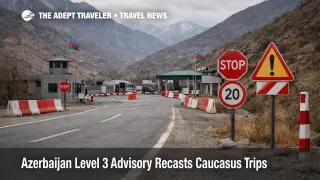
Travelers planning Azerbaijan as a straightforward Caucasus stop now face a more restrictive official risk picture. On March 12, 2026, the U.S. Department of State raised Azerbaijan to Level 3, or Reconsider Travel, while keeping its core risk indicators the same and updating the summary to emphasize terrorism, armed conflict, landmines, and specific no go areas. The practical consequence is not that all Azerbaijan travel suddenly becomes impossible. It is that overland plans, border adjacencies, and regional add on logic now need to be screened route by route instead of treated as ordinary Caucasus positioning.
Azerbaijan Level 3 Advisory: What Changed
The immediate change is the U.S. posture itself. The State Department says the advisory level was raised to 3 on March 12, 2026, even though the underlying risk indicators did not change. It now tells travelers to reconsider travel to Azerbaijan because of terrorism, armed conflict, and the risk of landmines, while specifically warning against travel to the southern border region, the border with Armenia, and the former Soviet era Nagorno Karabakh Autonomous Oblast and surrounding territories. The southern border warning includes an unusual caveat, unless that route is your best overland exit from Iran, which shows how closely this advisory is tied to wider regional contingency planning rather than only to domestic tourism inside Azerbaijan.
The advisory also links the change to the current regional security environment. In its armed conflict summary, the State Department says that after hostilities between the United States and Iran began on February 28, there has been an ongoing threat of drone and missile attacks from Iran, and it cites the March 5 drone strike on Nakhchivan International Airport. That matters operationally because it shifts Azerbaijan from being just a destination decision to being a transit and fallback decision, especially for travelers who had been treating Baku, Azerbaijan, the south, or Nakhchivan as flexible pieces of a wider Caucasus or Iran exit plan.
Which Caucasus Trips Now Carry More Risk
The travelers with the highest exposure are not only those heading into obviously sensitive zones. The bigger problem is anyone building an itinerary that depends on being near one of those zones without really entering it, for example a road trip that hugs the Armenian frontier, a southern Azerbaijan segment added to an Iran contingency exit, or a route that treats former Nagorno Karabakh areas as a normal overland sightseeing extension. Those plans now have a much narrower margin for error.
British guidance helps show how that risk spreads on the ground. The FCDO says the Armenia border remains closed, advises against all travel within 5 kilometers of the rest of that border, and says some areas in south western Azerbaijan remain risky because of leftover military equipment, unexploded weapons, and landmines from former conflict. It specifically lists districts in and around the former Nagorno Karabakh area, and notes that entering some of those places without Azerbaijani permission can lead to entry denial later. That is not identical to the U.S. map, but the overlap is strong enough that travelers should stop thinking in country level terms and start thinking in corridor level terms.
There is also a broader Caucasus planning consequence here. In an earlier Adept Traveler article, Nakhchivan Airport Hits Widen Caucasus Transit Risk showed how quickly a small regional shock can turn Azerbaijan routing into a weaker backup option. Another earlier Adept Traveler article, Iran Armenia Land Border: Agarak Crossing Status, showed the same pattern from the other side, land borders can look usable on paper and still fail as reliable throughput channels once pressure builds.
What Travelers Should Do Before Booking Or Crossing
For most leisure travelers, the cleanest move is to keep Baku centered trips separate from border adjacency plans. If the purpose of the trip is Baku, a standard city stay with normal airport access is a different proposition from a road heavy Caucasus loop that edges toward Armenia, southern Azerbaijan, or former conflict areas. Treat those as different products, not one flexible itinerary.
The next decision threshold is overland dependence. Rework the trip if any essential leg requires you to move near the Armenia border, through former Nagorno Karabakh districts, or down toward the southern border region unless that southern movement is part of a deliberate Iran exit calculation and you have current consular guidance, documents, cash buffer, and onward transport lined up. If the trip only works when every land segment runs on time, it is too brittle for current conditions.
Travelers already committed should keep a tighter watch window than usual. Monitor the State Department advisory page, foreign office regional risk pages, airline operating notices for Azerbaijan, and any fresh security messaging around Nakhchivan or the southern border. Insurance also needs a second look here, not because the advisory automatically voids coverage in every case, but because a Level 3 posture and named excluded areas can change how a claim is evaluated if you knowingly route into restricted zones.
Why The Planning Logic Changed, And What Happens Next
What changed is less about a brand new threat than about official tolerance for route ambiguity. The State Department explicitly says the advisory level rose even without a change to the core risk indicators, which is a signal that the government now wants travelers to apply a stricter planning standard to Azerbaijan as a whole. In practice, that widens the gap between a contained urban trip and a complex regional itinerary, because once the national advisory rises, more travelers, insurers, tour operators, and corporate travel approvers start treating edge case routes as unacceptable even if a few central corridors remain functional.
The likely next phase is not a clean all clear or a full shutdown. It is a more selective travel environment, stable enough for some trips, but less forgiving of border adjacency, overland improvisation, and mixed country itineraries. That is why the Azerbaijan Level 3 advisory matters beyond Azerbaijan itself. It changes how the Caucasus should be drawn on a traveler's map, where the safe margins sit, and which backup plans are no longer strong enough to count as backups.