

Nakhchivan Airport Hits Widen Caucasus Transit Risk
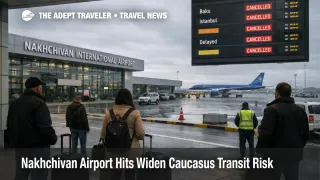
Azerbaijan's travel risk is now more concrete than a generic regional warning. The U.K. Foreign, Commonwealth & Development Office, or FCDO, says Azerbaijan confirmed two drone strike impacts at Nakhchivan International Airport on March 5, 2026, and warns that wider regional escalation could still trigger airspace closures and other unexpected disruption. For travelers, that turns Nakhchivan from a marginal geopolitical concern into a real airport reliability problem, especially for trips that depend on a clean domestic connection or a same day onward move. The practical takeaway is simple, defer discretionary Nakhchivan travel, build more buffer for eastern Türkiye and wider Caucasus itineraries, and watch for any fresh airspace or airport operating restrictions before you move.
Nakhchivan airport drone impacts matter because the fallback network is thin. When a secondary exclave airport takes direct hits and the government simultaneously warns about possible wider airspace disruption, the trip stops being only about whether one flight operates. It becomes a confidence problem across the whole chain, airport access, rerouting, overnighting, border formalities, and whether the backup plan is still legal and practical by the time you use it.
Nakhchivan Airport Drone Impacts: What Changed
What changed on March 5 is that the airport itself entered the story. The FCDO says Azerbaijan confirmed two drone strike impacts at Nakhchivan International Airport, while Reuters reported that one drone fell on the terminal building and another landed near a school in a nearby village, with four people injured in the broader incident. That is a different traveler problem from a vague regional alert because it puts a named civilian air gateway inside the disruption zone.
The second new fact is operational. Azerbaijan Airlines, or AZAL, said all March 5 Baku, Azerbaijan to Nakhchivan flights were canceled, and that it substituted flights to Igdir, Türkiye, with special buses onward to Nakhchivan. That tells travelers the system has already shifted from a normal air corridor into a mixed air and land workaround. Even if flights resume or stabilize later, that one day response shows how quickly a simple itinerary can turn into a multi step transfer with more moving parts and less slack.
Which Trips Should Be Deferred First
The trips that should be deferred first are discretionary point to point visits to Nakhchivan, short stays built around fixed meetings, and any itinerary that depends on arriving and leaving on precise timings without an overnight cushion. Travelers on separate tickets are also exposed, because a missed domestic leg or an improvised Türkiye transfer can break baggage handling, hotel timing, and fare protection all at once.
This also matters for wider Caucasus positioning, even for travelers not ending in Nakhchivan. When regional conflict narrows usable air corridors, traffic pressure shifts toward the Caucasus and Central Asia, while smaller airports and border checkpoints become more important release valves for disrupted demand. That means eastern Türkiye, Azerbaijan domestic positioning, and nearby overland plans lose resilience faster than a casual route map would suggest. Adept's earlier Middle East Airspace Reopens, Closures Stay Fluid piece is useful background on how reopened corridors can still behave like capped, fragile channels rather than true recovery.
For travelers trying to build a land fallback elsewhere in the region, the broader lesson is not that every border becomes a safe substitute. It is that land exits can absorb pressure quickly, then slow or fail with little warning once air networks break. Adept's Iran Armenia Land Border: Agarak Crossing Status shows that pattern clearly on another nearby corridor.
What Travelers Should Do Now
For travel in the next 24 to 72 hours, the cleanest decision threshold is this, defer if Nakhchivan is the trip's main destination and the trip is optional, or if missing the first day would defeat the purpose of travel. This is not the moment to trust a tight same day connection into or out of the exclave, and it is a weak moment for separate ticket plans that depend on perfect timing.
If you must travel, keep the itinerary simple. Favor a plan with a confirmed overnight in Baku, Azerbaijan, or on the Türkiye side if your carrier or onward arrangements point that way, rather than assuming a clean domestic turn. Carry passports or accepted identity documents exactly as your operator requires, keep offline copies of bookings, and budget for the possibility that a flight sector becomes a road sector on short notice. AZAL's March 5 response is the clearest evidence that this kind of substitution is already part of the operating reality.
The main things to monitor next are any new FCDO wording on Azerbaijan, any airline specific changes to Nakhchivan service, and any fresh notice of airspace restriction or closure tied to regional escalation. Travelers should treat "operating" as a weaker signal than normal right now. The real question is whether the operating chain is stable enough to protect the whole trip, not whether one sector remains bookable for one more day.
Why Nakhchivan Matters More Than Its Size Suggests
Nakhchivan matters because it is an exclave, not because it is a major hub. Its separation from mainland Azerbaijan makes fallback options more awkward, more conditional, and more dependent on neighboring states and corridor stability. When a traveler loses confidence in a hub airport, there are usually multiple replacement paths. When a traveler loses confidence in a smaller exclave airport, the substitutes are fewer, slower, and more vulnerable to border rules and transport bottlenecks.
That is the mechanism that widens the Caucasus transit watch. First order, Nakhchivan flights become a harder sell. Second order, overland substitutions pull pressure onto nearby gateways such as Igdir, bus links, and any other corridor that can absorb displaced travelers. Third order, a broader airspace tightening can spread well beyond Azerbaijan by reshaping routing choices for carriers and travelers trying to avoid unstable skies. The strike itself is local. The planning consequences are regional.