

Iran Armenia Land Border: Agarak Crossing Status
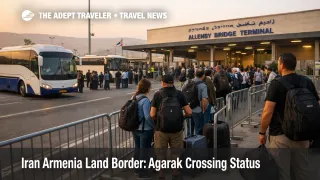
Iran Armenia land border crossing decisions shifted again on March 5, 2026, as embassy guidance and local reporting pointed travelers toward overland exits while also showing how fragile the border process can be when systems fail. The practical takeaway is that the Agarak, Armenia crossing can be usable as a departure option from Iran when air routes are constrained, but it is not a guaranteed throughput channel, and it can slow or stop with little warning because of technical disruptions on the Iranian side. Travelers who can move overland should treat this as a time sensitive logistics problem, not a simple drive to a border.
## Iran Armenia Land Border Crossing: What Changed The new element versus earlier broad "leave now" messaging is the move toward named, actionable border posture, with Agarak, Armenia repeatedly cited as a workable land option when flying is not. At the same time, Armenia focused reporting shows that Iran has temporarily stopped individual traveler crossings at times, citing technical issues and disruptions to automated systems, which turns the crossing into a bottleneck even when it is officially described as open. This matters now because overland routes are absorbing demand that would normally clear by air, including third country nationals leaving Iran as well as some citizens evacuating through neighboring states. Reuters reporting on departures via Azerbaijan underscores the same structural point, when aviation networks are unstable, land borders become the release valve, and that concentrates pressure on a small number of checkpoints and onward gateways. ## Who This Route Works For, and Who It Fails This route is most relevant for travelers who can safely reach northwest Iran by road, have documents in hand, and can tolerate unpredictable processing times at the frontier. It is also a practical fit for travelers whose trip objective is simply to exit Iran, then rebuild flights from a receiving country, rather than trying to wait for a specific airport restart that may not materialize on schedule. It is a weak option for travelers with tight onward commitments, limited cash for unplanned overnights, medical constraints, or any situation where a several hour delay at the border could create a safety problem. It is also higher risk for anyone relying on a same day onward flight out of Armenia, because a short border stoppage can cascade into missed departures once you add transfer time to Yerevan, Armenia, plus check in cutoffs and rebooking queues. For U.S. citizens specifically, the paperwork side is comparatively straightforward once you are on the Armenia side. The U.S. State Department says U.S. citizens can enter Armenia visa free for up to 180 days per year with a valid passport. Armenia's Ministry of Foreign Affairs also describes a 180 day within one year framework for visa free regimes, and it notes a temporary visa exemption window in early 2026 for certain residents of third countries, which can matter for non U.S. passport holders moving through the same corridor. ## What Travelers Should Do Now Treat the border as the constraint, and plan the trip backward from the moment you need to be out of Iran, rather than from the moment you want to arrive in Armenia. Build a buffer that assumes at least one failure mode, a processing halt, a shift to manual checks, or a road delay getting to the checkpoint. Local reporting indicates crossings have resumed after stoppages, but with slower, manual processing, which is exactly the kind of delay that breaks tight plans. Make the documentation decision early. Before you start moving, confirm that everyone in your party has a valid passport that will be accepted for entry, and that your nationality's Armenia entry rules are understood. For U.S. travelers, the baseline is simple, but mixed nationality groups should confirm who needs what, because a refusal at the border can strand the entire plan. Rebuild onward flights as if capacity will tighten. The second order effect of a usable land corridor is that hotels in the receiving region, ground transport, and seats out of Yerevan can disappear fast, especially when multiple countries are simultaneously advising evacuation by land. If you are trying to connect onward through the broader region, keep the wider disruption context in view, and use the most recent operational updates to choose corridors that are actually functioning. For related coverage, see [Middle East Airspace Reopens, Closures Stay Fluid](https://adept.travel/news/2026-03-04-middle-east-airspace-reopens-closures-stay-fluid) and [Middle East Charter Flights Expand for U.S. Citizens](https://adept.travel/news/2026-03-04-middle-east-charter-flights-us-citizens-uae-saudi-jordan). ## Why This Border Option Is Both Useful and Fragile When airspace restrictions, flight cancellations, and uneven hub restarts block conventional departures, land borders become the system's fallback infrastructure. That sounds simple, but it changes the failure modes. Instead of canceled flights, you get throughput constraints, limited staffing, communications failures, and technology dependencies at checkpoints, plus the real world friction of long road transfers and uncertain waiting conditions. The Armenia, Iran border is also structurally narrow. Reporting from Armenia described it as the sole crossing between the two states, which means even a "technical" disruption on the Iranian side can halt individual travelers and create queues quickly. Once a queue forms, the second order effects show up immediately, travelers burn hotel nights on either side, transport prices spike, and onward inventory tightens in the receiving country. Finally, as more travelers use Armenia and Azerbaijan exits, the land route becomes coupled to onward aviation capacity elsewhere. Reuters reporting on departures via Azerbaijan illustrates how quickly these corridors can become shared evacuation channels across multiple nationalities, which is why travelers should expect volatility even if their own nationality's guidance sounds stable. ## Sources * [Iran's Border With Armenia Closed For 'Technical' Reasons](https://www.azatutyun.am/a/33695260.html) * [Persons' passage through border checkpoint from Iran to Armenia resumes](https://news.am/eng/news/934217.html) * [Armenia International Travel Information](https://travel.state.gov/content/travel/en/international-travel/International-Travel-Country-Information-Pages/Armenia.html) * [Visa](https://www.mfa.am/en/visa/) * [Over 300 people have fled Iran via Azerbaijan, source close to government says](https://www.reuters.com/world/middle-east/about-500-russians-be-evacuated-iran-via-azerbaijan-says-russian-embassy-2026-03-01/)