

DFW PS Private Terminal Opens June 2026
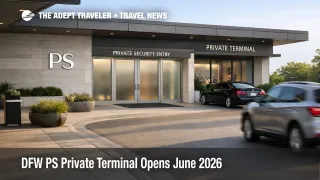
PS is bringing a DFW private terminal option into a U.S. airport environment that has recently been defined by long security lines and weaker screening reliability. PS says Dallas Fort Worth International Airport (DFW) is one of its next locations, lists the site as coming in June 2026, and is now taking reservations, while third party booking coverage says DFW reservations begin for travel on June 3, 2026. For travelers who can afford it, that creates a real workaround to crowded public terminals, not a systemwide fix. The practical move is to treat it as a premium time saving tool for trips where privacy, tight timing, or a fragile itinerary matters more than price.
DFW Private Terminal: What Is New, and When It Starts
PS markets the product as a separate airport experience away from the main terminal flow. On its own site, the company says guests get private TSA and customs clearance, lounge access, luggage handling, food and drinks, and a vehicle escort across the airfield to or from the aircraft door. The Dallas location is listed in PS materials as coming in June 2026, with the DFW address posted as 1816 N. 24th Ave., Dallas, Texas 75261, in a secured terminal area off North Service Road.
Pricing is aimed at travelers buying time, privacy, and predictability rather than a better version of a normal lounge. PS lists The Salon at $1,295 per person without a membership, while the Private Suite is $4,950 for up to four travelers. Annual memberships reduce those rates, with All Access members paying $895 for The Salon and $3,650 for a Private Suite, and Salon members paying $995 and $4,950 respectively. The service already operates at Los Angeles International Airport (LAX) and Hartsfield Jackson Atlanta International Airport (ATL), with Miami International Airport (MIA) also listed for June 2026.
Who Benefits Most From the DFW Private Terminal
This is not a mass market answer to TSA stress. It fits a narrow slice of travelers, executives on time sensitive same day trips, families or small groups trying to protect a premium long haul departure, public figures or security conscious travelers who value privacy, and flyers making an expensive international trip where missing the flight would trigger hotel, meeting, or connection losses far larger than the PS fee. At those price points, the real comparison is not with a standard airport lounge. It is with the cost of a broken itinerary, or with the convenience of private aviation for travelers still flying commercial.
The service also makes more sense at a hub as large as DFW, where the ordinary terminal experience can be efficient on a good day, but still demands curbside timing, security buffering, and long walks through a massive airport complex. PS is selling an entirely different entry point into that system. Instead of joining the public queue, the traveler buys a private processing lane and a controlled handoff to the aircraft. In that sense, the product is less about luxury decor than about removing the unpredictable parts of a busy airport departure or arrival.
What Travelers Should Do Before Booking
Travelers considering PS DFW should start with trip economics, not the renderings. The question is whether the premium buys back something valuable enough to justify the spend. For a short domestic trip, it may be hard to defend. For an international departure from Dallas, a traveler with a tight schedule, a high risk misconnect, or a need for privacy may view the service very differently. The threshold is simple, book it when preserving the itinerary matters more than extracting value from the airfare itself.
The second decision point is timing. Because PS is still listing DFW as coming in June 2026 on its own site, travelers should treat early reservations as bookable inventory tied to launch timing, not as proof that every operational detail is already settled months in advance. If the trip is inflexible, confirm the reservation terms, cancellation rules, and whether your specific airline, departure time, baggage load, and arrival or departure use case fit the product cleanly before you build the rest of the itinerary around it.
The broader planning point is that PS helps the travelers who can pay for an alternate path, while the main U.S. airport system still faces ordinary screening strain. In an earlier Adept Traveler article, TSA Shutdown Risk Grows Ahead of March 27 Deadline the main concern was not one bad queue, but systemwide screening reliability under staffing pressure. In another earlier Adept Traveler article, ICE At U.S. Airports Is Not Fixing TSA Lines the visible federal response still did not materially change the underlying checkpoint bottleneck for most travelers.
What Happens Next for PS at DFW and Miami
The next development to watch is whether PS can turn a niche luxury product into a small but meaningful pressure release valve at major hubs. DFW is a logical place to try. The airport has scale, premium demand, long haul traffic, and enough physical sprawl that bypassing the main terminal process has real operational value for some customers. Miami follows a similar logic from a different angle, pairing luxury demand with a large international passenger base and a market more accustomed to premium airport services.
That does not make the model broadly transformative. The service is expensive, capacity constrained, and useful precisely because it serves a small share of travelers. What it does signal is that the premium end of the market sees value in buying out of terminal friction altogether. If the DFW private terminal sells well after launch, expect more talk of similar private terminal products at large U.S. hubs. If it does not, PS remains what it is now, a specialized airport bypass for travelers whose time, privacy, or trip stakes are worth several thousand dollars.