

ICE At U.S. Airports Is Not Fixing TSA Lines
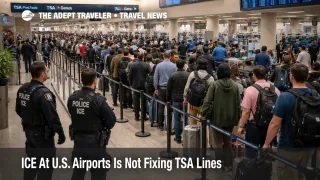
U.S. Immigration and Customs Enforcement (ICE) at U.S. airports is now live on March 23, 2026, but the administration's answer to the TSA staffing shortage is not solving the core problem travelers actually feel. Early reporting from airports across the country shows immigration officers are present in terminals and around checkpoints, yet the real bottleneck remains trained TSA screening capacity. For travelers, that means longer lines can still turn into missed flights, even with a visible federal surge at the airport.
ICE At U.S. Airports: What Changed
What changed on Monday is that the White House moved from threat to deployment. Reuters reported that ICE agents were sent to more than a dozen U.S. airports, while AP journalists saw them at Hartsfield-Jackson Atlanta International Airport (ATL), John F. Kennedy International Airport (JFK), Newark Liberty International Airport (EWR), George Bush Intercontinental Airport (IAH), and Louis Armstrong New Orleans International Airport (MSY), among other locations. The administration presented the move as a way to relieve checkpoint strain during the partial Department of Homeland Security shutdown, which has left TSA officers working without pay since February 14.
The problem is that the deployment appears to be aimed mostly at support work, not the specialized screening work that determines how many passengers can actually clear security each hour. Reuters reported on March 22 that ICE agents were being prepared to help screen travelers, but same day reporting from AP and CNN showed officers mainly patrolling terminals, standing near lines, and in Atlanta at least, not checking IDs or materially moving passengers through the checkpoint. AP also reported that federal officials had described likely roles such as guarding exit lanes or handling support functions around the checkpoint.
Which Travelers Still Face the Biggest TSA Risk
The travelers still most exposed are the same ones who were already vulnerable before ICE arrived, people departing from large hubs with severe staffing losses, passengers on morning banks, travelers with checked bags, and anyone whose trip breaks if security takes two to four hours instead of 30 to 60 minutes. Reuters reported last week that TSA absenteeism hit 10.2 percent nationally on March 18, with much higher rates at some major airports, including 38 percent in Atlanta and Houston Bush, and 25 percent at JFK. Transportation Secretary Sean Duffy also warned that smaller airports could eventually face closure risk if staffing keeps eroding.
Early evidence from Monday suggests the visible federal buildup has not yet changed that traveler math in a meaningful way. AP reported that long waits persisted at major hubs, with Atlanta still urging passengers to allow at least four hours, and on the ground reporting showed lines snaking through the atrium and out the entrance doors while ICE officers patrolled nearby. One New Orleans traveler told AP that lines seemed to be moving quicker there, but even that account came with uncertainty about whether the deployment justified the cost and complexity. In other words, there may be isolated operational help, but there is no solid evidence yet of a systemwide fix.
That is the part travelers should not misread. The presence of armed federal officers can create the impression that more capacity has been added to screening itself. So far, the reporting does not support that conclusion. The checkpoint can only process passengers as fast as trained TSA officers can conduct ID verification, bag screening, body screening, lane supervision, and resolution procedures. If ICE is mostly covering peripheral tasks, the line may look more managed without becoming meaningfully shorter.
What Travelers Should Do Now
Travelers should plan as if ICE at U.S. airports changes the atmosphere more than the throughput. That means treating the checkpoint as unstable until local evidence shows otherwise. The safest move is still to arrive materially earlier than normal, complete check in before reaching the airport where possible, avoid checked baggage if the trip allows, and be far more skeptical of tight same day connections. For the worst affected airports, four hour airport arrival guidance is no longer an outlier, it is a serious planning signal.
The decision threshold is simple. If missing the flight would break a cruise embarkation, an international long haul, a wedding, or a nonrefundable event, the better tradeoff is to protect time now rather than assume the line will move because more federal officers are visible. If your airport has a single main checkpoint, few later departures, or a fragile rebooking market, the risk is even less forgiving. In an earlier Adept Traveler article, U.S. Airport Security Strain Nears Continuity Risk, the warning was that the system was losing slack. In an earlier Adept Traveler article, ICE at U.S. Airports Starts, Raising TSA Travel Risk, the warning was that support roles would not equal restored screening capacity. Monday's reporting largely supports both conclusions.
Why the ICE Deployment Has Limited Effect
The mechanism is not complicated. Airport security lines are not only a headcount problem, they are a skills and certification problem. When trained TSA staffing thins out, the system loses the people who can actually run screening positions, keep lanes open, resolve alarms, and sustain throughput safely. Adding outside officers to crowd control, exit monitoring, or terminal presence can free up some labor at the margins, but it does not recreate the screening workforce that has been depleted by unpaid work, absences, and resignations.
That is why the administration's ICE move looks, at least for now, more like a pressure relief tactic than a durable operational fix. Reuters reported Monday that more than 100 airport leaders urged Congress to end the TSA funding standoff, which is the clearest institutional signal that airports do not believe the current workaround is enough. Until the funding lapse ends and TSA staffing stabilizes, ICE at U.S. airports is best understood as a visible supplement with limited power to shrink the main traveler pain point.
Sources
- ICE agents deployed to more than a dozen US airports amid staffing gaps, Reuters
- ICE officers go to TSA checkpoints at Trump's direction, while long wait times at airports persist, AP News
- ICE officers aren't trained in airport security. Can they help ease long lines?, AP News
- US official warns small airports could soon shut over TSA absences, Reuters
- US says TSA absences rose slightly to 10.2% Wednesday, Reuters
- 1 Week into Democrats' Shutdown, DHS Implements Emergency Measures to Conserve Resources and Keep Americans Safe, DHS
- US airports implore Congress to end TSA funding standoff, Reuters