

Kavimvira Border Update Shifts DRC Burundi Routing
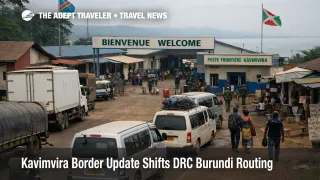
The Kavimvira border crossing between the Democratic Republic of the Congo and Burundi looks more usable than it did a few weeks ago, but it is still not a normal overland travel route on March 24, 2026. The immediate change is narrow: the UK Foreign, Commonwealth and Development Office removed its earlier notice that the crossing remained closed, and separate February reporting and humanitarian updates indicate the post did reopen and is being used. For travelers and operators moving through Uvira and toward Bujumbura, Burundi, that is enough to justify a fresh route check. It is not enough to treat eastern DRC as stabilized, or to build a leisure itinerary around the crossing without live local confirmation.
Kavimvira Border Crossing: What Changed
What changed is specific and limited. The FCDO updated its Democratic Republic of the Congo travel advice on March 19, 2026 and removed the statement that the Kavimvira border crossing between DRC and Burundi remained closed. That matters because official advisory wording had been telling travelers to assume the crossing was shut, and that wording is now gone.
That wording change lines up with separate evidence that the crossing reopened on February 23, 2026. Reuters described Congolese migration officials processing travelers during the reopening that day in Uvira, and UN reporting on March 24 said most spontaneous returnees from Burundi were crossing through the Kavimvira border point near Uvira in South Kivu Province. Taken together, that is a real operational signal that movement has resumed at the post. It is stronger than rumor, but still weaker than a broad normalization signal for the region.
Which Travelers Can Use This Signal, and Who Still Should Not
This update is most useful for aid operators, regional business travelers, transport planners, and travelers already in the region who are comparing exit or transfer options. It also matters for anyone sequencing hotels, drivers, or onward flights around the Uvira to Bujumbura corridor, because a crossing that was previously treated as closed may now be available in practice. That can reduce unnecessary fallback to last minute air tickets or extra nights on the Burundi side, at least for travelers with a strong reason to move and with live local support.
But the broader risk picture still crushes the case for routine travel in eastern DRC. The FCDO continues to advise against all travel to South Kivu, and specifically says that if you are in North or South Kivu and judge it safe to do so, and if routes are available, you should leave. It also says Uvira was captured in December 2025, that rebels withdrew in January 2026, and that clashes continue in surrounding areas, with routes from Uvira, Goma, and Bukavu limited and changeable at short notice. The U.S. State Department likewise keeps the DRC at Level 3 overall and says travelers should not go to North and South Kivu because of armed conflict, kidnapping, terrorism, and civil unrest.
The Burundi side is not a clean fallback either. The FCDO advises against all but essential travel to Bujumbura, Burundi, and nearby eastern parts of former Bujumbura Rural Province because of proximity to conflict in eastern DRC. It also warns that the Burundi DRC border area is unstable, says the Tanzanian border continues to operate, and notes that other land exit options are limited, with the Rwandan border closed.
What Travelers Should Do Before Committing to Overland Travel
Travelers should treat this as a verification signal, not a booking green light. If your plan depends on moving between Uvira and Burundi by road, confirm the Kavimvira border crossing status on the day of travel with your transporter, hotel, fixer, or local contacts on both sides of the border. The best use of this update is to reopen route planning conversations that were previously dead, not to assume reliable daily operations.
The decision threshold is blunt. If you are a discretionary traveler, or if your trip can be postponed, eastern DRC still does not support normal overland travel planning. If you are already in the area and need to move, a reopened Kavimvira route may be better than assuming total closure, but only if you also have a same day fallback, enough cash, document certainty, and a contingency for sudden suspension or fighting near the corridor. In an earlier Adept Traveler article, Goma Airport Closed, DR Congo Security Alerts Rise, the eastern DRC picture was already constrained by airport disruption and unstable route options. That wider constraint still applies.
Over the next 24 to 72 hours, the key signals to watch are whether official advisory language stays stable, whether humanitarian or media reporting continues to show people using the crossing, and whether fresh security incidents around Uvira or the Burundi border provinces start narrowing movement again. A functioning crossing can help with one corridor. It does not fix the surrounding security environment.
Why This Is Only a Small Signal, Not a Normal Border Return
The mechanism here is straightforward. When one overland crossing moves from officially closed to apparently usable, route planning changes immediately for a narrow group of travelers. Hotel sequencing, driver positioning, onward lake or road choices, and backup flight demand can all shift because an overland leg that was impossible becomes at least checkable again. That is the first order effect. The second order effect is that regional operators may temporarily lean less on expensive last minute air alternatives or long detours, which can slightly change transport pressure around Bujumbura and nearby corridors.
What it does not change is the strategic risk picture in eastern DRC. South Kivu remains under an avoid all travel warning from the FCDO, U.S. officials still warn against travel to the Kivu provinces, and the FCDO says routes out of Uvira can change at short notice. That keeps the Kavimvira border crossing in the category of usable if confirmed, not dependable by default. In an earlier Adept Traveler article, Security Risks Sahel And West Africa Overland Travel, Adept noted that some African overland routes must be treated as hard security constraints, not soft logistics problems. Eastern DRC still fits that logic, even with this smaller border improvement.
Sources
- Democratic Republic of the Congo travel advice, GOV.UK
- Burundi travel advice, GOV.UK
- Democratic Republic of the Congo International Travel Information, U.S. Department of State
- The reopening of the Congo-Burundi Kavinvira border post and transit center located in Uvira, Reuters Connect
- UN Geneva Press Briefing, March 24, 2026