

Pakistan Advisory Raises Fuel and Transport Risk
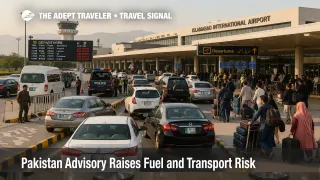
Pakistan travel advisory planning became more operationally difficult after the U.K. Foreign, Commonwealth & Development Office, or FCDO, updated its Pakistan advice on March 14, 2026, to add possible fuel shortages, transport disruption, road restrictions, curfews, protests, drone activity, and Middle East airspace related flight disruption. The shift does not mean all travel in Pakistan has stopped. It does mean travelers should stop treating domestic flights, long road transfers, and same day airport runs as routine, even outside the country's highest risk zones. For departures in the next several days, the safest baseline is more buffer on every internal movement, fewer tight connections, and a backup plan for any fuel dependent road leg.
Pakistan Travel Advisory: What Changed
The practical change is that the FCDO's March 14 update moved beyond a generic security warning and tied several different traveler risks together in one planning frame. Its current Pakistan page says regional escalation has already led to travel disruption, that flights are being disrupted by Middle East airspace closures, that drone activity has been reported in some cities, and that protests, road access restrictions, and curfews may arise at short notice. It also now warns that global supply routes could affect fuel availability and pricing, leading to transport disruption and delays in some areas.
That combination matters because each element can magnify the others. A delayed inbound due to airspace disruption is manageable on its own. It becomes harder to recover when the onward domestic sector is fragile, when the airport approach is slowed by protest controls, or when a long prebooked road transfer depends on fuel supply or an open highway. The result is not necessarily a nationwide breakdown, but a higher variance operating environment where normal timing assumptions are less reliable.
Which Pakistan Trips Now Carry More Exposure
Travelers headed into the areas already under the highest FCDO warnings remain the most exposed. The FCDO continues to advise against all travel to Balochistan Province, to within 10 miles of the Pakistan Afghanistan border, to parts of Khyber Pakhtunkhwa including Peshawar and sections of the Karakoram Highway, and to within 10 miles of the Line of Control. It also advises against all but essential travel to Gilgit Baltistan, to parts of Khyber Pakhtunkhwa, to areas within 5 miles of much of the India border, to parts of Sindh north of and including Nawabshah, and to Dera Ghazi Khan in Punjab.
But the more useful traveler distinction is not only map based. The itineraries that now look weakest are mountain circuits that stack domestic air and road legs, overland journeys with long distances between fuel stops, border focused trips, and business or leisure itineraries that depend on same day transfers in or out of major cities such as Islamabad, Karachi, Lahore, or Skardu. The U.S. State Department still rates Pakistan at Level 3, Reconsider Travel, and says some areas carry higher risk, while also warning that terrorists may target transportation hubs, airports, trains, hotels, and tourist spots, and that internet and mobile outages are common during protests.
In an earlier Adept Traveler article, Pakistan Fuel Warning Raises Transport Risk outlined the fuel side of the problem. In another, Pakistan Gilgit Baltistan Unrest Hits Trip Planning showed how quickly movement restrictions and outages can break northern itineraries. The new March 14 advisory language matters because it broadens that risk from a regional or sector specific issue into a more national planning caution for transport and flight reliability.
What Travelers Should Do Now
For trips departing within 72 hours, the cleanest move is to rebuild the itinerary around slack, not around published best case timings. Travelers should allow more time for airport access, avoid self made short connections between international and domestic flights, and treat any long road leg as vulnerable to late notice restrictions or slower than normal progress. If a destination requires a single fragile join, such as an inbound flight landing just before a domestic departure or a late evening arrival feeding a multi hour drive, the better call is to add an overnight buffer before the next segment.
The main rebook threshold is practical. Rework the trip now if a missed domestic flight would collapse the whole itinerary, if your route depends on fuel intensive road transport into remote areas, if your operator cannot confirm current local movement conditions, or if you would be traveling against official advice that could invalidate insurance. Wait only when you still have time, your bookings are flexible, and your plan is concentrated in lower risk urban corridors with strong local support and multiple fallback options.
Over the next 24 to 72 hours, the most important signals are not rhetoric but operating proof. Watch for airline schedule cuts rather than generic cautions, repeated airport access delays in major cities, official notices of movement controls or curfews, local reports of fuel queues or reduced transport frequency, and any fresh embassy or government movement restrictions. If those indicators harden, Pakistan travel advisory risk will shift from warning language into a clearer day to day disruption story.
Why the Risk Has Become More Operational
What makes this advisory more serious for travelers is the mechanism. Pakistan does not need a blanket shutdown for itineraries to fail. Travel breaks when several thin margins are hit at once, a rerouted or delayed flight, a protest blocked urban road, an airport run that takes longer than expected, a fuel constrained transfer market, or a mobile outage that makes it harder to confirm the next step. Those are first order disruptions at separate points in the chain, but together they create second order consequences such as missed domestic sectors, forced hotel overnights, broken trekking joins, and harder same day exits from remote regions.
That is also why the new warning matters beyond the no travel zones. A traveler staying in a lower risk city may still face practical disruption if a domestic airline trims operations, if airport access slows, or if the onward ground leg depends on fuel and unrestricted roads. The advisory still does not say Pakistan is under nationwide transport failure. It does say the country now sits in a more fragile operating window, where movement assumptions that looked normal earlier in March should be treated with more caution through the current regional escalation period.