

Pakistan Fuel Warning Raises Transport Risk
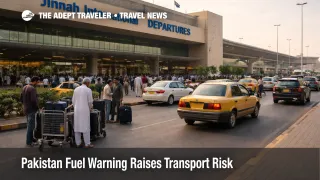
Pakistan fuel shortage travel risk moved from background concern to explicit travel advice on March 14, 2026, when the U.K. Foreign, Commonwealth & Development Office updated its Pakistan guidance to warn that global supply routes could affect fuel availability and pricing, leading to transport disruption and delays in some areas. That does not confirm a nationwide breakdown. It does change the planning baseline for anyone relying on long road transfers, domestic flights, or same day airport runs in Pakistan over the next several days. The safest move now is to build more slack into itineraries, avoid tight self connections, and treat normal transfer times as less reliable than usual.
The practical point is simple. Pakistan is now under an official advisory that links regional escalation, airspace disruption, protest risk, and possible fuel friction into one travel planning problem. Travelers do not need to assume the system is failing everywhere. They do need to assume that road access, ground transport reliability, and domestic movement could become patchier with limited warning.
Pakistan Fuel Shortage Travel: What Changed
What changed is the threshold of official language. FCDO says regional escalation has already led to travel disruption, notes Middle East airspace closures are disrupting flights, and now adds that global supply routes could affect Pakistan's fuel availability and pricing, which may lead to transport disruption and delays in some areas. It also warns that protests may persist in major cities, with road access restrictions and curfews possible at short notice. That turns fuel stress from an energy market story into a direct traveler operations story.
There are also real signs that the warning is not purely theoretical. Reuters reported on March 9 that Pakistan announced austerity and fuel conservation measures, including school closures, a shorter government workweek, reduced office attendance for non essential services, and cuts to official vehicle use as oil prices surged. AP reported on March 19 that Pakistan is limiting fuel use and exploring alternate supply routes as regional energy disruption worsens. Those steps do not prove a tourism wide transport breakdown, but they do show the government is already trying to preserve fuel and reduce demand.
Which Travelers Face the Most Disruption
The most exposed travelers are not necessarily international visitors on nonstop flights into one major city hotel. The bigger risk sits with people whose trips depend on multiple moving parts on the ground. That includes travelers with long airport transfers, overland itineraries between cities, domestic sectors feeding international departures, and hotel pickups tied to fixed departure windows.
Business travelers and short stay visitors face a different problem from slower leisure trips. When a trip is built around a same day meeting, a conference check in, a domestic connection, or a fixed international departure, even moderate ground friction matters. A one hour delay on the road can turn into a missed check in cutoff, a lost ticket value, or an extra hotel night. Travelers heading beyond the main gateways also carry more exposure because backup transport options thin out faster once fuel availability or road conditions become uneven.
This is also an update story. Earlier coverage treated Pakistan mainly as a watchlist item tied to regional tension. The difference now is that the fuel and transport warning is written directly into official travel advice, which is a stronger signal for itinerary planning. Related Adept coverage already live includes Pakistan Fuel Shortage Warning Hits Travel Planning and Jet Fuel Shortages Spread as Hormuz Risk Deepens.
What Travelers Should Do Now
For trips in the next 24 to 72 hours, the best adjustment is simplification. Build larger airport transfer buffers, avoid the last practical departure of the day, and do not stack a long road move directly in front of an international check in window. If your plan depends on a hotel car, a rideshare pickup, or an intercity drive, confirm it again closer to departure instead of assuming the original timing still holds.
The rebook versus wait threshold depends on how fragile the itinerary is. Rebook or restructure earlier if your plan depends on a domestic connection plus a long surface transfer, or if missing one segment would strand you overnight. Wait, but monitor closely, if you are staying in one main city, have flexible departure timing, and have enough slack to absorb slower ground movement without breaking the trip.
The main signals to watch next are straightforward. One, more official language shifting from warnings to explicit service restrictions or rationing. Two, airline notices tied to schedule changes, not just fare pressure. Three, visible reports of local fuel queues, reduced transport frequency, or repeated airport access delays in major cities. If those signals harden, Pakistan fuel shortage travel risk will move from advisory language into a clearer day to day disruption story.
Why The Risk Can Spread Beyond Fuel Pumps
The mechanism is broader than fuel station availability. FCDO's warning ties Pakistan's transport exposure to regional escalation, Middle East airspace disruption, protests, and global supply route pressure. That matters because travel systems rarely fail at a single point first. Friction tends to appear in connected layers, road transfers slow, airport access becomes less predictable, domestic flights lose slack, and same day itineraries start breaking more easily.
That is the key second order effect for travelers. Even if airports remain open and flights still operate, weaker ground reliability can still damage the itinerary. Missed check in windows, disrupted pickups, delayed hotel arrivals, and lost domestic positioning time are often the first visible breakpoints. In that sense, Pakistan fuel shortage travel is not only about whether fuel is physically available. It is about how quickly reduced transport resilience turns a manageable trip into one with no margin for error.