

Flight Delays and Airport Impacts: March 25
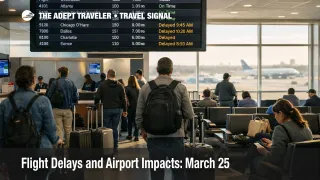
Flight delays and airport impacts on March 25 are more localized than the broader disruption picture many U.S. travelers saw earlier this week. The Federal Aviation Administration says flying conditions are generally favorable nationwide, but Tampa International Airport (TPA) is under a staffing-driven arrival delay advisory, Florida en route traffic is still being managed around thunderstorms east of Orlando International Airport (MCO), and LaGuardia Airport (LGA) remains under airfield constraints tied to runway closure and recovery work. For most travelers, this is a buffer and routing day, not a cancel-the-trip day, but people moving through Florida, New York, and later Denver should still treat timing as fragile.
Flight Delays and Airport Impacts: What Changed
The biggest confirmed change for March 25 is that the FAA is no longer describing a weather-heavy national delay day. Its daily air traffic report says flying conditions are favorable across the United States, which is a material shift from broader, weather-led disruption patterns on March 24. But the command center operations plan shows that the calm headline does not mean a friction-free day everywhere. TPA has a staffing trigger in effect until 1800Z, or 1:00 p.m. CDT, with an arrival delay advisory published because of staffing. The same plan says convective weather remains east of MCO, and Jacksonville Center and Miami Center airspace are dealing with thunderstorms.
New York also has not fully normalized. The FAA operations plan lists an early ground delay program for LGA, runway 04/22 closed until March 27, 2026, at 1100 a.m. UTC, and taxiway closures at John F. Kennedy International Airport (JFK) through March 26, 2026, at 1000 p.m. UTC. Those are not identical problems, but together they keep the New York system less flexible than a routine midweek day. Denver International Airport (DEN) is not yet in an active program, though the FAA says a ground stop or delay program is possible after 2100Z, or 4:00 p.m. CDT.
In an earlier Adept Traveler article, Flight Delays and Airport Impacts: March 24 the main story was a narrower weather map layered onto the New York recovery picture. March 25 looks even tighter in scope, but it still carries airport specific failure points that can break short layovers and same day plans.
Which Travelers Face the Most Risk Today
The most exposed travelers are not all domestic flyers. They are people with low margin itineraries moving through the specific choke points the FAA is flagging. That starts with Tampa departures and arrivals during the staffing window, where the issue is throughput rather than severe weather at the terminal itself. It also includes Florida travelers whose flights cross Jacksonville or Miami Center airspace, especially if they are trying to hold tight onward connections or ground transfers after landing.
New York travelers remain a second high risk segment, especially anyone using LaGuardia for short haul business travel, same day returns, or tight onward connections to rail, meetings, or separate tickets. A runway closure does not always produce dramatic cancellations on its own, but it reduces recovery slack. When banks bunch up or inbound aircraft arrive late, reaccommodation options shrink faster. In an earlier Adept Traveler article, LaGuardia Flight Delays Persist After Deadly Crash that reduced-capacity dynamic was already visible, and the FAA plan shows the constraint is still not fully cleared.
There is also a smaller early-day flow issue over the Great Lakes. The FAA reroute system showed Lake Erie East and Lake Erie West constrained areas valid from 251000 to 251300 UTC, which is an upstream traffic-management problem rather than a headline airport shutdown. Travelers usually feel that kind of constraint as modest airborne holding, wheels-up delays, or connection erosion rather than a clean, obvious closure.
What Travelers Should Do Before Leaving for the Airport
The practical move on March 25 is to protect time, not to overreact. If you are flying through Tampa, Orlando, South Florida routings, or New York, leave more ground buffer than you would on a normal Wednesday and assume the weak point may be arrival sequence or en route flow, not just check in. If your trip includes a cruise embarkation, an event ticket, a same day meeting, or a separate onward booking, the cost of being late is higher than the cost of arriving early.
Rebooking only makes sense for a narrower slice of travelers. Consider changing plans before departure if you are connecting through one of the affected regions on a sub-90-minute domestic connection, if your arrival in New York or Florida is time critical, or if you are booked on a late day Denver routing that leaves little room if a ground delay program is activated. Waiting is more reasonable if you are on a nonstop flight, have flexible onward plans, or can absorb a delay without losing the day.
Over the next several hours, the signals that matter most are whether the Tampa staffing advisory clears on time, whether Florida thunderstorm management expands beyond the east-of-Orlando corridor, and whether Denver moves from possible to active delay controls. Travelers who want deeper system context on why modest disruptions can cascade into harder reaccommodation days can also read U.S. Air Traffic Control Privatization: Reality Check, which explains the structural limits inside the U.S. air traffic network.
Why March 25 Is Narrower Than March 24, and What Happens Next
The main reason March 25 is operationally calmer is that the FAA is not flagging a broad national weather burden in its daily report. That matters because the network recovers faster when disruption stays local. Aircraft and crews can usually be repositioned more cleanly, and travelers have a better chance of same day reaccommodation when the problem is one region, one airport, or one airspace stream rather than several overlapping weather systems.
But narrower does not mean harmless. The mechanism on days like this is concentration. A staffing trigger at one airport, thunderstorms in one airspace corridor, and lingering runway or taxiway limits in New York can all push delay into the same parts of the schedule. First order, some departures and arrivals leave late. Second order, travelers lose connection margin, airport pickups fail, and later banks inherit aircraft that are already out of position. That is why modest FAA language can still produce a frustrating traveler day in specific markets.
What happens next depends less on a national collapse scenario and more on whether the known pressure points stay contained. If Tampa staffing normalizes, Florida weather stays manageable east of Orlando, and Denver never moves into an active stop or delay program, March 25 should remain a patchy disruption day. If one of those pieces worsens late in the day, the biggest losers will be short connection itineraries and travelers with no slack built into evening arrivals.