

Gulf Airline Recovery Stays Too Uneven for Connections
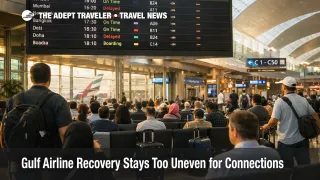
Gulf airline recovery is no longer a total shutdown story, but it is still far from a reliable normal on March 23, 2026. Reuters, using Flightradar24 data, reported Emirates had recovered to nearly three quarters of pre conflict capacity, Etihad and Air Arabia to about half, flydubai to about one third, and Qatar Airways to about one fifth. That leaves travelers with a misleading picture, because a flight being back on sale does not mean a hub has regained the schedule depth needed to absorb delays, cancellations, missed connections, or sudden airspace changes.
Gulf Airline Recovery: What Changed
What changed is the shape of the disruption. In early March, the problem was broad shutdowns across Gulf hubs. Now the issue is uneven restoration, with Dubai recovering faster than Abu Dhabi, Sharjah, and especially Doha. Emirates and flydubai still say they are operating reduced schedules, Etihad resumed only a limited commercial schedule from March 6, and Qatar Airways is still advertising a revised limited number of flights through March 28.
That matters operationally because hub carriers sell reliability through frequency, backup departures, and broad onward banks. When that depth is missing, the first order effect is thinner choice on the original route. The second order effect is harsher disruption when something slips, because there are fewer same day rebooking paths, fewer workable connection banks, and less spare room when travelers from suspended Europe to Middle East services are pushed onto the remaining flights. Reuters reported that Europe bound alternatives are already pulling demand, with Qantas adding Rome and Paris flying as Gulf hub disruptions reshape traffic flows.
In an earlier Adept Traveler article, Dubai Phantom Flights Raise Gulf Transit Risk outlined how even operating flights could still reverse, divert, or arrive badly out of pattern when regional conditions changed suddenly. That remains the right frame.
Which Gulf Connections Look Strongest, And Weakest
Dubai currently looks like the strongest Gulf transfer point of the major hubs, but strongest does not mean fully restored. Emirates is the furthest along in capacity recovery, while flydubai, which matters heavily for regional feed and secondary city connectivity, is still running at roughly one third of normal levels. That weakens the network beneath Dubai even when an Emirates long haul sector appears available.
Abu Dhabi is in the middle tier. Etihad has recovered more than Qatar Airways by the Reuters count, but its own public language still points to limited or reduced operations rather than a normalized bank structure. For travelers, that means Abu Dhabi may work for simpler itineraries, especially nonstop or one stop trips into major cities, but it remains less forgiving for tightly timed onward connections, cruise embarkations, and same day hotel or tour commitments.
Doha remains the weakest of the big three for now. Reuters said Qatar Airways was operating at only about 20% of pre conflict capacity, and the airline's current advisory still describes only a revised limited number of flights through March 28. A Doha connection can still make sense when it is the only workable fare or routing, but travelers should treat it as a fragile itinerary until the airline stops using limited schedule language and restores more meaningful frequency.
What Travelers Should Do Before Booking
Travelers booking through the Gulf should now judge itineraries by resilience, not just by whether seats are for sale. A nonstop into Dubai, Abu Dhabi, or Doha is materially safer than a two stop itinerary that depends on a thin regional feeder. The main risk is no longer only cancellation at departure, but a chain reaction that leaves too few recovery options once the first segment runs late, diverts, or misses its bank.
Rebook early if your trip depends on a Gulf connection to meet a cruise departure, fixed tour, wedding, or high value nonrefundable hotel stay. Wait a bit longer only if your dates are flexible, your fare rules are generous, and you can absorb an overnight without breaking the trip. Travelers connecting through Doha should be especially cautious, while Dubai is the better bet for those who still need a Gulf bridge between Europe, Asia, and Australasia.
The next decision point is schedule language. If the carrier still says reduced, limited, or revised operations, treat the hub as operational but not resilient. Also leave longer connection buffers than you normally would, avoid last flight of the day dependencies, and check whether your onward segment is on the same ticket. Separate tickets are much harder to protect in a recovery environment like this. In an earlier Adept Traveler article, British Airways Extends Gulf Flight Cuts to May 31 showed how quickly lost nonstop options can force passengers back into already thin Gulf connection banks.
Why Recovery Still Breaks So Easily
The mechanism is straightforward. Gulf hubs depend on dense waves of arrivals and departures, wide transfer banks, and enough spare frequency to rebuild an itinerary when one piece fails. A hub can reopen well before that structure returns. That is why visible recovery can still produce weak real world reliability.
Costs are also pushing in the wrong direction. Reuters reported global average jet fuel prices had nearly doubled to $197 per barrel by March 20, and airlines elsewhere are already reacting with higher surcharges or selective capacity cuts. When fuel stays expensive and routings remain inefficient, carriers have less room to add recovery flying, and rebooking pressure gets worse across Europe and Asia, not just inside the Gulf.
What happens next depends on whether carriers can restore bank depth, not only headline departures. The clearest positive signal would be airlines dropping reduced schedule language and restoring more regional feed around their long haul cores. Until then, Gulf airline recovery should be treated as partial access, not restored normal.
Sources
- Gulf airlines recover slowly as Iran conflict drags, Reuters, March 23, 2026
- Travel Updates, Emirates
- Operational updates, flydubai
- Etihad Airways to resume limited flight schedule from 6 March, Etihad Airways
- Travel Alerts, Qatar Airways
- Cathay Pacific to hike fuel surcharge by 34% as jet fuel prices surge, Reuters, March 26, 2026
- Australia's Qantas boosts Europe flight as demand climbs due to Mideast war, Reuters, March 26, 2026
- United Airlines to cut more flights as it eyes oil above $100 through 2027, Reuters, March 20, 2026