

Dubai Phantom Flights Raise Gulf Transit Risk
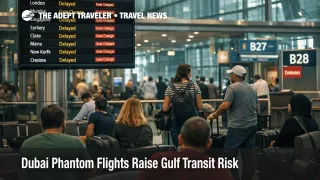
Travelers connecting through Dubai International Airport (DXB) now face a more damaging kind of disruption than a normal cancellation, a flight can depart on time, stay airborne for hours, and still fail to reach the hub. Reuters reported that on March 18, 2026, more than 30 Emirates flights were turned back or diverted after drone alerts and temporary airport closures, including a London to Dubai service that flew about 9,100 kilometers round trip and returned to origin. The practical consequence is harsher than a predeparture cancellation, because passengers can lose most of a travel day, miss onward flights, and still end up back where they started or in a diversion city with limited rebooking options. Emirates and Dubai Airports are still warning that operations remain reduced or only partially resumed, so travelers should treat Gulf itineraries as live operational risk, not restored normal service.
Dubai Phantom Flight Risk, What Changed
The change is not simply that some Gulf flights are canceled. It is that a flight which looks viable at boarding can become nonviable mid-journey if the destination airport closes, the surrounding airspace tightens, or carriers lose confidence in the arrival window while the aircraft is already in the system. Reuters' March 18 reporting showed how quickly that can happen in practice, with aircraft returning to origin or diverting to airports such as Cairo, Egypt, Karachi, Pakistan, and Dhaka, Bangladesh instead of completing the planned arrival into Dubai. Emirates' own public update still says it is operating a reduced flight schedule after the partial reopening of regional airspace, and Dubai Airports has described only a partial resumption of operations rather than a full return to normal.
That makes this a systems story, not only an airline story. A predeparture cancellation is ugly, but it at least leaves aircraft, crews, bags, and passengers in one place where the rebooking process can start. A mid-flight reversal scatters those assets. The plane may need fuel, a new crew duty calculation, a new slot, or a different airport. The passenger may need immigration clearance in an unscheduled stop, or may be carried back to the origin with no clean way to reconnect that same day. Checked baggage can separate from the traveler entirely if the onward handling chain breaks. Emirates says delayed bags can involve multiple airlines or airports and tracing can take up to 21 days in some cases.
Which Itineraries Are Most Vulnerable
The most exposed travelers are long-haul one-stop passengers whose trip depends on a Gulf hub bank working on time. That includes Europe to South Asia, Europe to Southeast Asia, Africa to Asia, and some North America to Indian Ocean or South Asia routings that rely on Dubai, Doha, or Abu Dhabi as the connection engine. These travelers are not only buying a seat, they are buying a timed sequence. Once the hub loses reliability, the whole value proposition of the one-stop itinerary weakens. In an earlier Adept Traveler article, UAE Airspace Shutdown Deepens Gulf Hub Risk tracked the repeat closure problem. In another, Middle East Reroutes Stretch Europe Asia Flights showed how quickly Europe to Asia journeys started lengthening when the Gulf corridor became unstable.
Travelers with short onward connections, cruise embarkations, wedding or event deadlines, same-day visa deadlines, or one-night stopovers are in worse shape than flexible leisure passengers. So are travelers on separate tickets, because the second carrier may treat a missed connection as your problem rather than a protected misconnect. Even passengers not flying into the main conflict zone can still get caught by second-order effects, out-of-position aircraft, crews timing out, hotel inventory tightening near hubs, and fewer same-day backup seats for people rerouted off the original plan. Reuters' reporting on repeated diversions and cancellations, plus ongoing reduced schedules at Gulf carriers and airports, shows that the recovery problem is no longer local to one airport closure window.
What Travelers Should Do Now
The immediate move is to stop treating departure as success. If your trip touches a Gulf hub in the next 24 to 72 hours, confirm not only that the first flight is operating, but that your arrival airport and onward connection are still realistic by the time you are expected to land. Travelers with a tight onward connection should price out a longer layover or an overnight stop now, before another alert day compresses remaining seats. If the purpose of the trip is time sensitive, rebooking around the Gulf may now be more rational than waiting for a waiver, especially for Europe to Asia itineraries where alternate routings exist.
Passenger rights are also more limited than many travelers assume. Under UK and EU guidance, extraordinary circumstances such as security events can remove the fixed cash compensation that normally applies for delays or cancellations, even though airlines may still owe care, rerouting, or reimbursement support depending on the itinerary. For baggage and provable delay losses on many international trips, the Montreal Convention still matters, but that is a different framework from standard EU or UK compensation. In plain terms, travelers should expect help requests to take longer, and should keep receipts, boarding passes, baggage reports, and screenshots of airline messages.
If your bag does not arrive with you after a diversion or reversal, file the baggage report before leaving the airport whenever possible. Travelers should also avoid checking essential medication, chargers, work equipment, or next-day event clothing on these itineraries right now. A carry-on buffer is not a nice extra in this environment, it is basic protection against the Dubai phantom flight risk turning into a multi-day baggage problem after the aircraft and your suitcase stop following the same path.
How Mid Flight Reversals Spread Through Travel
Mid-flight reversals are operationally worse because they burn time, fuel, and network slack all at once. A normal cancellation leaves the airline with a visible broken plan. A reversal creates a hidden one. The aircraft is no longer where the next sector expects it. The crew may no longer be legal to continue. Gates, bags, catering, airport slots, and onward passengers all have to be reassembled around a moving target. That is why one sudden airport closure can keep producing problems after the runway reopens. Reuters' March 18 account, combined with official reduced-schedule language from Emirates and partial-resumption language from Dubai Airports, suggests the region is still in a phase where airspace or airport alerts can restart the same cycle with little warning.
What happens next depends less on any single suspension notice and more on whether Gulf hubs regain predictability. If alerts continue but airports remain mostly open, travelers should expect more partial schedules, long reroutes, and occasional phantom flights rather than a clean shutdown. If closures become longer or more frequent, the next stage is broader de-banking of hub connections, meaning the classic one-stop Gulf itinerary stops working as a same-day product. For now, the right assumption is simple, a departing flight into the Gulf is no longer proof of arrival, and Dubai phantom flight risk should be part of any connection decision until airports and carriers stop using reduced-operations language.
Sources
- Phantom flight: Iran war creates 9100-km round trips to nowhere, Reuters
- Travel Updates, Emirates
- Dubai Airports issues operational updates following temporary airspace measure, Dubai Airports
- Am I entitled to compensation?, UK Civil Aviation Authority
- Air passenger rights, Your Europe, European Union
- The Montreal Convention 1999 (MC99), IATA
- Delayed or damaged baggage, Emirates