

Gulf Cruise Ships Stranded Across Four Lines
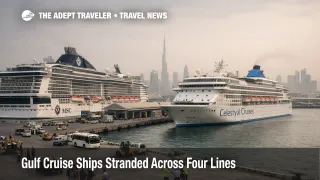
Gulf cruise ships stranded in Dubai, Doha, and Abu Dhabi remained a live planning problem on March 25, 2026, because six vessels from MSC, TUI Cruises, Celestyal, and AROYA still had not repositioned out of the region. The immediate issue is no longer only guest repatriation. It is that canceled Gulf departures are now bleeding into later sailings in Greece, Spain, South Africa, and Northern Europe, depending on which ship was supposed to move next. Travelers with spring cruises tied to these vessels should treat the disruption as a fleet deployment problem, not a one port delay.
Gulf Cruise Ships Stranded, What Changed
What changed is scale and duration. Cruise Industry News reported on March 24 that six ships were still stuck in the Gulf: MSC Euribia in Dubai, Celestyal Discovery in Dubai, Celestyal Journey in Doha, Mein Schiff 4 in Abu Dhabi, Mein Schiff 5 in Doha, and AROYA in Dubai. That means the disruption has lasted well beyond the first wave of passenger offloading and charter flights home.
The line by line fallout is now clearer. Celestyal said on March 25 that delayed repositioning for both Celestyal Discovery and Celestyal Journey forced three more cancellations, two April 4 sailings on Journey, and an April 6 sailing on Discovery, with affected guests offered either a full refund or future cruise credit. AROYA had already ended its remaining Gulf season, saying on March 7 that the rest of its Arabian Gulf sailings would not proceed, and that all guests were safely disembarked in Dubai that day. Reuters had earlier reported that TUI Cruises canceled several departures beginning between February 28 and March 5, while offering free rebooking or full refunds, and said MSC Euribia remained in Dubai under guidance from regional U.S. military authorities.
The practical implication is that this is no longer a single brand problem. In an earlier Adept Traveler article, Gulf Cruise Cancellations Hit Europe Departures, the first spillover into Europe was already visible. The new development is that multiple lines still have ships trapped in place late in March, which raises the odds of more schedule edits outside the Gulf if repositioning windows keep slipping.
Which Travelers and Voyages Face the Most Risk
The most exposed travelers are not only people booked on canceled Gulf cruises. They are also guests on follow on sailings that depend on a stranded ship reaching a new region on time. Celestyal Journey was still listed in Doha with an April 4 Piraeus start, Discovery in Dubai with an April 3 Lavrion start, Mein Schiff 4 in Abu Dhabi with an April 11 Cape Town departure, Mein Schiff 5 in Doha with an April 17 Palma de Mallorca departure, MSC Euribia in Dubai with its next listed departure not until May 2 from Kiel, and AROYA in Dubai with a May 14 Jeddah restart.
That creates very different risk levels by line. MSC has more buffer because Euribia's next listed revenue sailing is in Northern Europe in early May. AROYA also has more room after canceling the rest of its Gulf season and shifting toward a Red Sea restart in mid May. Celestyal and TUI look tighter because their stranded ships are tied to nearer term Mediterranean and repositioning schedules in early to mid April, leaving less recovery margin if movement restrictions persist.
The traveler segments with the most to lose are those who built land arrangements around a cruise that sits in the middle of a longer trip. A canceled or delayed sailing can break charter or scheduled flights, pre cruise hotel stays, port transfers, post cruise rail bookings, and fixed Mediterranean tours. That is especially true for travelers expecting a Europe departure to be insulated from Gulf events. It is not, if the ship itself is still in Dubai, Doha, or Abu Dhabi.
What Travelers Should Do Now
The first step is to check the ship, not only the departure port. If your April sailing depends on Celestyal Discovery, Celestyal Journey, Mein Schiff 4, or Mein Schiff 5, assume schedule risk remains elevated until the vessel is physically underway out of the Gulf. For AROYA guests, the remaining Gulf season is already gone, so the decision is about refunds, credits, and rebuilding the wider trip. For Celestyal guests on the newly canceled sailings, the current options are a full refund or future cruise credit through the original travel provider.
Rebook early if the cruise is attached to nonrefundable flights, a cruise embarkation hotel, or a fixed onward itinerary with little slack. Waiting can make sense when the cruise line has already canceled and is processing remedies, or when your sailing still sits several weeks out and the ship has a wider repositioning buffer, as with MSC Euribia. The tradeoff is simple, waiting may preserve optionality, but early changes may save the rest of the trip.
Over the next 24 to 72 hours, the key signals are whether any of the six ships actually leave port, whether lines extend cancellation windows, and whether Mediterranean or Africa linked departures begin slipping again. In an earlier Adept Traveler article, AROYA Gulf Cruises Canceled for Rest of Season, the season wide effect on Dubai embarkations was already visible. The broader lesson now is that ship location matters more than brochure itinerary when a regional disruption blocks repositioning.
Why the Disruption Keeps Spreading
The confirmed facts are straightforward. The ships remain in Gulf ports, lines have canceled sailings, and operators continue to frame decisions around regional operational considerations and coordination with authorities. Trade outlets have tied the bottleneck to the inability to safely transit the Strait of Hormuz, while Reuters separately documented the earlier airspace closures and wider travel disruption that complicated guest returns. Those are related but distinct pressures, one affects ship movement, the other affects passenger recovery and airline logistics.
This is why the disruption spreads beyond the Gulf. First order, a ship misses its next local sailing. Second order, it misses the repositioning voyage that was supposed to place it in Greece, Spain, South Africa, Germany, or Saudi Arabia for the next seasonal program. Once that happens, later departures in another region can fail even if the destination itself is operational. That is already visible in Celestyal's April Mediterranean cancellations and in the tighter April restart dates attached to TUI's stranded ships.
What happens next depends on movement, not announcements alone. If ships begin leaving soon, some later April and May itineraries may still hold. If they remain alongside into another week, more downstream cancellations become likely because cruise schedules are sequential and seasonal deployments leave limited slack. Travelers should read this as an ongoing fleet positioning disruption with regional security roots, not a closed chapter from the early March evacuations.