

U.S. Visa Bond Routing Rules Catch Air Travelers
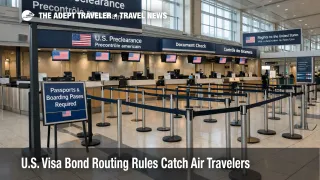
The U.S. visa bond routing rules now create a second planning hurdle for some visitors, beyond the cash deposit itself. The State Department says travelers who post a visa bond must enter and leave through commercial air ports of entry, including CBP preclearance sites, and may not use charter air, general aviation, land, or sea ports. That restriction is already in effect, and it lands just before April 2, 2026, when 12 more countries join the bond list. For affected travelers, the safest move is to treat the visa interview, the bond amount, and the airport routing plan as one compliance chain before locking in nonrefundable flights, cruises, hotels, or cross border ground travel.
U.S. Visa Bond Routing Rules: What Changed
The practical change is not the existence of the bond pilot itself, but how tightly the trip must now be routed once a bond is required. State says covered B1 and B2 travelers who post a bond must use commercial air ports of entry for both arrival and departure, and that includes preclearance locations. The same State guidance says bond holders may not use charter air, general aviation, land crossings, or sea ports, which turns what might have been a flexible North American itinerary into an airport only compliance rule.
The bond amounts remain $5,000.00 (USD), $10,000.00 (USD), or $15,000.00 (USD), with the Federal Register rule saying consular officers are generally expected to start at $10,000 unless the applicant's circumstances support a lower or higher amount. The rule also says the bond must be posted within 30 days of the interview to overcome the initial INA 221(g) refusal, and a posted visa is issued for a single entry within three months. CBP officers at the port of entry will generally limit admission to 30 days.
On April 2, 2026, the State Department list expands again, adding Cambodia, Ethiopia, Georgia, Grenada, Lesotho, Mauritius, Mongolia, Mozambique, Nicaragua, Papua New Guinea, Seychelles, and Tunisia. In an earlier Adept Traveler article, U.S. Visa Bonds Add 12 Countries for April 2 the main pressure point was the wider country pool. This update matters separately because it changes how a compliant trip can be built after the visa is issued.
Which Travelers Are Most Exposed by the Air Only Rule
The travelers most likely to get caught are not only first time U.S. visitors. The bigger exposure is among people who build multi country trips around surface flexibility, such as flying into the United States and leaving overland to Canada or Mexico, joining a cruise from a U.S. port, arriving on one ticket and departing by private or charter aircraft, or using a yacht or ferry segment as part of the exit. Those options may still look workable in ordinary trip planning, but they do not fit the bond holder's routing terms.
That raises the operational risk for weddings, family visits, conferences, school visits, and cruise vacations with fixed dates. First order, the traveler has fewer legal routing options after clearing the bond hurdle. Second order, hotel nights, onward rail tickets, transfer bookings, cruise embarkations, and Canada or Mexico side trips become more fragile because one noncompliant exit can jeopardize how departure is recorded. State warns that using nondesignated ports can lead to denied entry or a departure that is not properly captured in the system.
There is also a planning mismatch hidden in the phrase "preclearance locations." A traveler can still use certain foreign airports with U.S. preclearance because those count as commercial air processing points, but that is very different from assuming any airport or any private aviation option will work. In an earlier Adept Traveler article, US Visa Bond Expansion Starts Jan 21, New Countries Listed the earlier travel friction was wider country coverage and narrower entry planning. The current wrinkle makes exit planning just as important.
What Travelers Should Do Before Departure
Travelers from covered countries should plan around the highest likely friction, not the most convenient itinerary. The immediate step is to confirm whether the passport country is on the State list, then budget for a possible bond amount of up to $15,000.00 (USD), even though the assigned amount may be lower. After that, the routing check comes next: both arrival and departure should be built around scheduled commercial air service, not a land border, cruise terminal, ferry port, or charter arrangement.
The rebook threshold is straightforward. If a trip depends on driving into Canada or Mexico after a U.S. stay, boarding a cruise from a U.S. port, leaving by private aviation, or improvising the exit later, the traveler should rebuild the itinerary before departure. Waiting makes sense only when every major segment already fits the commercial air only rule and there is enough time to post the bond, complete visa issuance, and still preserve workable fares and hotel terms.
Travelers who do post a bond should also keep departure records. The Federal Register rule says the bond is fully refunded after substantial compliance, including timely departure through the designated air route, but no interest accrues on refunded bonds. If departure is not properly recorded, the rule allows a manual cancellation request outside the United States within 30 days, supported by evidence such as boarding passes or passport stamps.
Why the Rule Works This Way, and What Happens Next
The visa bond pilot is designed as a 12 month program that the State Department says targets B1 and B2 applicants from countries identified for high overstay rates, deficient screening and vetting information, or certain citizenship by investment cases. The routing rule is part of that same logic. By forcing entry and exit through commercial air ports, the government is making arrivals and departures easier to capture in official systems and easier to match against bond compliance.
That mechanism is what makes this more than a payment issue. A bond holder can comply financially and still create problems by building the trip around the wrong exit path. The next thing to watch is whether State adds more countries beyond the April 2 expansion, whether consular practice clusters around $10,000.00 (USD) or shifts upward more often, and whether the department changes or expands the designated port rules during the pilot period, which currently runs until August 5, 2026. Until then, U.S. visa bond routing rules should be treated as an itinerary design problem, not just a visa cost problem.