

Gulf Cruise Cancellations Reach Into Early May
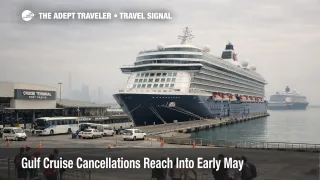
Gulf cruise cancellations widened again on March 27, 2026, and the new value for travelers is duration. TUI Cruises now says Mein Schiff 4 cancellations run through the start of the April 11 departure, and Mein Schiff 5 through the start of the April 24 departure, while MSC Euribia is still tied to a next scheduled sailing on May 2 from Kiel, Germany, and AROYA has already written off the rest of its Arabian Gulf season. That shifts more April trips, and some early May plans, from watch and wait territory into active rebooking territory.
What changed since earlier Adept coverage is not the existence of trapped ships, but the sharper end dates now attached to them. In an earlier Adept Traveler article, Gulf Cruise Ships Still Stuck, Europe Fallout Grows, the problem was already moving beyond the Gulf. The newer fact is that several lines now have longer, more concrete disruption windows, which makes it easier for travelers to judge whether a spring itinerary is still realistically salvageable.
Gulf Cruise Cancellations: What Changed
TUI Cruises' March 25 update is the clearest new marker. The line says cruises on Mein Schiff 4 can no longer take place up to and including the start of the April 11, 2026 trip, and cruises on Mein Schiff 5 can no longer take place up to and including the start of the April 24, 2026 trip. That is a materially longer disruption window than the early March cancellations travelers were dealing with before.
MSC looks less immediate, but not risk free. Cruise Industry News reported that MSC Euribia, still docked in Dubai, has its next scheduled cruise on May 2, 2026, from Kiel, Germany. That gives MSC more buffer than TUI, but it also means the ship still has to reposition out of the Gulf in time for a Northern Europe program that has not started yet. AROYA is the opposite case. Its public updates say the remaining sailings scheduled in the Arabian Gulf for the current season will not proceed, which effectively ends the line's Gulf season rather than leaving travelers to guess departure by departure.
The compensation picture is now clearer by brand, but not equally clear. Celestyal says guests booked on its newly canceled departures can choose a full refund or a future cruise credit. Cruise Industry News reported that MSC's earlier canceled Gulf departures would be automatically refunded in full. AROYA says affected guests have been contacted with available options, and it separately provided up to two hotel nights in Dubai for guests who were onboard during the March 7 disembarkation, but it has not posted one simple public compensation formula for every later affected booking. TUI's latest public page confirms the longer cancellation windows and says affected guests have been informed directly, but it does not spell out a fresh public remedy grid for these newly extended dates.
Which Spring Sailings Now Sit in the Strike Zone
The most exposed travelers are no longer only people booked on Gulf departures. They are also passengers whose Europe or Africa sailings depend on ships that are still physically in Dubai, Abu Dhabi, or Doha. Mein Schiff 4's canceled window now reaches the start of its April 11 departure, and Mein Schiff 5's reaches April 24, which puts a wider portion of TUI's spring repositioning chain under direct pressure. MSC Euribia's next scheduled departure from Kiel on May 2 gives it more room, but that sailing still depends on a ship that has not yet completed the long move back into Europe.
That changes the exposure map for travelers who thought the danger was confined to the Gulf. The real fault line now runs through downstream embarkation points such as Cape Town, South Africa, Palma de Mallorca, Spain, and Kiel, Germany, because those departures only work if the ship gets there on time. In an earlier Adept Traveler article, Gulf Cruise Ships Stranded Across Four Lines, the first broad fleet picture was already visible. The sharper dates now make that fleet problem more useful for decision making.
The people with the most to lose are travelers who wrapped flights, hotels, transfers, or time sensitive land plans around the cruise. The first order effect is a canceled or threatened sailing. The second order effect is usually the more expensive one, because airfare into replacement embarkation cities, pre and post cruise hotel nights, and same week transfers can tighten once other displaced passengers start chasing the same alternatives.
What Travelers Should Do Before Rebooking Windows Tighten
Start by separating confirmed cancellations from inherited positioning risk. If you are booked on AROYA's remaining Arabian Gulf season, the program is gone. If you are on a Celestyal sailing already named in the line's update, the cancellation is confirmed and the refund or credit choice is already defined. If you are booked on a later TUI or MSC sailing that still depends on a trapped ship reaching Europe or Africa on time, the task is different. You are managing elevated risk, not yet a published cancellation.
That means travelers should protect the non cruise parts of the trip first. Check whether your airfare is bundled or separate, whether your hotel is still refundable, and whether your insurance covers supplier disruption beyond the cruise fare itself. For TUI guests in particular, do not assume the remedy language from the line's first early March cancellation wave automatically governs these later, newly extended windows. The safest move is to get the exact current handling terms tied to your booking before you cancel linked travel on your own.
The decision threshold is straightforward. Rebook early if a missed sailing would break a larger itinerary, especially a long haul flight, a one night hotel stay before embarkation, or a fixed onward land tour. Wait only if your sailing still sits weeks out, your surrounding travel is flexible, and you can absorb a forced change without blowing up the rest of the trip. This is one of those cases where saving the cruise fare is not the same thing as saving the trip.
Why Early May Is Still on the Fault Line
The mechanism has not changed. Ships trapped in Gulf ports cannot simply appear in Europe on schedule. If they cannot safely reposition out of the region, the disruption spreads forward into later departures that were supposed to start somewhere else entirely. That is why one maritime choke point keeps distorting cruises in the Mediterranean, Northern Europe, and Red Sea programs long after the first passenger repatriation phase ended.
What happens next depends on ship movement, not marketing calendars. TUI's new dates make clear that a meaningful slice of April is already compromised. MSC's buffer means its early May restart is still more plausible than TUI's late April chain, but that is not the same thing as risk free. The next real recovery signal is a confirmed repositioning move, or a line by line reset of sailings around the vessels' actual locations. Until then, Gulf cruise cancellations remain a live planning problem for April, and they still reach into early May.