

Gulf Cruise Ships Still Stuck, Europe Fallout Grows
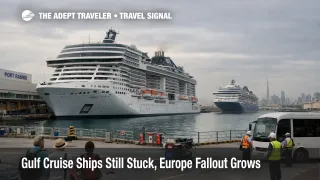
Gulf cruise ships stuck in Dubai, United Arab Emirates, Doha, Qatar, and Abu Dhabi, United Arab Emirates are still disrupting spring itineraries on March 27, 2026. The problem is no longer only about passengers who were stranded during the first wave of suspensions. Six vessels from MSC Cruises, TUI Cruises, Celestyal Cruises, and AROYA still have not repositioned out of the Gulf, and confirmed cancellations have already spread into April while later departures in Europe and the Red Sea remain tied to the same unresolved ship movement problem.
Gulf Cruise Ships Stuck, What Changed
Cruise Industry News reported on March 24 that the six ships still trapped in the Gulf are MSC Euribia in Dubai, Celestyal Journey in Doha, Celestyal Discovery in Dubai, Mein Schiff 4 in Abu Dhabi, Mein Schiff 5 in Doha, and AROYA in Dubai. It also said the ships remain unable to leave because the Strait of Hormuz is effectively closed to normal international maritime transit for these operations.
The cancellation picture is now clearer by line. Celestyal's March 25 travel update canceled two April 4 departures on Celestyal Journey and one April 6 departure on Celestyal Discovery, with guests offered either a full refund or a future cruise credit. AROYA said on March 7 that it would not proceed with the remaining sailings in its Arabian Gulf season. MSC had already canceled Gulf departures on MSC Euribia earlier in March and, according to Cruise Industry News, said affected guests would automatically receive a full refund of fares paid.
That makes this a broader fleet backlog, not a one brand disruption. In an earlier Adept Traveler article, Gulf Cruise Ships Stranded Across Four Lines tracked the shift from passenger repatriation to deployment risk. The new development is persistence. As of late March, ships are still not where their spring schedules assumed they would be, and that keeps later departures on an operational fault line even when they have not yet been canceled.
Which Sailings and Travelers Are Most Exposed
The most immediate exposure now falls on travelers booked on departures that were supposed to start once these ships reentered Europe or the Red Sea. Cruise Industry News listed MSC Euribia's next scheduled cruise as May 2 from Kiel, Germany, Mein Schiff 4's as April 11 from Cape Town, South Africa, Mein Schiff 5's as April 17 from Palma de Mallorca, Spain, and AROYA's as May 14 from Jeddah, Saudi Arabia. Celestyal's early April departures were already the first confirmed Europe spillover.
The travelers with the biggest downside are not only cruise guests. The harder hit group is travelers who built a larger trip around these sailings, especially separate flights, pre cruise hotel nights, private transfers, and timed land arrangements after disembarkation. A canceled sailing can usually be refunded or credited by the line. Separate air, hotel, and transfer pieces are where the financial damage and planning friction spread.
Families, groups, and anyone using these departures as repositioning anchors are more exposed than flexible solo travelers. A spring Mediterranean cruise out of Greece or Spain is not easy to replace at the same price and dates once a ship goes missing from its intended program. Adept has already tracked this progression in AROYA Gulf Cruises Canceled for Rest of Season, where the key shift was from one missed sailing to the removal of an entire remaining seasonal program.
What Travelers Should Do Now
If you are booked on one of the affected lines, the first move is to separate confirmed cancellations from sailings that are merely still exposed. Celestyal's three early April departures are confirmed canceled. AROYA's remaining Gulf season is confirmed canceled. For MSC Euribia, Mein Schiff 4, and Mein Schiff 5, the more important question is whether their next published departures can still operate if the ships do not reposition in time. Travelers on those voyages should assume schedule risk remains live until the vessel is physically moving or the line gives a formal all clear.
The next step is to protect the non cruise parts of the itinerary before fare classes and hotel inventory get worse. Check whether your airfare is bundled or separate, whether your hotel can still be canceled without penalty, and whether your travel insurance covers supplier disruption beyond the cruise fare itself. If your sailing date is within the next few weeks, the tradeoff is simple, waiting may preserve flexibility if the line resolves the ship move quickly, but acting early can preserve seats and room nights that disappear once a wider group of affected guests starts rebooking into the same gateways.
Travelers should also stop treating this as a Gulf only story. The practical planning risk has already moved into Piraeus, Greece, Lavrion, Greece, Palma de Mallorca, Spain, Kiel, Germany, Cape Town, South Africa, and Jeddah, Saudi Arabia because those are the downstream handoff points in the deployment chain.
Why the Backlog Still Threatens Europe Departures
The mechanism is straightforward. These ships do not have an alternate sea route out of the Gulf. If they cannot safely transit the Strait of Hormuz, they cannot reach the Mediterranean, Northern Europe, or the Red Sea programs that were supposed to follow. That turns one regional maritime choke point into a spring scheduling problem across several cruise markets at once.
First order, canceled Gulf sailings remove current capacity. Second order, delayed repositioning threatens later departures far from the original disruption zone. That can tighten replacement cruise inventory, raise airfare into substitute embarkation cities, and force hotel demand into fewer nights and fewer ports as travelers scramble to salvage spring trips. The seriousness here is not that every later departure will fail. It is that multiple April and May programs still depend on ships that, as of March 27, are not yet where they need to be.
What happens next depends on movement, not messaging. The recovery signal travelers need is not another generic advisory. It is a confirmed repositioning departure, or a line by line revision that resets later cruises around the ships' actual locations. Until that happens, the safest assumption is that this cruise disruption remains a live spring planning problem well beyond the Gulf itself.
Sources
- Travel Updates, Celestyal Cruises
- Arabian Gulf Updates, AROYA Cruises
- MSC Cancels Departures in the Middle East, Cruise Industry News
- Six Cruise Ships Remain Stuck in the Arabian Gulf, Cruise Industry News
- German Tour Operators Dertour and TUI Cruises Suspend Middle East Trips, Reuters
- Gulf Cruise Ships Stranded Across Four Lines, Adept Traveler
- AROYA Gulf Cruises Canceled for Rest of Season, Adept Traveler