

Gulf Flight Suspensions Expand by Carrier
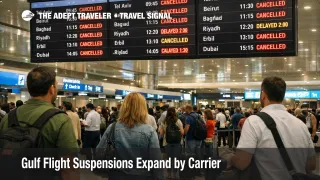
Gulf flight suspensions became more actionable on Friday, March 27, 2026, because the latest carrier by carrier map now shows how long some routes are likely to stay offline, not just that disruption still exists. Aegean, airBaltic, and Air Canada all have spring suspensions that now reach well beyond a short wait and see window, which changes the decision point for travelers holding April trips through the region. For many itineraries, the practical risk is no longer a brief schedule wobble. It is a thinner market with fewer fallback seats, costlier overnight stops, and weaker recovery if one leg fails. Travelers with tight connections or fixed dates should start treating some bookings as rebook now cases rather than passive watch items.
Gulf Flight Suspensions: What Changed
What changed since the earlier broad Europe coverage is specificity. In an earlier Adept Traveler article, Europe Middle East Flight Cuts Stay in Place for Summer, the emphasis was on a wider reduced network. The newer value is the route matrix from additional carriers. Reuters' latest carrier roundup says Aegean has Tel Aviv, Beirut, and Amman canceled until April 22, Erbil and Baghdad until May 24, Dubai until April 19, and Riyadh until April 18. airBaltic says Tel Aviv is canceled until April 29 and Dubai until October 24, while Air Canada says Dubai remains suspended until April 30 and Tel Aviv until May 2.
That matters because the disruption has moved from vague regional instability to named routes with long dated consequences. A traveler deciding whether to protect an April school break trip, a cruise embarkation, or a one night connection is no longer choosing between patience and overreaction. In several of these markets, the operating carrier itself is already signaling that normal restoration is not imminent. airBaltic also tells affected passengers not to go to the airport unless a flight is confirmed, which is a strong operational sign that same day assumptions are unsafe.
Which Spring Itineraries Now Need Rebooking
The highest exposure sits with travelers booked on nonstop or single connection itineraries that depended on one of these carriers to reach Tel Aviv, Dubai, Amman, Beirut, Riyadh, Erbil, or Baghdad during April, and in airBaltic's Dubai case, far beyond that. That includes passengers using Athens, Greece as an Aegean bridge into the region, Baltic origin travelers relying on Riga, Latvia based airBaltic service, and Canada originating travelers who expected Air Canada to preserve a direct option into Tel Aviv or Dubai. Once suspensions stretch to late April, early May, or October, the odds fall that a short delay will save the original plan.
The second layer of exposure is for travelers who are not even flying these carriers, but are buying into the same remaining pool of seats. When one airline leaves a city pair offline for weeks or months, displaced demand compresses onto the carriers and hubs still operating. Reuters has separately reported slower Gulf airline recovery and continuing limits around Israel, while Adept has already tracked how Ben Gurion Capacity Collapse Shifts Israel Exit Routes. The result is higher fares, fewer same day backups, more forced hotel nights, and more pressure on overland workarounds and safer transfer points.
What Travelers Should Do Now
Travelers with departure dates inside the published suspension windows should stop waiting for a minor adjustment and start pricing alternatives now. For Aegean affected trips, that means treating late April travel to Tel Aviv, Beirut, and Amman as disrupted until the carrier changes its advisory. For airBaltic customers booked to Dubai, the issue is much more severe because the airline's own page now shows cancellations through October 24, 2026. For Air Canada customers, Dubai and Tel Aviv itineraries inside the published dates should be reviewed against waiver, rebooking, or refund options immediately.
The rebook versus wait threshold is now clearer than it was earlier in the week. Rebook now if you have a fixed event, an onward cruise or tour, a same day long haul connection, or a trip where an extra overnight would break the plan. Waiting is more defensible only when your dates sit beyond the current suspension window, your fare rules are flexible, and you still have multiple alternate routings that do not depend on the same stressed hubs. For Israel bound or Israel exit itineraries, travelers should be especially cautious because airport restrictions and carrier limits can stack on top of each other even when a route technically returns to sale.
Over the next 24 to 72 hours, the signals that matter most are carrier advisory updates, not generic flight search availability. Watch whether airlines extend dates again, add specific waiver language, or keep telling customers not to head to the airport without confirmation. A real stabilizing sign would be dates moving inward, frequencies returning, and carriers restoring routes without heavy caveats. Right now, the published pattern still points the other way.
Why the Disruption Is Lasting Longer
The mechanism is larger than any one airline. Reuters has reported that the Iran war disrupted major Middle East aviation flows after the February 28 strikes, and later coverage showed Gulf carriers recovering only slowly. Even where airspace reopened in part, airlines still had to manage security exposure, aircraft rotations, crew positioning, insurance costs, and uncertain route economics. That is why a route can stay suspended long after the first headline about airport closures fades.
This also explains why Gulf flight suspensions have become a broader spring planning problem instead of a narrow emergency bulletin. First order, travelers lose the canceled flight itself. Second order, the rest of the system gets tighter. Surviving hubs absorb more demand, reaccommodation gets harder, overnight connection costs rise, and ordinary schedule disruptions become more expensive because there is less spare capacity in the market. Until carriers start shortening suspension windows instead of extending them, Gulf flight suspensions should be treated as an active booking risk, not just a headline to monitor.
Sources
- Airlines cancel more flights as Middle East conflict escalates
- AEGEAN additional flight cancellations to and from Tel Aviv, Erbil, Baghdad, Beirut, Dubai, Riyadh and Amman
- Information on airBaltic Flights to and From Dubai and Tel Aviv
- Military situation in the Middle East
- Gulf airlines recover slowly as Iran conflict drags
- Israel's El Al Airlines to operate at 5% of capacity after government limits traffic