

Ben Gurion Capacity Collapse Shifts Israel Exit Routes
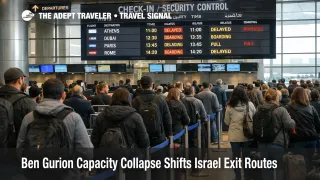
Travelers trying to leave Israel now face an airline level capacity crunch, not just a slower airport. Reuters reported El Al will operate at about 5% of normal capacity after Israel limited Ben Gurion Airport to one inbound and one outbound flight per hour and capped each departure at 50 passengers, while Arkia said it is shifting most of its operations to Aqaba, Jordan and Taba, Egypt. For travelers, that changes the decision point. Ben Gurion Airport (TLV) is no longer a constrained but broadly usable default for most outbound plans. Travelers without a credible near term seat should start treating Jordan and Egypt overland exits as primary workarounds, not backup ideas.
Ben Gurion Capacity Collapse: What Changed
The new fact is not only that Ben Gurion remains restricted, it is that airline usable capacity has fallen to a level where the airport's practical value for ordinary departures has collapsed. Reuters said El Al is down to roughly 5% of normal capacity under the current government limits, and the carrier is focusing on essential service to a small set of major cities rather than anything close to a normal network. Arkia, meanwhile, said the Ben Gurion rules are so tight that it is moving most of its operations to Aqaba and Taba.
That matters differently from the earlier phase of this story. In an earlier Adept Traveler article, Ben Gurion Outbound Flights Narrow to Four Airlines described a limited outbound window. What changed now is the scale of the squeeze at airline level. A 50 passenger cap on one outbound flight per hour leaves very little room for families, groups, missed connections, or people waiting for standby openings, even before holiday demand and security uncertainty are added on top.
Which Travelers Should Stop Waiting on Tel Aviv
The most exposed travelers are those without a confirmed near term seat, those trying to move within the next 24 to 72 hours, and anyone whose trip depends on multiple travelers leaving together. They are competing for a tiny outbound pool while foreign carrier service remains heavily curtailed and Israeli carriers are operating under emergency limits. Travelers with onward long haul tickets, timed medical or family obligations, or fixed hotel and cruise connections outside Israel have the least room to wait and hope for a same day opening.
The practical pressure is now shifting outward. If Ben Gurion cannot move normal passenger volumes, the bottlenecks move to the border, then to hotels, then to onward air inventory from nearby gateways. First order, more people try to leave by land. Second order, that raises queue risk at crossings, increases the odds of forced overnights in Amman, Jordan or near Taba, Egypt, and makes late booked onward tickets harder to secure. The Jordan route is more organized for some U.S. travelers because the U.S. Embassy in Jerusalem is running assisted bus departures to Queen Alia International Airport (AMM), but that does not remove visa rules, border processing, or onward booking pressure.
What Travelers Should Do Now
A traveler who already has a confirmed, near term Ben Gurion departure should still try to use it. Everyone else should stop treating Tel Aviv as the default answer and compare full door to door exit chains instead. The better question now is not whether a flight exists on paper, it is whether the whole sequence is controllable, airport or border, transport, documents, onward seat, and possible overnight.
The Jordan option works best for travelers who can secure onward flights from Amman before moving and who can tolerate a border to airport handoff rather than a direct departure. In an earlier Adept Traveler article, Israel Jordan Exit Buses Shift Departure Decisions explained how the assisted bus route lowers one layer of uncertainty while leaving Jordan entry and onward ticketing as the next choke points. Travelers overnighting in Amman should leave extra transfer buffer because Thursday and Friday demonstrations can trigger rolling roadblocks and checkpoints around the capital and major approach roads.
The Egypt option works best for travelers who understand the cash and paperwork burden before they go. In an earlier Adept Traveler article, Taba Exit Costs Raise Israel to Egypt Cash Risk detailed the British government guidance that travelers crossing at Taba should carry at least $110.00 (USD) in cash per person, with extra cash because charges can rise at short notice. That means Taba is not a friction free airport substitute. It is a route that can still fail if a traveler arrives short of cash, short of documents, or with an onward plan that does not match the entry permission available at the border.
Why the Exit Pressure Is Moving to Jordan and Egypt
The mechanism is simple. When authorities reduce the airport to one outbound flight per hour and 50 passengers per departure, the failure mode is no longer only cancellation. It becomes throughput starvation. Even flights that still operate cannot absorb normal outbound demand, so the shortage spills into border crossings and nearby foreign airports that can still connect travelers onward. That is why Arkia's move toward Aqaba and Taba matters. It is a market signal that airlines themselves no longer see Ben Gurion as the main release valve for regular outbound demand under the current rules.
What happens next depends on whether security conditions improve enough for Israel to restore higher airport throughput. For now, the next decision point is practical, not political. If a traveler already has a real seat out of Ben Gurion, use it. If not, the odds increasingly favor choosing a controlled overland pivot earlier, before hotel space, border processing, and onward air inventory tighten further in Amman, Aqaba, or Taba.
Sources
- Israel's El Al Airlines to operate at 5% of capacity after government limits traffic, Reuters
- Israel imposes flight restrictions at Ben Gurion Airport, Anadolu Agency
- U.S. Department of State Launches Assisted Overland Departures via Jordan, U.S. Embassy Jerusalem
- Security Alert: U.S. Embassy Jerusalem, March 24, 2026, U.S. Embassy Jerusalem
- Israel Travel Advice, GOV.UK
- Egypt Entry Requirements, GOV.UK