

Europe Middle East Flight Cuts Stay in Place for Summer
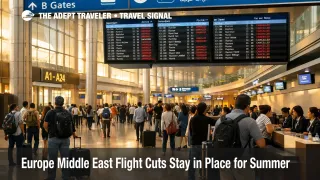
Travel between Europe and the Middle East is still running on a reduced map, and the practical change now is duration. As of Friday, March 27, 2026, Wizz Air is still holding Israel flights until March 29 and keeping Dubai, Abu Dhabi, Amman, and Jeddah suspended from mainland Europe until mid September, while Turkish Airlines and SunExpress continue to show parts of their Gulf schedules offline through late March and into April. That leaves fewer nonstop choices for spring and summer trips, especially for travelers who assumed the system would normalize once the first wave of closures eased. Travelers booking now should stop treating published summer schedules as stable until the operating carrier is actually flying the route.
Europe Middle East Flight Cuts, What Changed
The newest traveler problem is that long suspension windows are surviving well past the immediate shock phase. Wizz Air remains one of the clearest examples, with Israel still paused until March 29 and several Gulf and Jordan routes from mainland Europe still blocked until mid September. Turkish Airlines has kept most Middle East flying canceled until the end of March, and SunExpress has kept Dubai suspended until April 6 and Bahrain until April 30. This is no longer just a disruption story tied to a few bad operating days. It is a late spring and late summer planning problem for travelers who need nonstop certainty.
In an earlier Adept Traveler article, Europe Middle East Flight Cuts Stretch to October, the focus was the Lufthansa Group and Eurowings side of the cutback picture. The latest angle is different. Low cost and Turkish linked capacity are still not coming back on a short timetable, which means the thinner market is spreading across more price points and more booking styles.
Which Travelers Face the Most Exposure
The highest exposure sits with travelers who built their plans around nonstop flying from Europe into the Gulf, Jordan, or Israel, then expected backup space to be easy. That includes cruise passengers trying to protect embarkation days, travelers on one night stopovers before long haul connections, and leisure flyers using low cost carriers for city breaks or shoulder season sun trips. When one airline suspends a route for months, the problem is not only the canceled seat count. The remaining demand gets pushed onto fewer carriers and fewer hubs.
Israel remains the hardest case. Ben Gurion Airport is still operating under severe limits, with authorities allowing only one incoming and one outgoing flight per hour, and outbound flights capped at 50 passengers. That means even when a ticket exists on paper, the recovery path is narrow and heavily rationed. For Gulf connections, Dubai and Abu Dhabi look more workable than Doha right now because Emirates has recovered to roughly three quarters of pre conflict capacity and Etihad to about half, while Qatar Airways is still around one fifth.
What Travelers Should Do Now
Travelers should treat summer bookings in these markets as active risk management, not routine shopping. If your original plan depends on Wizz Air from mainland Europe into Dubai, Abu Dhabi, Amman, or Jeddah, assume that suspension window is real until the airline shortens it, not the other way around. If your trip depends on Tel Aviv, assume severe capacity limits remain part of the journey even after individual airline advisories shift.
For transfer planning, Dubai and Abu Dhabi currently look like the more usable Gulf connection points, but they are not back to normal. In an earlier Adept Traveler article, Gulf Airline Recovery Stays Too Uneven for Connections, the key point was that bookable does not mean resilient. That still applies. A workable hub is not the same thing as a forgiving hub, so short same day connections remain the wrong bet while capacity is still materially reduced.
The best decision threshold is simple. Rebook early if a missed departure would break a cruise, a tour start, a wedding, or a long haul connection. Wait only if your dates are flexible, your airline is operating the route now, and you can absorb a forced overnight stop or a shift to another hub. Over the next one to two weeks, the signal to watch is not marketing schedules. It is whether airlines actually restore flying and whether Gulf hub capacity keeps climbing instead of stalling at reduced levels.
Why This Is Still a Late Summer Problem
The mechanism is straightforward. The conflict that erupted after the February 28 strikes on Iran broke normal traffic flows across key Middle East airspace and major hub airports. Even where airports reopened, airlines did not snap back to prior schedules. Aircraft rotations, crew flow, insurance exposure, route economics, and airspace risk all kept pressure on recovery. That is why Europe Middle East flight cuts can outlast the first closure headlines by months.
The second order effects matter almost as much as the suspensions themselves. Fewer nonstops mean higher fares on remaining seats, more forced overnight connections, and less slack when weather, security limits, or airport caps hit an already thin schedule. That is also why travelers should stop assuming summer schedules will normalize on their own. In this market, published inventory can still be less reliable than actual operating depth, and Europe Middle East flight cuts remain a live booking risk into late summer.
Sources
- Airlines Cancel More Flights as Middle East Conflict Escalates, Reuters, March 16, 2026
- Factbox, Airlines Cancel More Flights as Middle East Conflict Escalates, Reuters, March 26, 2026
- Gulf Airlines Recover Slowly as Iran Conflict Drags, Reuters, March 23, 2026
- Israel's El Al Airlines to Operate at 5% of Capacity After Government Limits Traffic, Reuters, March 23, 2026
- Flights Interrupted Due to Middle East Conflict, Reuters Graphics, March 2, 2026
- Current Travel Updates, SunExpress