

Hawaii Flood Recovery Leaves Beach, Park Gaps
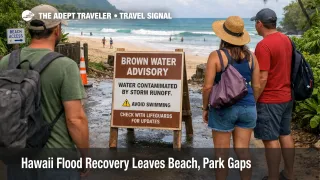
Hawaii flood recovery travel has shifted out of statewide storm mode and into a more uneven cleanup phase. Most visitor services are operating again, and the Hawaii Tourism Authority said on March 23 that there is no reason to cancel or postpone trips later in the week and beyond, but that does not mean every beach, park, or road linked to visitor plans is back to normal. Travelers heading to Oahu, Maui, Kauai, or Hawaii Island now face a narrower problem, localized closures, cleanup work, and water quality risk that can still break beach days, scenic drives, and timed park visits.
In an earlier Adept Traveler article, Hawaii Flood Watch Keeps Flight Risk for March 23 the main question was whether lingering weather would still disrupt departures and interisland connections. That piece no longer describes the main statewide risk. The weather system has weakened, and the National Weather Service now describes a stable trade wind pattern with mainly light to moderate windward showers rather than a broad repeat of the kona low emergency.
Hawaii Flood Recovery Travel: What Changed
The operational improvement is real. Hawaii Tourism Authority guidance says conditions are improving, most visitor services are operating, and most areas and attractions are either reopened or reopening. The National Weather Service forecast discussion issued late on March 26 said the islands were back in a stable trade wind pattern, with mostly light showers and no statewide watches, warnings, or advisories showing on the Honolulu forecast office page early on March 27.
The remaining friction is more specific than the storm itself was. On Maui, Waiʻānapanapa State Park remains closed through March 29, and Iao Valley State Monument is closed through March 30, with a tentative March 31 reopening. On Oahu, some city park facilities still remain closed from storm impacts, while Honolulu park officials continue to post recovery updates. At Haleakalā National Park, the summit area is open, which undercuts the claim that the whole summit district remains closed, but some visitor facilities and swimming access limits remain in place.
That makes this a meaningful but localized disruption, not a statewide stop signal. Flights and hotel stays can still go forward, but parts of the visitor experience are temporarily thinner, especially if a trip depends on specific beaches, the Road to Hana corridor, North Shore Oahu day trips, or closed state park reservations.
Which Hawaii Trips Still Carry The Most Friction
Travelers with flexible resort stays in Honolulu, Waikiki, Wailea, or Kona are in a better position now than visitors whose itinerary depends on exact outdoor assets. The most exposed segments are beach focused travelers, road trippers with fixed scenic stops, and anyone trying to salvage a tightly sequenced island hopping plan that leaves no room for detours.
Oahu remains a special case for visitors treating the North Shore like a normal day trip. In an earlier Adept Traveler article, Oahu North Shore Flooding Hits Access and Lodging the issue was active flooding and rescues. That immediate danger has eased, but the area still sits on the recovery side of the event, where cleanup, road friction, and local sensitivity matter more than dramatic weather headlines.
Beachgoers across several islands also need to treat water quality as a real trip planning variable. Hawaii's Department of Health warns the public to stay out of beaches or streams contaminated by storm, or brown, water because runoff can carry pathogens, sewage overflow, and other pollutants. The state's advisory system has continued to post brown water advisories during the recovery period, which means a sunny beach day can still be a bad swim day.
What Travelers Should Do Now
Travelers should stop thinking in statewide terms and start checking the exact asset they plan to use. That means confirming state park entry, national park conditions, beach advisories, and road access before leaving the hotel, not just assuming that clear skies equal full reopening. For Maui itineraries in particular, travelers should verify whether a closure on the Hana side or in Iao Valley removes one of the trip's core reasons for that day's routing.
The next decision point is simple. Keep the trip if the core pieces of the itinerary are flights, lodging, dining, and flexible sightseeing. Adjust the plan, or rework day by day bookings, if the trip depends on swimming conditions, closed state parks, or a narrow scenic corridor with little substitution value. Waiting for "full normal" is unnecessary for most travelers, but assuming every attraction has bounced back is sloppy planning.
Over the next 24 to 72 hours, travelers should monitor three signals. First, whether brown water advisories shrink or expand. Second, whether Maui state park closures lift on their posted timelines. Third, whether local operators, parks, and counties begin removing storm recovery notices from their current conditions pages. Those are better recovery signals than a generic tourism reassurance line.
Why Recovery Still Feels Uneven
Kona lows do not just create flight delay risk. They saturate ground, damage roads, contaminate nearshore water, and leave behind cleanup zones that keep affecting travel after the heaviest rain is gone. That is why Hawaii Tourism Authority can reasonably say there is no reason to cancel later trips while health and parks agencies still maintain targeted warnings and closures. The weather emergency ends first, then the access and water quality problems fade later.
The second order effects matter more for visitors than the storm label does. A closed park can force a longer drive or wasted reservation. Brown water can remove a beach day even when the hotel zone looks fine. Local recovery work can also make travelers unwelcome in places where unnecessary traffic slows crews or strains communities already dealing with mud, debris, and repairs. That does not justify broad trip cancellations. It does justify a more respectful and more exact style of planning through the end of March.
Sources
- March 23: Kona Low Storm Update, Hawaii Tourism Authority
- Area Forecast Discussion, National Weather Service Honolulu
- NWS Forecast Office Honolulu, HI
- Maui Parks - Closure, Hawaii Department of Land and Natural Resources
- Waiʻānapanapa State Park Conditions, Hawaii Department of Land and Natural Resources
- Alerts & Conditions, Haleakalā National Park
- General Health Advisory, Hawaii Department of Health Clean Water Branch
- Clean Water Branch Advisory System, Hawaii Department of Health