

Israel Exit Routes Shift to Aqaba and Taba
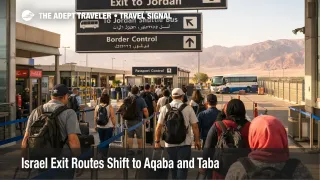
Israel exit routes have shifted from a flight search problem to a full corridor planning problem in Israel as of March 27, 2026. Ben Gurion Airport (TLV) is still operating only a limited outbound schedule, with the U.K. Foreign, Commonwealth and Development Office saying operations are currently approved for El Al, Israir, Arkia, and Air Haifa under Home Front Command passenger limits, while Reuters reported El Al is down to roughly 5 percent of normal capacity and Arkia has moved most operations toward Aqaba, Jordan, and Taba, Egypt. For travelers trying to leave in the next few days, the practical consequence is simple, Tel Aviv can no longer be treated as the default departure point for most outbound plans.
Israel Exit Routes: What Changed
The new fact is not only that Ben Gurion remains constrained. The bigger change is that the workaround network is now becoming more important than the airport itself. FCDO guidance updated on March 24 says outbound flights remain limited and currently concentrated on four Israeli carriers, while Reuters reported the government framework allows only one inbound and one outbound flight per hour and caps departing flights at 50 passengers, which is why El Al says it is operating at about 5 percent of normal capacity. Reuters also reported that Arkia is shifting most of its operations to Aqaba and Taba, and that El Al is pressing for Ramon Airport (ETM) near Eilat to open as a complementary alternative.
That makes this a different traveler problem from the earlier capacity squeeze. In an earlier Adept Traveler article, Ben Gurion Outbound Flights Narrow to Four Airlines focused on which carriers were still in the outbound window. The bigger problem now is corridor design, not just seat scarcity. A family, a business traveler with a long haul connection, and a tourist with a fixed cruise or hotel date may all face the same conclusion, the workable exit may start on the road, not at Tel Aviv.
Which Travelers Should Pivot to Aqaba, Taba, or Wait for Ramon
The most exposed travelers are those without a confirmed near term Ben Gurion seat, those traveling within 24 to 72 hours, and anyone whose itinerary depends on multiple people leaving together. A 50 passenger cap per departure sharply reduces room for ordinary outbound demand, and that pushes more people toward Jordan and Egypt overland options. The travelers with the least room to wait are those holding onward long haul tickets, timed medical or family trips, cruise embarkations, or expensive nonrefundable stays outside Israel.
Aqaba works best for travelers who can manage an overland move to the Yitzhak Rabin Border Crossing near Eilat, then rebuild the trip from Jordan. That route is still operational, with passenger terminal hours listed as 630 a.m. to 800 p.m. Sundays through Thursdays, and 800 a.m. to 800 p.m. on Fridays and Saturdays, but the Israel Airports Authority has also warned that from March 30 through April 10 it will not be possible to exit Israel to Jordan by private vehicle via Yitzhak Rabin or Jordan River. That means some self drive plans will fail even if the border itself is open.
Taba works best for travelers who can tolerate a more cash heavy, document sensitive handoff into Egypt. The Menachem Begin, or Taba, crossing operates 24 hours a day for passengers and is open to holders of Israeli and foreign passports, but U.K. government advice now says travelers crossing into Egypt at Taba should bring at least $110.00 (USD) in cash per person, with extra cash because charges have changed at short notice since early March. That same guidance says travelers going beyond Taba and the Sinai Peninsula may need a $60.00 (USD) border tax, a $30.00 (USD) visa, and a letter of guarantee costing about $20.00 (USD).
Ramon is different. It is not yet a broad public workaround on the same footing as Aqaba and Taba. It remains a proposed pressure release valve that El Al wants opened as a complementary alternative. Until authorities formally expand its role, travelers should treat Ramon as a policy watch item, not a dependable booked solution.
What Travelers Should Do Now
A traveler holding a confirmed, near term Ben Gurion departure should still try to use it, because a controlled airport departure is usually simpler than rebuilding an international exit chain through a land border. Everyone else should compare full door to door options, not just the first leg. The real decision is whether the entire chain is controllable, airport or border access, passport and visa position, cash needs, onward seat availability, and likely overnight costs.
For Aqaba, confirm whether you are arriving on foot, by bus, or by private vehicle, because the private vehicle restriction at Yitzhak Rabin from March 30 through April 10 changes the math for families and self drive travelers. For Taba, do not leave for the border assuming cards or on site fixes will solve missing cash or entry paperwork. In an earlier Adept Traveler article, Taba Exit Costs Raise Israel to Egypt Cash Risk laid out why Taba is not a simple handoff point, and Egypt Tourist Entry Requirements For 2026 is the better starting point if the onward plan involves Cairo, Hurghada, or any mainland Egypt departure.
The main threshold for rebooking versus waiting is whether you already control a credible outbound seat from Israel itself. If yes, keep it unless the carrier cancels or materially retimes it. If no, and the trip matters in the next few days, start pricing the overland route, the border fees, one probable hotel night, and a fresh outbound ticket from Aqaba or Egypt. Waiting may preserve cash in theory, but early rebuilding may preserve the itinerary.
Why the Pressure Has Moved to Borders, Hotels, and Next Flights
Ben Gurion's cap changes the travel system in layers. First order, fewer people can leave directly by air from Israel. Second order, more passengers shift to land crossings, which increases queue pressure, turns ground transport and border operating hours into failure points, and moves the real competition to onward seats from Jordan and Egypt. That is why this story is bigger than one airport restriction. The bottleneck has moved outward from the runway to the entire exit chain.
The next thing to watch is not just whether Ben Gurion remains open, but whether authorities loosen the outbound cap, formally expand Ramon's role, or tighten border side rules as holiday demand rises. Until one of those changes happens, Israel exit routes remain a corridor management problem. Travelers should expect the practical pressure point to stay outside Tel Aviv, at the border, in the transfer, and on the next available flight.
Sources
- Israel travel advice, GOV.UK
- Reuters, Israel's El Al Airlines to operate at 5% of capacity after government limits traffic
- Yitzhak Rabin Border Crossing updates, Israel Airports Authority
- Yitzhak Rabin opening hours, Israel Airports Authority
- Menachem Begin opening hours, Israel Airports Authority
- Menachem Begin notifications and updates, Israel Airports Authority
- Egypt entry requirements, GOV.UK