

O'Hare Summer Cap Fight Keeps Schedules Unstable
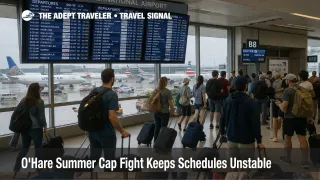
Chicago O'Hare International Airport (ORD) is heading into summer with a schedule problem that is still not fully settled. The FAA says published peak day schedules top 3,080 daily operations, up from about 2,680 last summer, and the agency has already concluded that kind of increase would stress O'Hare's runway, terminal, and air traffic control systems. For travelers booked from March 29 through late October, the practical issue is that a flight can still look bookable while the broader summer plan remains too crowded for the airport the FAA says it can safely and reliably run. That raises the odds of retimed departures, trimmed frequencies, thinner connection banks, and fewer recovery options when storms or ATC flow controls hit Chicago.
O'Hare Summer Flight Cap: What Changed
What changed is that the FAA moved beyond a broad warning and into a formal reduction process. In its March 18 Federal Register notice, the agency said Summer 2026 schedules at O'Hare exceed manageable capacity, reconvened reduction talks for March 19, and said it would issue a final order after reviewing submissions. The FAA first floated a 2,800 daily limit, then later sought a lower 2,608 target, with half hour reduction targets meant to prevent overscheduling from one bank spilling delays through the rest of the day. That is why this is not just another Chicago congestion story. It is a regulator saying the published schedule itself is the risk. In an earlier Adept Traveler article, Chicago O'Hare Summer Flight Cap Planned by FAA covered the first push toward a cap, and O'Hare Summer Flight Cuts Move Toward Hard Limits tracked the shift toward a lower working ceiling.
Which Travelers Face the Most ORD Exposure
The most exposed travelers are not necessarily people taking a simple local nonstop. The bigger risk sits with anyone using O'Hare as a transfer machine. Short domestic to international connections, separate ticket builds, final departures of the day, and itineraries tied to a cruise, tour, wedding, or major event all become less forgiving when a hub loses schedule slack. The FAA explicitly warned that disruptions at ORD spread across the National Airspace System, forcing tools like ground delay programs at other airports, so the damage is not confined to Chicago gates and taxiways. In plain terms, a thinner O'Hare bank can break onward trips in places far from Illinois.
The carriers with the most at stake are the ones that pushed growth hardest. Reuters reported United planned to operate about 780 daily O'Hare flights this month, up from 541 on average last year, while American said its summer daily departures would rise to 526 from 484 last summer. Because the FAA says reductions should be shared proportionally from Summer 2025 baselines, travelers on both carriers should assume schedule edits can still land across peak banks rather than hitting only one airline.
What Travelers Should Do Now
Treat March 29 through late October O'Hare schedules as provisional until the final FAA order and carrier updates fully settle. If your trip has a hard start time, the safest move is to buy more margin, not to trust a legal minimum connection at a hub under structural pressure. Earlier flights are better than last bank departures, and a same day connection through O'Hare is weaker than arriving the night before for cruises, tours, conferences, or expensive timed plans.
The next decision threshold is simple. If a missed connection would trigger a self funded hotel, lost event value, or a broken long haul itinerary, O'Hare needs more buffer than usual this summer. Travelers should also watch for retimed banks, aircraft swaps, and disappearing backup flights on the same route, because the real risk is not only cancellation. It is a schedule that keeps running, but with less room to absorb weather, ATC spacing, or a late inbound. In an earlier Adept Traveler article, U.S. Air Traffic Control Privatization: Reality Check explained the broader system pressure that makes hub congestion harder to recover from once staffing and infrastructure run tight.
Why the O'Hare Fight Matters Beyond Chicago
The larger mechanism is straightforward. O'Hare is one of the country's biggest connection hubs, so when too many flights are packed into the same periods, even a modest delay can grow into gate holds, longer taxi times, missed crew sequences, and late aircraft turning up somewhere else in the network. The FAA's notice says that kind of overscheduling can force cascading delay management through the day, and Reuters reported Chicago itself warned deeper cuts could disrupt the wider National Airspace System. The dispute, then, is not over whether there is pressure. It is over where the workable ceiling really sits, and how much schedule pain travelers should absorb now to avoid a worse operational mess later in the summer.
As of Friday, March 27, the FAA had not yet published its final O'Hare reduction order in the Federal Register. That leaves airlines, and passengers, in the awkward space between published timetables and the schedule the regulator ultimately decides the airport can handle. For travelers, that means the next useful signals are not press statements. They are visible timetable changes, weaker same day backup options, and any carrier notice that a connection through O'Hare has become materially thinner than it looked when booked.
Sources
- Operating Limitations at Chicago O'Hare International Airport, Notice of Meeting and Request for Information
- FAA plans to reduce flights at Chicago O'Hare, cites boost in schedules
- FAA seeking steeper cuts in flights at Chicago O'Hare airport, sources say
- FAA to resume hearing Thursday on plan to reduce flights at Chicago O'Hare
- Chicago says FAA should not cut daily flights below 2,800