

Senate Deal Leaves U.S. Airport Weekend Risk Live
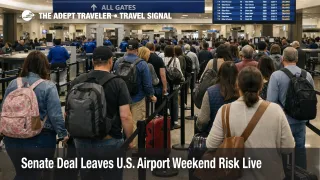
The U.S. airport weekend risk changed on March 27, 2026, because the Senate passed a compromise bill that would restore funding for most of the Department of Homeland Security, including TSA, after six weeks of disruption. That gives travelers a visible path toward relief, but not a working fix yet. The House had not cleared the bill as of Friday, and airports were still reporting unusually long security lines. For travelers flying this weekend, the practical point is simple, plan for checkpoint disruption first, and treat any political progress as incomplete until staffing and wait times actually normalize.
U.S. Airport Weekend Risk: What Changed
What changed is not that the airport problem is over. It is that the problem moved from one of simple deterioration to one of uncertain transition. Reuters reported that the Senate approved a measure to restore funding for TSA, FEMA, and the Coast Guard, but the House response was immediately shaky, with Speaker Mike Johnson weighing alternatives and no settled timing for final action. AP reported that House Republicans were openly resisting the Senate package because it leaves out ICE and Border Patrol funding, which means the funding lapse can still continue even after the Senate breakthrough.
That distinction matters because airport operations recover in stages, not by headline. A bill can pass one chamber, pay can be discussed, and yet checkpoint throughput can still stay weak for another operating cycle or more. Reuters said many of TSA's roughly 50,000 screeners have been working without pay since mid February, with callouts and resignations contributing to long lines. AP reported nearly 500 transportation security officers have quit during the shutdown, and more than 11 percent of scheduled TSA employees missed work nationwide on Wednesday. Even if the House moves quickly, airports still need people to show up, lanes to reopen, and passenger flows to settle back into something closer to normal.
Which Travelers and Airports Are Most Exposed
The highest exposure remains with weekend travelers departing from airports where screening was already strained before the Senate vote. Reuters reported especially long lines on Friday in New York, Atlanta, and New Orleans, while Baltimore urged travelers to arrive at least three hours early as lines extended outside. Houston remains one of the clearest pressure points. Houston Airports warned that on Friday, March 27, wait times at George Bush Intercontinental Airport (IAH) could reach four hours or longer, and its live advisory said travelers should prepare for longer than normal waits with checkpoints operating in Terminals A and E.
The most fragile itineraries are not all the same. Origin passengers at the worst airports face the most direct risk because a long line can break the trip before boarding even starts. Connecting passengers face a different problem. If they miss the first segment because screening is slow, the entire itinerary can unravel, and if they misconnect later because inbound flights are out of position, the rebooking pool may already be thin. Families, infrequent flyers, travelers checking bags, and anyone booked on the first wave of Saturday and Sunday departures should treat security as the main failure point, not the flight status alone. Reuters' Friday reporting from Atlanta showed lines still visibly stretched after the Senate action, which underlines that this remains an operational story, not just a congressional one.
In an earlier Adept Traveler article, Worst TSA Lines Hit Atlanta, Houston, and New York, the pressure was already concentrated at a small group of major hubs. In another earlier Adept Traveler article, Airport Security Delays Could Outlast the Shutdown, the main warning was that screening recovery would likely lag behind any political settlement. Friday's Senate move makes that lag the central traveler issue.
What Travelers Should Do Now
Travelers flying on March 27 through the weekend should leave more buffer than usual for screening, especially at George Bush Intercontinental Airport (IAH), Hartsfield, Jackson Atlanta International Airport (ATL), Baltimore Washington International Thurgood Marshall Airport (BWI), New York area airports, and Louis Armstrong New Orleans International Airport (MSY). At the most stressed airports, the old assumption that a normal domestic airport buffer is enough no longer holds. The most practical move is to check the airport's own advisory page before leaving, not just the airline app, because the line problem can be local even when the flight still shows on time.
The next decision point is whether to protect the itinerary now or wait for conditions to improve. For short, optional trips, waiting may make sense if the House actually passes the Senate bill and airports begin reporting visibly shorter lines. For expensive or tightly timed trips, especially cruises, weddings, tours, or long haul connections, the safer move is to preserve margin now. That can mean moving to an earlier departure, avoiding tight same day connections, or shifting from a stressed origin airport when an alternative is realistic. The tradeoff is straightforward, rebooking early may cost flexibility, but waiting can cost the itinerary.
What to watch over the next 24 to 72 hours is not more rhetoric from Washington. It is operational proof. That means airports removing extraordinary arrival warnings, checkpoint access expanding back toward normal, and fewer reports of lines stretching outdoors or into terminal circulation areas. Until those signs appear, the U.S. airport weekend risk stays live even with a Senate deal on the table.
Why the Headline Fix Is Not Yet Operational
The mechanism is simple. Funding relief, if it becomes law, addresses pay status. It does not instantly repair attendance, morale, lane staffing, or airport passenger flow. AP reported that TSA absences and quits had already climbed materially during the shutdown. Reuters reported that airports around the country were still dealing with very long lines on Friday after the Senate vote. That is why the first order effect remains checkpoint delay, while the second order effects remain missed flights, thinner same day rebooking options, extra hotel nights, and spillover demand into car rentals or alternate airports.
There is also still a political failure mode. If the House rejects the Senate package and advances a different measure, the Senate is already out of town and resolution could slip again. AP said senators had already left Washington after passing the early morning deal, which means any new House version would take time to reconcile. That leaves travelers caught between a visible funding path and a system that may still operate as if no real fix has landed. The headline improved on March 27. The traveler math did not improve enough yet.