

Worst TSA Lines Hit Atlanta, Houston, and New York
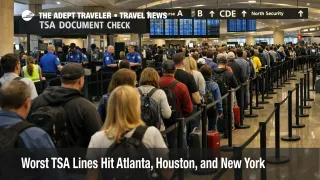
Long TSA lines across the country have stopped being a generic spring break complaint and turned into a concentrated airport by airport problem. On March 23, 2026, the worst TSA lines U.S. airports story is centered on a handful of hubs where staffing losses, checkpoint consolidation, and heavy passenger banks are colliding at once. Travelers flying out of Hartsfield Jackson Atlanta International Airport (ATL), George Bush Intercontinental Airport (IAH), the New York airport system, and Louis Armstrong New Orleans International Airport (MSY) should assume the old two hour domestic buffer is weak. The practical move now is to treat security as the first failure point, not the flight itself.
Worst TSA Lines U.S. Airports: What Changed
The change on March 23 is that the worst line problem is no longer evenly spread. Atlanta and Houston are the clearest top tier pressure points. Reuters reported that more than 40 percent of TSA officers at Atlanta failed to show up on Sunday, and the airport told passengers to arrive at least four hours early on Monday. Houston Airports issued even more concrete guidance, saying TSA wait times at IAH could exceed four hours on March 23, while standard screening was limited to Terminals A and E and checkpoints in Terminals C and D were closed.
New Orleans belongs in the next group of worst affected airports, not because it is larger than Atlanta or Houston, but because the staffing hit is severe enough to break normal departure timing. Local reporting said lines at MSY stretched into the parking garage, and DHS told reporters that New Orleans posted the highest TSA callout rate in the country on Sunday, at 42.3 percent. In New York, the security story is less clean because delays are moving hour to hour, but the system is still under heavy strain. Reuters said airports in New York were among the locations where more than one third of TSA staff were absent, and NPR found that JFK could swing from reports of hourslong delays to roughly 20 minute waits later, which is exactly why same day planning has become unreliable.
Which Airports Are Worst for Travelers Right Now
Atlanta is the most dangerous airport to underestimate. It is the biggest hub in the country by passenger flow, so a deep staffing hole there reaches beyond local travelers. When security lines stretch at ATL, the first order effect is missed departures. The second order effect is that missed domestic banks then distort onward long haul flights, crew connections, and rebooking across the Southeast. A traveler departing from a smaller city can still get caught because the weak point is the Atlanta connection, not the origin airport.
Houston is the most clearly documented same day risk. The airport itself said IAH wait times could exceed four hours, and the operational impact is broader than a long line headline suggests. Travelers also have to deal with checkpoint closures, terminal reassignment for screening, and weaker premium lane assumptions because CLEAR was not operating at IAH on Monday. William P. Hobby Airport (HOU) was under staffing strain too, but Houston's own updates suggested the worst March 23 pain was concentrated at Bush.
New York is less about one single monstrous line and more about stacked fragility. Reuters said JFK, Newark Liberty International Airport (EWR), and LaGuardia Airport (LGA) were among the airports receiving ICE support as TSA absences widened, and the same metro area was also dealing with broader operational pressure on March 23. That means a traveler can clear security in a tolerable time and still lose the day to regional disruption. New Orleans is more straightforward. It is a smaller market than Atlanta or New York, but when lines back up into landside space and staffing holes exceed 40 percent, the airport becomes a miss your flight problem much faster because travelers have fewer same day recovery options.
What Travelers Should Do Before Leaving for the Airport
For Atlanta and Houston, the threshold is blunt. If you are not at the airport about four hours before departure, you are gambling on a staffing recovery you do not control. For New Orleans, three hours is the safer floor based on local reporting, and for the New York airports, travelers should build extra time even when a current snapshot looks manageable because the pattern is unstable. The wrong move is checking one line estimate, seeing something tolerable, and assuming the airport will look the same 45 minutes later.
There are also two bad assumptions travelers should drop. First, do not assume premium products will save you. At IAH, Houston Airports said CLEAR was not operating on March 23. Second, do not assume the MyTSA style picture is current enough to trust on its own. Houston said it was manually updating wait times based on observed passenger flow and open lanes, which is a sign that local airport pages are more useful than a national rule of thumb right now.
The practical decision rule is simple. If your trip depends on a cruise embarkation, an international departure, a wedding, a fixed time meeting, or a one shot connection, rebook rather than trust a tight same day airport run. If your itinerary is flexible and your airport is not one of the worst affected hubs, watch live local conditions before moving. NPR's reporting is useful here because it shows the national picture is uneven, not universally catastrophic. Orlando and Dulles looked manageable in that sample, while Atlanta, Houston, and parts of New York swung sharply through the day.
Why the Lines Are Concentrating, and What Happens Next
The mechanism is not complicated. TSA officers are working without pay during the partial Department of Homeland Security shutdown, callouts have climbed, and more than 400 officers have resigned since February 14, 2026. DHS says nearly 12 percent of TSA officers, more than 3,450 people, did not show up for work on Sunday. That national number matters, but the traveler outcome is determined locally. When absenteeism crosses a critical point at a hub, airports start consolidating checkpoints, reducing open lanes, and shifting officers to the highest demand points. That is why Atlanta, Houston, New York, and New Orleans can look much worse than airports that are technically inside the same national crisis.
What happens next depends on whether staffing stabilizes or keeps slipping. ICE and Homeland Security Investigations officers are being used for support roles such as crowd control and line management, not full checkpoint screening, so this is not a true substitute for lost TSA capacity. That means the worst TSA lines U.S. airports problem can still deepen even with extra federal bodies in the terminal. Over the next 24 to 72 hours, watch for three signals, whether more airports move to four hour guidance, whether additional checkpoints close or consolidate, and whether the worst hubs begin posting steadier rather than wildly swinging wait times. Until that happens, travelers should assume the biggest U.S. airport security risk is concentrated, unpredictable, and still getting harder to time.
Sources
- ICE agents deployed to more than a dozen US airports amid staffing gaps, Reuters
- Government shutdown impacts TSA, passengers, Houston Airports
- George Bush Intercontinental Airport security advisory, Houston Airports
- ICE agents headed to airports as TSA shortages drive long lines, NPR via WAER
- ICE agents headed to airports as TSA shortages drive long lines, Axios New Orleans
- Long security lines at JFK as immigration officers begin assisting, News 12 The Bronx
- U.S. Airport Security Strain Nears Continuity Risk, Adept Traveler
- ICE at U.S. Airports Starts, Raising TSA Travel Risk, Adept Traveler
- Flight Delays and Airport Impacts: March 23, Adept Traveler