

Airport Security Delays Could Outlast the Shutdown
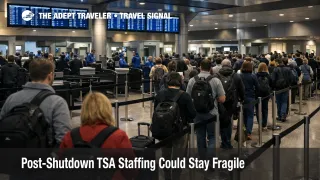
Airport security delays could last beyond the end of the federal shutdown as TSA loses officers faster than airports can rebuild screening capacity. Nearly 500 Transportation Security Administration employees have quit during the funding lapse, and that staffing loss matters after pay resumes because trained checkpoint coverage does not recover on the same timetable as federal funding. The main post-shutdown risk is uneven screening at major U.S. hubs, where thinner staffing can keep lines longer, weaken recovery from routine disruptions, and raise misconnect risk even after the political crisis ends.
Post-Shutdown TSA Staffing Is the Real Signal
The signal Adept Traveler should be watching is not just that TSA staffing worsened during the shutdown. It is that the staffing loss now looks structural enough to shape post-shutdown air travel. Reuters reported on March 26 that nearly 500 TSA officers had quit during the lapse, while AP reported the same day that the total was around 500 and that more than 3,100 TSA employees were absent on one recent day. That is already large enough to matter operationally. It suggests the damage is no longer limited to morale, headlines, or one bad week of spring break lines. It has become a real resilience problem for the screening system itself.
In an earlier Adept Traveler article, TSA Quits Raise U.S. Airport Screening Risk Before March 27, the focus was the immediate pre-payday squeeze. That story still matters, but the more useful forward signal now is what happens after funding resumes. If trained officers left for other jobs, some airports will still be screening passengers with less slack, fewer experienced staff, and less margin for the next weather event, crew crunch, or bank of late inbound flights.
That is the distinction travelers are most likely to miss. Shutdown politics can end in a vote. Screening capacity recovers through rehiring, retraining, shift stabilization, and better attendance. TSA's own careers material says the Transportation Security Officer hiring process averages about 90 days, and new officers also complete formal academy training before they fully contribute at checkpoints. Even if applicants appear quickly after funding returns, there is no instant way to rebuild experienced lane coverage.
Where Post-Shutdown Air Travel Could Stay Most Fragile
The post-shutdown effect is unlikely to hit every airport equally. The biggest exposure is at large hubs and high-throughput airports where security lines are already sensitive to small staffing losses. Reuters and AP reporting has repeatedly pointed to major pressure at Atlanta, Houston, New York area airports, New Orleans, and Baltimore, while some callout rates at specific airports have run well above the national average. Those are the kinds of airports where a thinner screening roster can keep the system brittle even after the funding fight ends.
In an earlier Adept Traveler article, Worst TSA Lines Hit Atlanta, Houston, and New York, the pressure was already visible at the checkpoint. In another earlier Adept Traveler article, Houston TSA Delays Hit IAH and Hobby on March 23, the traveler problem became more specific, weaker checkpoint access, reduced premium screening reliability, and more fragile departure timing at two busy airports. Those pieces matter for a signal article because they show where staffing losses first became operationally visible, and why some airports are more likely to suffer a long tail after funding resumes.
The most exposed travelers after a shutdown deal are the ones who assume normal schedules mean normal airport operations. That is especially risky for early morning departures, same day cruise embarkations, short domestic connections, and international itineraries that depend on fast reclearing or a clean onward bank. A checkpoint can still fail the trip even when the aircraft is on time. First order, the line stays longer than expected. Second order, passengers miss check-in cutoffs, lose separate tickets, burn hotel nights, or reach the gate after doors close.
What Travelers Should Watch After Funding Returns
The smartest post-shutdown posture is not panic. It is skepticism. Travelers should not assume that the first funding agreement restores pre-shutdown airport performance. For at least the next several weeks, airport-specific advisories, checkpoint closures, suspended wait time reporting, and unusually early arrival guidance will be more useful than generic reassurance that the shutdown has ended. If those signals continue, the staffing drag is still active.
This is also a moment to make sharper itinerary choices. Travelers with flexibility should favor nonstop flights over tight hub connections, build more ground buffer on departure day, and avoid assuming that PreCheck or premium checkpoint access will work exactly as it did before the lapse. People flying for weddings, tours, cruise departures, or same day business meetings should be more conservative than leisure travelers with slack. The post-shutdown problem is not universal collapse. It is uneven reliability, which is harder to spot and easier to underestimate.
The clearest escalation signs would be continued airport-specific checkpoint closures, multi-hour waits at major hubs after funding returns, fresh airline advisories that tell passengers to arrive far earlier than normal, or evidence that staffing support measures are still failing to restore normal throughput. The clearest stabilization signs would be shorter waits at the known pressure airports, fewer airport alerts about checkpoint consolidation, and a visible drop in absenteeism rather than only a political declaration that the shutdown is over.
Why the Recovery Could Lag After the Shutdown Ends
The mechanism is straightforward. Airport security is not just a headcount problem. It is a trained staffing problem. In an earlier Adept Traveler article, ICE At U.S. Airports Is Not Fixing TSA Lines, the central point was that support personnel can help with line management and some peripheral tasks, but they do not replace certified screening officers. That remains true after the shutdown. If the agency lost experienced staff, some lanes may reopen slowly, some shifts may stay thin, and some airports may remain more vulnerable to disruption stacking than travelers expect.
That is why the end of the shutdown could produce a misleading calm. Politically, the crisis would be over. Operationally, the system could still be working through attrition, scheduling gaps, and lagging replacements. In an earlier Adept Traveler article, U.S. Shutdown Airport Risk Shifts to Continuity, the framework had already widened from long lines to broader resilience risk. This signal takes the next logical step. It argues that post-shutdown TSA staffing may become the real traveler issue, because the recovery clock for labor and training is slower than the recovery clock for politics.
A durable recovery would mean more than back pay or a reopened government. It would mean that the airports hit hardest during the shutdown stop behaving like fragile systems. Until that happens, travelers should assume some large U.S. hubs remain in a post-shutdown adjustment phase where a routine day can still go bad faster than expected.