

United Flight Attendant Deal Cuts Summer Labor Risk
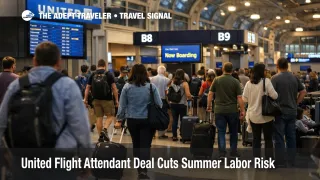
United flight attendant deal risk shifted lower on March 26, 2026, when United Airlines and the Association of Flight Attendants reached a tentative five year agreement covering roughly 30,000 flight attendants. For travelers, the near term takeaway is useful but not final. A major summer disruption threat at one of the country's largest network carriers now looks less likely, yet the agreement still must clear an April 1 union leadership vote and, if advanced, a membership ratification window running from April 23 to May 12. That leaves United itineraries in a better position than they were a day earlier, but not fully out of the labor woods.
United Flight Attendant Deal: What Changed
The confirmed change is procedural, but meaningful. United and AFA announced a tentative agreement after mediated talks in Washington, D.C. Reuters reported the package includes higher base pay, larger retroactive payments, pay for long waits between flights, tighter hotel and schedule change rules, and restrictions on overnight flying. United said the deal would bring immediate raises upon ratification, add boarding pay, and eventually lift top hourly rates to $100, with a total signing bonus pool of $740 million.
That matters because labor risk at a large hub and connecting carrier is not abstract. When cabin crew negotiations are unresolved, the threat is not only a possible strike or other labor escalation. It is also weaker planning confidence around peak season schedules, tighter recovery options when weather hits, and more uncertainty for travelers booking far ahead on complex domestic and international itineraries. A tentative agreement does not erase those risks, but it cuts the odds that United becomes a fresh labor flashpoint just as summer schedules start tightening.
This is also a real change from the union's prior path. United flight attendants voted down an earlier tentative agreement in July 2025, sending both sides back into negotiations after members said that package did not go far enough on pay and work rules. The new deal is therefore more than a routine step in bargaining. It is the first sign in months that the contract dispute may be moving toward closure rather than escalation.
Which United Travelers Benefit Most Before Summer
The biggest beneficiaries are travelers who rely on United for connection heavy itineraries through hubs such as Chicago O'Hare International Airport (ORD), Newark Liberty International Airport (EWR), Denver International Airport (DEN), George Bush Intercontinental Airport (IAH), San Francisco International Airport (SFO), and Washington Dulles International Airport (IAD). These passengers are more exposed to labor related disruption because a cabin crew problem at a network carrier tends to spread across banks of departures, onward connections, and aircraft turns rather than staying isolated to one city pair. Lower labor pressure at United preserves more schedule stability across that web.
The benefit is especially relevant because other U.S. travel stress points are already active. In an earlier Adept Traveler article, TSA Quits Push U.S. Airport Lines Higher Before March 27, the main risk was checkpoint strain rather than airline labor. In another earlier Adept Traveler article, United Flight Cuts Raise Summer Risk at O'Hare, the concern was thinner summer capacity because of higher fuel costs and network cuts. A labor breakthrough does not remove either of those issues, but it keeps United from adding a third major self inflicted disruption layer on top.
Travelers should still read this as reduced risk, not zero risk. The union's Master Executive Council must first decide on April 1 whether to send the deal to members. If that happens, full details are due April 3, virtual roadshows begin April 7, voting materials are mailed around April 13, and the ratification vote runs until May 12. If members approve it, improved pay scales and boarding pay would take effect on May 31 with the June bid period. Until then, the agreement remains tentative, and the final member response still matters.
What Travelers Should Do Now
For travelers booking United in April, May, and early summer, the practical move is to treat this as a positive signal for reliability, but not as permission to ignore the labor calendar. The next clear decision point is April 1. If union leadership advances the deal, the immediate strike pressure drops further because the dispute moves into an organized ratification phase instead of open bargaining conflict.
For existing bookings, there is no strong reason to rebook away from United solely because of cabin crew labor fears right now. That is a shift from earlier uncertainty. The better reasons to change flights remain the usual operational ones, tight connections, fragile hub routings, or summer schedules that already look thin after broader capacity cuts. Travelers connecting through Chicago O'Hare or other major United hubs should still leave more slack than usual because thinner schedules make same day recovery harder even when labor conditions improve.
What to watch next is straightforward. First, see whether AFA leadership approves sending the deal to members on April 1. Second, review the full contract details once released on April 3, especially any provisions affecting scheduling flexibility, reserve coverage, and hotel rules. Third, treat the April 23 to May 12 vote as the final confidence window. If ratification clears, United enters summer with one major labor overhang meaningfully reduced. If it stalls, the risk picture can worsen again quickly.
Why the Risk Is Lower, but Not Gone
The reason this helps travelers before summer is simple. Airline reliability depends on more than aircraft and slots. It also depends on whether crews, schedules, and operations can absorb routine shocks without an additional labor dispute sitting on top of them. A tentative agreement lowers the chance of open conflict at a moment when United is already dealing with external pressure from fuel costs, international suspensions, and a broader U.S. airport environment strained by screening problems and summer congestion.
The first order effect is lower immediate strike pressure. The second order effect is that United keeps more recovery capacity in reserve for other problems, storms, air traffic control flow constraints, hub congestion, or thin rebooking pools on busy days. That is why a labor story can matter even when no flights are canceled. It changes how much slack a carrier has when something else goes wrong.
What happens next now depends less on rumor and more on a published timeline. April 1 decides whether the agreement advances. April 3 is the first fuller detail release. May 12 is the ratification finish line. Until those dates pass, the honest read for travelers is that United has moved from active labor vulnerability toward conditional stability, which is a real improvement, but not a finished one.
Sources
- United Airlines flight attendants reach tentative five-year labor deal, Reuters
- Tentative Agreement Reached, AFA United MEC
- March 26, 2026, Tentative Agreement Reached, United Flight Attendants Contract Negotiations Website
- TSA Quits Push U.S. Airport Lines Higher Before March 27, Adept Traveler
- United Flight Cuts Raise Summer Risk at O'Hare, Adept Traveler