

United Flight Cuts Raise Summer Risk at O'Hare
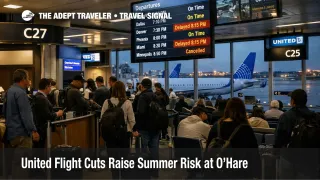
United flight cuts became a broader summer planning problem on March 20, 2026, when the airline said it would remove about 5 percentage points from planned second and third quarter capacity as jet fuel costs surged after the Iran war. Chicago O'Hare International Airport (ORD) is part of that pullback, with about one point of the reduction tied to O'Hare, while Tel Aviv and Dubai remain suspended. For travelers, the practical issue is not only a few canceled flights. It is a thinner network in Q2 and Q3 that can keep fares elevated and make same day recovery harder when weather or air traffic control problems hit.
United Flight Cuts: What Changed
The confirmed change is network wide, but it is being built from different pieces. Reuters reported that about 3 percentage points of United's reduction come from less profitable off peak flying, including some midweek, Saturday, and overnight departures. About 1 point comes from Chicago O'Hare, and another 1 point comes from the continued suspension of Tel Aviv and Dubai service. United also said it expects to restore its full schedule in the fall, which matters because this is being framed as a near term fuel response rather than a permanent retrenchment.
The fuel side is not a small move. Reuters reported on March 26 that IATA data showed global jet fuel prices had nearly doubled since the conflict began on February 28, 2026, reaching about $197 per barrel as of March 20. That cost shock is large enough to change route economics fast, especially on flights that already had weaker yields or weaker seasonal demand.
Which Travelers Face the Most Disruption
Travelers at O'Hare are exposed in a different way than travelers booked to Tel Aviv or Dubai. On the international suspension side, the impact is direct, because those routes are simply not operating. On the hub side, the problem is thinner coverage on certain days and times, which reduces schedule resilience even when a route stays on sale. That means passengers flying from O'Hare on marginal business days, lower demand weekends, redeyes, or off peak domestic banks are more likely to lose choice before they lose access entirely.
The second order effect is bigger than the flight count itself. Fewer seats can support higher fares and reduce reaccommodation options when thunderstorms, ATC flow programs, or misconnects hit a hub bank. That is the part travelers often miss. A route can still look bookable in search results while the underlying cushion has already been cut away. In an earlier Adept Traveler article, United Flight Cuts Tighten O'Hare and Hub Options this showed up as a hub flexibility problem, not only a schedule problem.
What Travelers Should Do Now
If you are holding a United summer booking through O'Hare, the main decision point is whether your itinerary depends on frequency. Nonstop passengers with multiple same day alternatives are in a better position than travelers built around the last flight of the day, a short connection, or an off peak departure. When those thinner flights disappear, recovery usually gets harder before the timetable visibly looks "bad" to casual shoppers.
Rebook earlier rather than later if your trip depends on a narrow operating window, especially for weekend returns, evening departures, or a same day international connection. Waiting can still make sense if United has not yet touched your specific flight and your trip is flexible, but that is a weaker strategy when the broader market is already using fare increases and capacity discipline to absorb fuel costs. In an earlier Adept Traveler article, U.S. Airfares Rise as Jet Fuel Shock Builds the pricing side of that squeeze was already becoming visible.
Over the next several days, watch for timetable changes rather than headline announcements alone. The useful signals are a vanished low frequency option, a retimed bank that creates a longer layover, or a route that still exists but only on stronger demand days. Travelers booking new summer trips should treat attractive off peak inventory with more skepticism than usual and avoid assuming the current schedule will survive unchanged into peak season.
Why This Is Happening, and What Comes Next
This is a classic airline math reset. Fuel is one of the industry's largest operating expenses, and Reuters reported that Scott Kirby said oil could remain above $100 a barrel through 2027, with United's annual fuel bill rising by about $11 billion at those levels. When demand is still strong, the first response is often not a dramatic network retreat. It is selective pruning of flying that cannot carry the higher cost. That preserves margins, supports higher fares on remaining seats, and lets the airline keep its longer term fleet plan intact.
What happens next depends on fuel and conflict duration. Reuters reported that United still plans to take 120 new aircraft in 2026 and expects to restore full scheduling in the fall, which argues against reading this as a structural growth reversal. But travelers should not assume summer normalization. If fuel stays elevated, the likely pattern is more selective trimming, firmer fares, and a network that looks stable on peak days but less forgiving around the edges. In an earlier Adept Traveler signal, Shutdown, Fuel Stress Threaten Flight Plans the broader warning was that resilience disappears before the trip looks broken. That remains the right way to read United's move now.