

TSA Quits Push U.S. Airport Lines Higher Before March 27
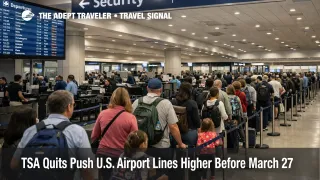
TSA airport shutdown lines across the United States have moved into a more serious phase before the March 27, 2026 pay deadline. On March 25, TSA's top official told Congress that more than 480 officers have quit since the mid February funding lapse, national absences have climbed above 10 percent, and some passengers are already waiting more than four hours to clear screening. For travelers, the problem is no longer just whether one airport has a bad morning. It is that screening reliability is breaking unevenly across the network, which raises the odds of missed check in cutoffs, forced same day rebooking, and extra hotel nights even when flights themselves still operate.
TSA Airport Shutdown Lines: What Changed
What changed on March 25 was the combination of a higher quit count, heavier spring break demand, and more explicit warnings from both TSA leadership and airport operators. Reuters reported that quits have risen above 480, travel volume is running about 5 percent above last year, and more than 30 percent of TSA workers were absent on Tuesday at airports in New York, Houston, Atlanta, and New Orleans. AP separately reported that some airports are now staffing only one third to one half of their normal checkpoint lines, which helps explain why wait times are stretching from ordinary delay territory into real itinerary failure territory.
Houston remains the clearest same day warning point. Houston Airports said on March 26 that wait times at George Bush Intercontinental Airport (IAH) could reach four hours or longer, with lines potentially extending outside. That is a direct operational warning, not a generic arrive early reminder. It means travelers on checked bag itineraries, families, and anyone departing in a tight morning or evening bank now faces a real risk of missing the flight even if road access and the airline operation hold together.
Atlanta is also under active airline flexibility measures. Delta's March 25 advisory covers travel originating from Hartsfield Jackson Atlanta International Airport (ATL) from March 23 through March 30, 2026, and allows rebooked travel in the same cabin through April 6 without a fare difference under the stated conditions. That is a sign Delta sees the screening problem as large enough to justify formal customer relief, not just airport messaging.
Which Travelers Face the Most Disruption
The most exposed travelers are people departing, not connecting, at airports where screening lanes are being consolidated. Houston is the highest profile case because the airport itself has warned of four hour lines, but Reuters' reporting shows the broader hotspot pattern still centers on Houston, Atlanta, New York, and New Orleans. In an earlier Adept Traveler article, Worst TSA Lines Hit Atlanta, Houston, and New York the pressure was already concentrated at a handful of hubs. In an earlier Adept Traveler article, TSA Quits Raise U.S. Airport Screening Risk Before March 27 the issue was fast erosion. The newer change is that the attrition count is now higher, the congressional warning is blunter, and the airport level consequences are easier to see in real time.
The practical split is simple. Travelers with TSA PreCheck, no checked bag, and a flexible fare still have options. Travelers with checked baggage, basic economy, family groups, cruise embarkations, tour starts, or expensive same day onward bookings are at much greater risk. The first order effect is a long security queue. The second order effect is that the queue breaks the rest of the day, missed baggage deadlines, lost seat assignments, blown cruise check in windows, and extra costs on hotels or ground transport that airlines may not fully absorb.
What Travelers Should Do Now
For departures from Houston, Atlanta, New York area airports, and other hubs already showing severe screening strain, the safer move is to treat security as the trip's main failure point, not the flight schedule. Travelers should build far more buffer than normal, especially when checking bags or traveling during the first major departure bank of the day. If the itinerary is discretionary and the airport or carrier has already issued a flexibility notice, a same day switch to a later flight or a next day departure can be the cleaner choice than gambling on a line that may not move fast enough.
The clearest rebooking trigger is when the airport itself warns of multi hour waits or when your airline issues a live waiver. Delta has done that for Atlanta, and Allegiant's March 23 "Travel With Confidence" policy lets customers with flights scheduled through the end of the partial shutdown change or cancel at no additional cost. If you hold an Allegiant booking, that flexibility is broad enough to justify acting before you reach the airport. If you are flying another carrier without a waiver, the calculation is harsher because long lines can still make you a no show even when the airline operates on time.
The next signals to watch over the next 24 to 72 hours are straightforward, airport advisories warning of four hour waits, new airline waivers, more reports of checkpoint consolidation, and whether Congress resolves funding before the March 27 missed paycheck lands. If those indicators worsen, overnighting near the airport before an early flight becomes more rational, especially for nonrefundable trips with cruise embarkation, international departure, or paid ground transfers on the other side.
Why This Is Happening, and What Happens Next
The mechanism is staffing, not weather. TSA cannot quickly replace trained screeners who resign, and Reuters reported that DHS has deployed other federal officers to 14 airports mainly to support operations around screening, not to restore full trained checkpoint capacity. AP reported that some airports are already functioning with only a fraction of usual screening lanes. That means the system can still look open while actually becoming much more fragile underneath, which is why airport disruption now feels uneven and unpredictable instead of uniformly bad everywhere.
What happens next depends less on whether one airport has a good or bad day, and more on whether staffing erosion accelerates after another missed paycheck. TSA leadership has already warned Congress that smaller airports could eventually face closure risk if staffing worsens further. Until that changes, TSA airport shutdown lines remain a departure day problem first, but they are increasingly becoming a network planning problem too. Travelers who act early, protect the first flight segment, and avoid tight same day chains still have room to reduce risk.
Sources
- Oversight Hearing, DHS Shutdown Impacts, TSA
- Government Shutdown Impacts TSA, Passengers, Houston Airports
- Atlanta Flexibility, Delta Air Lines
- Atlanta Flexibility Bulletin 2, Delta
- Allegiant Launches "Travel With Confidence" Policy
- Long Lines Reported at Major U.S. Airports as More TSA Officers Quit, Reuters
- TSA Boss Warns of Airport Shutdowns, AP News