

United Flight Cuts Tighten O'Hare and Hub Options
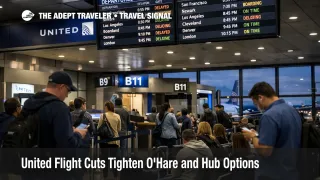
United flight cuts widened on March 20, 2026, when the carrier said it would remove about five percentage points from its planned 2026 capacity, including about one percentage point from Chicago O'Hare International Airport (ORD), while keeping Tel Aviv and Dubai suspended. For travelers, that shifts the story from fuel warning to actual schedule thinning over the next two quarters, with the biggest risk showing up in weaker dayparts, tighter hub connections, and fewer same day recovery options when something goes wrong. The immediate move is not to assume every United booking is in trouble, but to treat marginal itineraries, especially off peak connections and late day banks, as less forgiving than they looked a week ago.
United Flight Cuts: What Changed
What changed is that United has now put a number and a timetable on the pullback. Reuters reported that Chief Executive Scott Kirby told staff the airline would cancel about three percentage points of off peak flying in the second and third quarters, then remove another point of capacity from O'Hare, with the continued Tel Aviv and Dubai suspensions bringing the total reduction to about five percentage points of planned 2026 capacity. Kirby also said United currently expects to restore its full schedule in the fall, which makes this a near term operating response rather than a formal retreat from long term expansion.
The trigger is fuel, but the mechanism is network profitability. Reuters reported that United is modeling oil as high as $175.00 per barrel and above $100.00 through 2027, a scenario Kirby said could raise the carrier's annual fuel bill by about $11 billion. United's own January results showed how heavily it has been leaning into growth, with the largest mainline schedule in company history in 2025 and plans to keep taking deliveries of new aircraft in 2026, so the current cuts look targeted at weaker flying rather than a broad retrenchment.
Which Trips Lose the Most Flexibility
The biggest exposure is not every nonstop. It is itineraries that depend on schedule density. Midweek trips, Saturday flying, overnight departures, last bank connections, and smaller origin to hub to long haul itineraries are the most likely to feel the squeeze first, because those are the places where a carrier can trim capacity without abandoning its core markets. When one or two marginal frequencies disappear, the route may still be on sale, but the number of workable backup options drops fast.
O'Hare matters more than the raw one point number suggests. ORD is already in a separate summer scheduling fight, with the FAA pursuing flight reductions after airlines published more than 3,080 daily peak operations for Summer 2026, versus about 2,680 last summer. In an earlier Adept Traveler article, O'Hare Summer Flight Cuts Raise Booking Risk explained how that separate cap fight can thin connection banks and reduce recovery room. United's own pullback adds another layer of pressure for Chicago connections, because travelers could be hit both by airline network discipline and by airport level schedule limits.
The second order effect is a more brittle rebooking environment. In an earlier Adept Traveler article, United Cuts 5% of Flights as Fuel Prices Surge noted that fewer off peak flights can turn a manageable disruption into a forced overnight. That logic gets stronger if higher fuel costs also keep fares firm. In an earlier Adept Traveler article, U.S. Airfare Hikes Spread as Fuel Costs Double showed how carriers were already pushing fare increases and trimming weaker flying. Travelers starting at smaller airports, connecting through Chicago, or booking close in are the ones most likely to pay more for less slack.
What Travelers Should Do Before Summer
Travelers flying United through the end of the third quarter should stop treating thin itineraries as interchangeable. If your trip depends on a late day connection, a separate ticket, a cruise join, a wedding, or a meeting that cannot absorb a long delay, the safer move is to add margin now. That can mean a longer layover, an earlier departure, a nonstop, or an arrival the night before. The tradeoff is obvious, you may pay more or lose convenience, but you also reduce the odds that one trimmed frequency breaks the whole trip.
For O'Hare trips, do not look only at whether your current flight still exists. Price alternate banks and, when practical, alternate Chicago airport strategies before summer schedules harden further. If your booking is for June through August and you are relying on a perfect same day chain, the threshold for acting should be lower than usual because the airport itself is already under capacity pressure. Travelers who can tolerate a one to three hour retime may be able to wait. Travelers who cannot absorb an overnight or a broken international connection should move earlier.
The next thing to monitor is not only fuel. Watch for United timetable changes, fare jumps on the same city pair, and any final FAA action on ORD summer operations. Those signals will tell you whether the current pullback stays targeted or spreads into a wider schedule reset. For broader context on why fleet and schedule slack has already been under pressure, FAA Delays on Boeing 737 MAX 10 Hit Airline Capacity remains useful background.
Why the Network Is Tightening, and What Happens Next
United's message is that the airline still sees strong demand, but no longer wants to use weak flying to defend market share while fuel is this expensive. Reuters reported that the carrier has already been able to push through fare increases, and that capacity cuts are expected to support pricing power across the industry. That means the near term result is less likely to be a dramatic collapse in service than a more selective pattern, fewer marginal frequencies, firmer fares, and less spare capacity when weather or ATC problems hit a hub.
What happens next depends on whether fuel stays elevated and whether O'Hare's own summer operating limits tighten further. Reuters reported on March 20 that United expects to restore the full schedule in the fall, but that assumes the current cuts remain temporary and concentrated in weaker flying. If fuel stays high, or if ORD's summer cap materially trims hub flow, travelers should expect the practical pain to show up in reduced choice rather than mass cancellation. The system usually breaks at the edges first. This time, the edge cases are off peak departures, connection banks, and reaccommodation depth.
Sources
- United Airlines to cut more flights as it eyes oil above $100 through 2027, Reuters
- Operating Limitations at Chicago O'Hare International Airport, Notice of Meeting and Request for Information, Federal Aviation Administration
- FAA plans to reduce flights at Chicago O'Hare, cites boost in schedules, Reuters
- United Airlines Reports Fourth-Quarter and Full-Year 2025 Results, United Airlines Investor Relations