

Shutdown, Fuel Stress Threaten Flight Plans
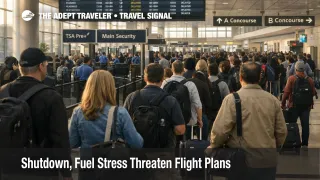
The main U.S. air travel signal for the next few weeks is not one isolated airport problem. It is the combination of a prolonged Department of Homeland Security shutdown that is still straining TSA checkpoint staffing, and a separate jet fuel shock that is making airlines raise fares, defend margins, and in some cases trim weaker flying. Taken together, those pressures create a more fragile system for domestic departures, international outbound trips that start with a U.S. connection, and inbound itineraries that still depend on a clean domestic handoff after arrival. The shutdown problem is already visible. Reuters reported overall TSA absences at 10.2 percent on March 19, with far higher rates at some hubs, while officials have warned some small airports could face checkpoint shutdown risk if another missed paycheck deepens absences.
Shutdown Fuel Stress Is Already Showing in U.S. Airports
The shutdown side of this signal is no longer theoretical. Reuters reported that 50,000 TSA officers have been working without pay, airline CEOs have warned Congress that the situation is already disrupting travel, and DHS said 366 TSA officers have left during the shutdown. On March 19, Reuters also reported airport specific absence spikes including 25 percent at New York John F. Kennedy International Airport (JFK) and San Juan, and 38 percent at Hartsfield Jackson Atlanta International Airport (ATL) and George Bush Intercontinental Airport (IAH). That is the kind of uneven staffing pattern that produces an airport by airport risk map rather than one national average story.
This is why the next few weeks matter more than a single bad spring break day. Transportation officials have warned that some small airports could soon shut checkpoints if absences worsen, and the earlier 43 day shutdown last fall ended with widespread flight disruption and an FAA ordered 10 percent flight cut at major airports. The practical point is that airport stress can escalate in stages. First order, longer security lines and closed lanes. Second order, missed departures, weaker same day reaccommodation, and more broken itineraries at airports with only a few later flights.
In an earlier Adept Traveler article, TSA Shutdown Delays Deepen at U.S. Airports tracked how this moved from a few ugly checkpoint scenes into a broader network risk. In another earlier Adept Traveler article, U.S. Shutdown Threatens Smaller Airport Closures showed why smaller fields are the next threshold to watch. Adept's earlier U.S. Global Entry Restarts as Shutdown Drags On also matters here, because it separates the restart of expedited arrivals processing from the still unresolved TSA departure problem.
Where Domestic and International Travelers Are Most Exposed
The most exposed domestic traveler is not automatically the person at the biggest hub. It is the traveler whose itinerary has no slack. That includes small airport departures, same day cruise or international handoffs, late day departures with few backup flights, and self connect itineraries where one broken segment can strand the whole trip. A two hour screening delay at a fortress hub is bad. The same delay at a small origin with one remaining departure can wipe out the itinerary.
International travelers face a double exposure. Outbound, many of them still start with a U.S. domestic departure that depends on TSA staffing holding together. That means the international ticket may be valid and the long haul flight may operate, but the trip can still fail at the first checkpoint. Inbound, the picture is somewhat better than it was earlier this month because Global Entry resumed on March 11, which restores a faster reentry path for approved travelers. But that does not solve the onward connection problem if a domestic follow on flight is tight, especially after a long haul arrival bank into a busy U.S. gateway.
Fuel stress widens that exposure. Reuters reported on March 20 that jet fuel prices have surged from roughly $85 to $90 per barrel to $150 to $200, and that airlines around the world are responding with fare hikes, outlook cuts, fuel surcharges, or flight cuts. In the United States, Reuters reported that United said fares booked over the past week were up 15 to 20 percent, that it had trimmed weaker midweek, Saturday, and overnight flights, and that Delta said it could cut capacity if fuel prices remain elevated. Reuters also reported that American and Delta each flagged roughly a $400 million first quarter fuel hit.
That is the key knock on effect for international planning. A shutdown raises the odds that the origin side of the trip breaks. Fuel stress raises the odds that the backup options cost more, operate less often, or disappear from the schedule altogether. For Europe and Asia bound travelers, the fuel issue is not just a U.S. pricing story. Reuters said many airlines in Europe and Asia face reroutings, flight cuts, and weaker outlooks, while SAS said it would cancel 1,000 flights in April. That means an already fragile U.S. origin can connect into a thinner international network on the other side.
In earlier Adept Traveler reporting, U.S. Airfares Rise as Jet Fuel Shock Builds, Europe Fuel Shock Threatens Summer Airfares, and Jet Fuel Shortage Risk Spreads Beyond Asia all pointed to the same mechanism. The cost shock starts as a fare story, then becomes a schedule and resilience story if it lasts.
What Travelers Should Do Before Conditions Tighten Further
For travel over the next few weeks, the best move is not panic rebooking. It is selective simplification. If the trip has a hard deadline, starts at a small airport, or feeds a long haul departure, the safest play is to buy more time into the itinerary now. That can mean an earlier departure, a larger origin airport, or an overnight before the international leg. If the trip is flexible and your airport has many same day frequencies, waiting can still be reasonable, but only if you are monitoring both airport specific conditions and any fare or schedule changes from the carrier.
The most important threshold is not a headline about the shutdown alone. It is whether conditions worsen after another missed paycheck. A second threshold is operational airline language. Once a carrier moves from fare action to language about network changes, weaker days of week, or schedule review, the traveler should assume the cheapest fallback options are likely to shrink first. Reuters already reported that United is trimming weaker flying and Delta is openly reserving the right to cut capacity if fuel remains high.
For international trips, the wrong assumption is that Global Entry's restart means the broader shutdown risk is solved. It is not. Global Entry helps the reentry side for enrolled travelers. It does not protect the outbound checkpoint, the domestic feeder segment, or the reaccommodation problem if a missed origin flight breaks a long haul itinerary. Travelers with tight return connections into domestic U.S. flights should either widen those buffers or prepare for the possibility of an overnight at the gateway.
Watch for four things. Watch airport specific recommendations for earlier arrival or reduced checkpoint hours. Watch for another rise in TSA absence rates. Watch for airline schedule trims on weaker domestic flying, because that is where fuel stress often shows up before broader cuts. And watch international fare ladders, because a sharp jump in backup pricing is often the first sign that capacity has become less forgiving even before the airline posts a formal cancellation notice.
Why This Pattern Could Broaden Over the Next Few Weeks
The mechanism is what makes this a real Travel Signals story. On their own, TSA staffing strain and higher jet fuel prices are serious but separate problems. Together, they attack different layers of the same trip. The shutdown pressure hits the front end of travel, getting through security and into the system at all. Fuel stress hits the back end, the price and resilience of the network once you are in it. That is why the result can feel worse than either story in isolation.
The reason this could spread is simple. Spring demand is already high. Reuters reported airlines expect 171 million passengers during the two month spring travel period, up 4 percent from a year earlier. At the same time, the U.S. market was already relatively tight before the fuel shock, with ultra low cost carriers cutting capacity and larger carriers benefiting from firmer pricing. When a high demand period meets unstable checkpoint staffing and more expensive flying, the system loses recovery margin. Flights may still operate, but the traveler has fewer good alternatives when anything slips.
The pattern could still stall. If the shutdown ends quickly, TSA staffing may stabilize before the next pay shock compounds attrition. If fuel prices ease, some of the pressure on fares and weaker routes could soften before airlines make deeper schedule decisions. But that is not the base case travelers should plan around today. The signal right now is a narrower margin for error, especially for origin airports with thin service, premium international itineraries built on domestic feed, and travelers who are still trying to make tight same day connections work in a system with less slack than it had a few weeks ago.