

U.S. Visa Bond Expansion Adds 12 Countries April 2
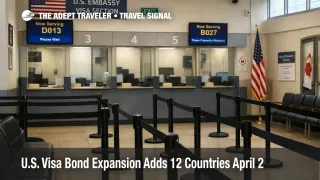
U.S. visa bond expansion reaches 50 countries on April 2, 2026, adding a new cash and timing hurdle for some visitors planning business or leisure trips to the United States. The newly added countries are Cambodia, Ethiopia, Georgia, Grenada, Lesotho, Mauritius, Mongolia, Mozambique, Nicaragua, Papua New Guinea, Seychelles, and Tunisia. For affected travelers, the practical move is to hold off on locking in nonrefundable flights, hotels, or tours until the visa interview determines whether a bond applies, and at what amount.
U.S. Visa Bond Expansion: What Changed on April 2
The State Department's live country list shows those 12 countries joining the bond program on April 2, 2026, taking the total covered pool to 50 countries. Reuters reported the expansion as a $15,000 requirement, but the current State Department page says otherwise eligible B1 and B2 applicants from covered countries may be assigned a bond of $5,000, $10,000, or $15,000 at the visa interview. The Federal Register rule adds another useful detail, consular officers are generally expected to start at $10,000, move down to $5,000 when circumstances support it, or up to $15,000 when they judge a higher amount necessary.
That difference matters operationally. Travelers should treat $15,000 as the worst case cash exposure, but they should not assume every affected applicant will be assigned the top amount. The bond also does not guarantee visa issuance, and applicants are told not to pay anything unless a consular officer directs them to do so through Pay.gov with Form I-352. In an earlier Adept Traveler article, U.S. Visa Bond Routing Rules Catch Air Travelers explained that the payment is only one part of the compliance chain.
Which Travelers Face the Most Booking Friction
This expansion applies to B1 and B2 visitor visa applicants traveling on passports from the 12 newly added countries. In plain terms, that means some leisure travelers, family visitors, conference attendees, and small business travelers now face a larger upfront liquidity test before they can finalize a U.S. trip. The bond is refundable if the traveler complies with the visa terms, does not travel before the visa expires, or is denied admission at the port of entry, but the money still has to be tied up first.
The first order effect is straightforward, some trips become harder to finance. The second order effect is where the travel damage spreads. A traveler who cannot know in advance whether the interview will produce a $5,000, $10,000, or $15,000 bond is less likely to commit early to airfare, hotel deposits, tours, wedding travel, or event based itineraries. That uncertainty can shorten stays, delay bookings, or push marginal demand toward other destinations with lower upfront entry friction. In an earlier Adept Traveler article, U.S. Visa Vetting Expands for More Nonimmigrant Classes the pressure point was added screening time. Here, the pressure point is cash, itinerary design, and compliance risk.
What Travelers Should Do Before Booking
Affected travelers should treat the visa interview as the real decision point, not a formality after flights are booked. The safest sequence is to attend the interview first, wait for the consular officer's bond decision, confirm the amount and payment instructions, and only then commit to major nonrefundable trip costs. Anyone traveling for a fixed event, a cruise, or a multi city U.S. itinerary should also budget extra time, because the Federal Register rule says a bond generally must be posted within 30 days of interview to overcome the initial refusal under INA 221(g).
Travelers who do move forward should also check routing carefully. The State Department says visa bond holders must enter and exit through commercial air ports of entry, including CBP preclearance locations, and may not use charter air, general aviation, land, or sea ports. That means flexible North American itineraries that rely on overland exits to Canada or Mexico, private aviation, or cruise departures from the United States can break even after the visa is issued.
The best threshold for waiting versus booking is simple. If the trip depends on tight dates, low cash reserves, or nonrefundable components, wait until the interview result is clear. If the traveler has sufficient liquidity to absorb a higher bond and the trip can still work with an air only entry and exit plan, then booking after the interview becomes more defensible.
Why the Program Is Growing, and What Happens Next
The pilot program was set up to test both operational feasibility and whether bonds can reduce B1 and B2 overstays. The Federal Register says covered countries are chosen based on high overstay rates, deficient screening and vetting information, or certain citizenship by investment concerns, and State says the list can be amended during the pilot with at least 15 days' notice before a new addition takes effect. Reuters also reported a State Department official saying the administration sees the program as successful at reducing overstays.
For travelers, what happens next matters as much as the April 2 expansion itself. The current pilot runs for 12 months from its August 2025 start, but bonds posted during that window can remain in force until canceled or breached. The next signals to watch are whether more countries are added, whether consular practice clusters around $10,000 or shifts upward more often, and whether more travelers start facing trip design problems because of the commercial air only routing rule. That is what turns the U.S. visa bond expansion from an immigration headline into a booking and cancellation story.