

U.S. Visa Online Vetting Widens March 30
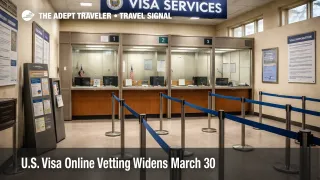
U.S. visa online vetting expansion takes effect on March 30, 2026, and it reaches a wider pool of travelers than the earlier student, exchange visitor, and H-1B rounds. The State Department said applicants in A-3, certain C-3 domestic worker cases, G-5, H-3, H-4 dependents of H-3, K-1, K-2, K-3, Q, R-1, R-2, S, T, and U classifications will now face online presence review, and those applicants are instructed to set social media accounts to "public" or "open." The immediate consequence is not a published visa shutdown or a formal new wait-time rule. It is a broader screening step that can lengthen preparation, complicate interview readiness, and make fixed-date trips more fragile if travelers keep booking against older assumptions.
U.S. Visa Online Vetting: What Changes on March 30
The operational change is scope. Starting March 30, the State Department expands online presence review to a new set of nonimmigrant visa classes, on top of F, M, and J student and exchange visitor applicants and the H-1B and H-4 applicants already covered. The Department also says applicants in all covered classes should make social media profiles public or open to facilitate vetting.
In plain English, the newly covered group includes domestic employees tied to diplomats or international organization staff in A-3, certain C-3, and G-5 categories, H-3 trainees and their H-4 dependents, K visas for a U.S. citizen's fiancé(e), children, or spouse, Q cultural exchange visitors, R religious workers and their family members, S informants and related family cases, T visas for victims of severe human trafficking, and U visas for victims of certain criminal activity. The State Department's visa directory identifies Q as international cultural exchange, R as religious work, H-3 as training not primarily for employment, U as victim of criminal activity status, and T as victim of human trafficking status. State's public visa pages also describe K-1 as the fiancé(e) route and K-3 as the nonimmigrant visa for the foreign-citizen spouse of a U.S. citizen.
Who Needs More Time Before Travel
The travelers with the most exposure are the ones building around hard dates. That includes couples trying to enter the United States for a wedding, families timing reunification around school or work calendars, religious workers with scheduled start dates, trainees entering fixed programs, and applicants in T or U related cases where travel timing can already be constrained by legal, safety, or support needs.
The seriousness here is structural friction, not an announced blanket slowdown. The State Department did not publish new interview capacity rules or processing-time estimates with the March 25 notice. But when a case now requires document review plus digital profile review, the weak point shifts. The first order effect is more pre-interview work, because applicants need to make accounts accessible and make sure the online record does not conflict with the application. The second order effect is trip fragility. Flights, ceremonies, start dates, conference appearances, and onward domestic bookings become more exposed when travelers assume the interview remains mostly a paperwork step.
This also lands on top of other U.S. entry frictions already building this month. In an earlier Adept Traveler article, U.S. Visa Bonds Add 12 Countries for April 2, the pressure point was cash and eligibility for some visitor visa applicants. This March 30 change hits a different lane, because it widens compliance and timing risk across family, work, cultural, religious, and humanitarian visa paths.
What Travelers Should Do Before Booking
Anyone interviewing on or after March 30 should treat the date as a real workflow cutoff. The practical move is to review every social account that could reasonably be associated with the applicant, follow the State Department instruction to make profiles public or open, and check that names, employment history, program details, relationship status, and trip purpose line up with the visa application and supporting documents. If the trip depends on a clean, fast issuance, applicants should assume the safest sequence is visa readiness first, nonrefundable travel second.
The booking threshold is straightforward. If the itinerary breaks when the visa does not issue on the expected timeline, keep flights, hotels, transfers, and event payments flexible until the visa is issued. That matters most for wedding travel, school or training intake dates, tours with fixed starts, cruises with hard embarkation windows, and domestic connections inside the United States that would be expensive to rebuild at the last minute. State's own K visa materials have long warned applicants not to make final travel plans before the visa is actually issued, and that warning becomes more relevant as U.S. visa online vetting expands again.
Sponsors, employers, religious organizations, and U.S. hosts should also stop treating interview preparation as an applicant-only task. When the traveler's online profile, timing, and purpose of travel all need to align cleanly, the strongest cases are usually the ones where the applicant and the U.S. side are working from the same facts and timeline before interview day.
Why This Is Broadening, and What Happens Next
The State Department says it uses all available information in screening and vetting to identify applicants who may be inadmissible, including those considered threats to U.S. national security or public safety, and it says every visa adjudication is a national security decision. That is the official rationale for the broader online presence review. The practical mechanism is simpler. More visa classes are now being pulled into the same screening architecture that had already been expanded in 2025 for students, exchange visitors, H-1B workers, and H-4 dependents.
What happens next depends on details the Department has not yet published. The biggest unknowns are how consistently embassies and consulates apply the expanded review, whether some posts begin moving more slowly than others, and whether more classifications are added later. For now, travelers should not read this as a blanket stop on U.S. visa issuance. They should read it as a process change with real timing consequences. For anyone in the newly covered pool, U.S. visa online vetting is now part of trip planning, not just a consular back-office step.
Sources
- Announcement of Expanded Screening and Vetting for Visa Applicants
- Announcement of Expanded Screening and Vetting for H-1B and Dependent H-4 Visa Applicants
- Directory of Visa Categories
- Immigrant Visa for a Spouse or Fiancé(e) of a U.S. Citizen
- Nonimmigrant Visa for a Spouse (K-3)
- Visas for Diplomats and Foreign Government Officials
- Visas for Employees of International Organizations and NATO
- U.S. Visa Vetting Expands for More Nonimmigrant Classes
- U.S. Visa Bonds Add 12 Countries for April 2