

Philippines Flight Grounding Risk Hits April Plans
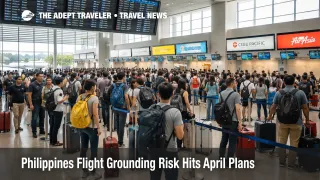
The Philippines flight grounding risk is no longer just a fuel price story. President Ferdinand Marcos Jr. said on March 24, 2026 that grounding planes because of jet fuel shortages is a "distinct possibility," after the government declared a national energy emergency and officials said the country had about 45 days of fuel reserves at current consumption levels. For travelers, that moves the decision point into April planning, especially on itineraries that depend on domestic or regional links through Manila and Cebu. Travelers with multi city Philippines trips, thin connection windows, or nonrefundable onward bookings should favor simpler routings and watch for schedule changes before waiting for last minute waivers.
Philippines Flight Grounding Risk: What Changed
What changed is the level of official language. Earlier fuel disruption coverage was mostly about higher costs, longer supply chains, and the possibility that airlines would start protecting margins. The Marcos warning pushed the story into explicit operational risk, and the national energy emergency gave Manila broader tools to secure fuel and manage distribution. That does not mean a nationwide grounding is imminent, but it does mean the government is publicly treating aviation disruption as a live contingency rather than a remote scenario.
The mechanism matters. Reuters reported that some countries told Philippine airlines they could not refuel there, forcing operators to carry fuel for both outbound and return sectors in some cases. That raises weight, narrows network flexibility, and can make marginal routes less attractive to keep flying at full frequency. It also shifts the pressure from one bad day of delays to a slower schedule problem, where carriers trim thinner routes first, protect stronger core markets, and leave travelers with fewer same day recovery options.
Which Travelers and Routes Look Most Exposed
The airlines with the clearest published exposure so far are Cebu Pacific and Philippine Airlines, because both have already moved from warnings to schedule changes. Cebu Pacific announced temporary network adjustments, including route suspensions and frequency reductions from April into October 2026, while Philippine Airlines said on March 26 that it was making schedule adjustments and suspending five routes from Cebu and Clark. That makes travelers starting outside Manila more exposed, because secondary hubs usually have less rebooking depth when frequencies come out of the system.
Cebu Pacific's published cuts show where the stress is hitting first. Search results for the carrier advisory show suspensions on Davao to Bangkok Don Mueang and Iloilo to Bangkok Don Mueang, plus reductions on selected international flying such as Manila to Jakarta. Philippine Airlines' published adjustments point to Cebu and Clark, including Cebu to Guam, Cebu to Ho Chi Minh City, Cebu to Calbayog, Cebu to Ozamiz, and Clark to Del Carmen, Surigao del Norte. PAL has also separately said it has secured sufficient jet fuel for scheduled operations for the foreseeable future, while Cebu Pacific said it had fuel secured through the end of April and was working on May and beyond. The right read is not that one carrier is safe and the other is not. It is that both are trying to preserve the core network while trimming weaker edges first.
That matters most for four traveler groups. First, domestic travelers using Cebu or Clark as feeders into long haul departures face more misconnect risk if one short domestic leg disappears. Second, regional leisure travelers heading to Thailand, Vietnam, Indonesia, Guam, or island destinations have thinner backup options once frequencies are cut. Third, travelers connecting onward through Gulf linked networks remain vulnerable because the same Middle East conflict is also disrupting refueling and hub reliability elsewhere. Fourth, late bookers can get hit twice, first by fewer seats, then by higher fares or surcharges as carriers protect margins. In an earlier Adept Traveler article, Philippines Fuel Preservation Raises Transport Risk the warning was that the country had moved into fuel preservation mode. The new airline schedule actions now make that risk more concrete.
What Travelers Should Do Now
Travelers should treat April and early May itineraries differently depending on trip complexity. If the trip is a simple point to point journey on a major trunk route, waiting can still be reasonable because the largest carriers are trying to protect core flying. If the itinerary depends on Cebu or Clark connections, a secondary domestic segment, or a same day handoff to an international departure, the safer move is to reduce connection complexity now, even at a slightly higher fare.
The main rebook sooner threshold is operational, not emotional. Rebook sooner if your trip includes one of the already affected city pairs, if your booking sits on a low frequency route, if you have a same day cruise, tour, or long haul departure after a domestic feeder, or if the only alternatives would require an overnight hotel if one leg is cut. Wait a bit longer only if you are on a high frequency trunk route, can tolerate an extra night, and are traveling on a ticket with decent change flexibility. Travelers should also avoid assuming a fuel crunch will look like a dramatic one day shutdown. More often, it shows up as compressed schedules, fewer frequencies, and harder rebooking.
The most useful signals to monitor over the next 24 to 72 hours are published airline advisories, additional route suspensions from Cebu, Clark, or secondary regional airports, new fuel surcharge filings, and any government update on reserve levels or secured replacement supply. A second signal is whether more carriers start talking about tankering fuel or preserving supply beyond April. A third is whether route cuts move from selected international leisure markets into broader domestic flying. In an earlier Adept Traveler article, Vietnam Flight Cuts Watch Expands Across Asia the key warning was that Asia's fuel problem was spreading from prices into published flying. The Philippines now looks further along that same path, even if a full grounding still remains a contingency rather than the base case.
Why This Is Happening, and What Comes Next
The bigger issue is not just that fuel is expensive. It is that the Middle East conflict has disrupted energy flows, refueling access, and aviation buffers across a region that depends heavily on imported fuel. IATA said jet fuel prices had nearly doubled since the conflict began on February 28, 2026, reaching $197 per barrel for the week ending March 20. For carriers, that means higher direct costs and less room to absorb operational inefficiency. For governments like the Philippines, it means a national supply problem that spills into aviation because planes cannot simply switch to another energy source or wait out a short squeeze without schedule consequences.
What happens next depends on whether Manila can stabilize supply faster than airlines have to keep trimming. The government has said it is trying to secure extra oil, including through talks involving sanctioned producers, and it has activated emergency funding to strengthen fuel security. That could reduce the probability of broader groundings if replacement barrels arrive in time. But travelers should not confuse national level intervention with immediate network normalization. Airlines can keep cutting marginal routes even while the state improves the overall supply picture, because rebuilding schedule confidence usually lags behind the headline announcement that fuel has been secured.
Sources
- Philippine president says grounding planes due to fuel shortage a 'distinct possibility', Bloomberg News reports
- Philippines declares energy emergency over Middle East conflict risks
- Philippines says it is working with Washington to obtain oil from U.S.-sanctioned countries
- Philippines launches $333 million fund to boost fuel security
- Middle East Conflict Exposes Jet Fuel Supply Vulnerabilities
- Network Adjustments Due to Middle East Crisis
- PHILIPPINE AIRLINES ON JET FUEL SUPPLY
- News and Events, travel advisory
- Philippines Fuel Preservation Raises Transport Risk
- Vietnam Flight Cuts Watch Expands Across Asia