

Vietnam Flight Cuts Watch Expands Across Asia
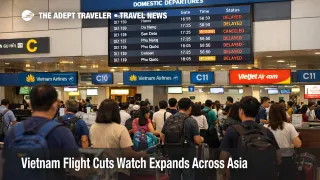
Vietnam is no longer just dealing with higher fuel costs. It is openly preparing for possible flight reductions from April after its aviation regulator warned that expected jet fuel supply may fall short, with China and Thailand halting exports and domestic refineries unable to raise output enough to close the gap. For travelers, that turns a market story into a timetable risk, especially on domestic and multi city itineraries that depend on short feeder flights into Hanoi, Ho Chi Minh City, Da Nang, and island markets. The immediate practical move is to simplify April routings where possible, avoid tight same day self connects, and watch for the first published cuts on domestic networks.
The important change since earlier coverage is scope. Vietnam still looks like the first aviation system openly bracing for schedule reductions, but the surrounding evidence now points to a wider Asia jet fuel squeeze rather than an isolated local procurement problem. Reuters reported that China has imposed a temporary ban on refined fuel exports, while Thailand and other regional suppliers have limited exports as governments try to protect domestic energy security.
Vietnam Flight Cuts: What Changed
What changed is that Vietnamese authorities are now treating reduced flying as a live contingency, not just a pricing headache. Reuters reported that the Civil Aviation Authority of Vietnam warned airlines to reassess schedules for April, with special concern around domestic flying, and asked airports to prepare for added aircraft parking if airlines need to trim operations. Vietnam's government outlet also said the regulator sees a risk of aviation fuel shortages from the start of April 2026 and has floated relief measures such as tax cuts, slot-use exemptions, and possible fuel surcharges on domestic tickets.
That matters because domestic flying is usually where cuts appear first when fuel is tight. Short haul domestic sectors are easier to trim than politically and commercially important long haul international services, and they are also the flights many travelers use to stitch together broader Vietnam itineraries. If even a modest number of those sectors are removed, the damage spreads fast into missed onward connections, weaker same day transfer options, and harder hotel sequencing. Adept covered the first stage of that risk in Vietnam Jet Fuel Warning Puts April Flights at Risk, but the new signal is that Vietnam now looks more like a lead indicator for regional stress than a one country outlier.
Which Southeast Asia Itineraries Look Most Exposed
The most exposed travelers are not necessarily long haul passengers on one simple round trip. The bigger risk sits with travelers whose plans depend on multiple flight segments inside Vietnam or across nearby Southeast Asia, especially where one domestic sector feeds an international departure later the same day. Domestic links into Hanoi Noi Bai International Airport (HAN), Tan Son Nhat International Airport (SGN), and Da Nang International Airport (DAD) are the first places to watch, because those airports function both as local gateways and as connection points into longer international journeys.
Island and leisure itineraries are also vulnerable. If carriers protect trunk routes first, thinner domestic leisure services and lower frequency regional links become easier candidates for reductions. That does not automatically mean mass cancellations, but it does mean travelers heading to places that rely on one or two daily flights have less recovery room if a schedule changes. The same logic applies to multi stop trips that combine Vietnam with Cambodia, Thailand, Singapore, or Malaysia on separate tickets. When fuel stress starts as a domestic cut, the second order effect is often not a headline airport shutdown, but a broken chain of smaller timed connections.
There is also a broader regional clue here. Reuters reported that China's export ban and Thailand's curbs are part of a wider tightening in Asia, with refiners in India and Japan becoming more hesitant exporters and Singapore supplies also easing for Vietnam. That means travelers should stop treating this as only a Vietnam story and start watching other import dependent markets for the same sequence, fuel stress, then airline warnings, then selective timetable cuts. That same progression is already visible in related fare and schedule coverage such as Middle East Fuel Spike Lifts Qantas, SAS, Air NZ Fares and Air New Zealand Cuts 1,100 Flights Through Early May.
What Travelers Should Do Before April Schedules Move
Travelers with April Vietnam trips should make the itinerary simpler before the airlines do it for them. The best move is to reduce unnecessary same day domestic to long haul connections, especially on separate tickets, and to build at least one overnight buffer before an international departure if the trip depends on a domestic feeder. That costs time, but the tradeoff is straightforward, one extra hotel night is usually cheaper than losing a long haul ticket chain. Travelers with fully flexible fares or strong alliance protection can afford to wait longer than self connecting leisure passengers.
For booking decisions, the threshold is whether the trip depends on low frequency sectors or a tightly timed domestic connection. If yes, reprice a simpler routing now, even if it costs a bit more. If the trip is a nonstop international in and out of Hanoi or Ho Chi Minh City, the immediate risk is lower, though not zero, because domestic reductions can still consume rebooking capacity if irregular operations hit later. Travelers should also avoid assuming that a ticket on sale today means the operating pattern is safe through April, because fuel shortages often hit the timetable only after airlines and regulators decide which services to protect.
The next official signals to watch are clear. First, any published domestic schedule trims by Vietnam Airlines, VietJet, Bamboo Airways, or Pacific Airlines. Second, further government or regulator language about "essential routes," slot exemptions, airport parking plans, or tax and surcharge measures. Third, signs that another import dependent country moves from price warnings to explicit airline conservation measures. Once officials start framing fuel allocation around essential flying, the squeeze has moved from a cost problem into an operational rationing problem.
Why Asia Jet Fuel Stress Could Spread Beyond Vietnam
The mechanism is simple, and that is why this deserves attention beyond Vietnam. China has been a major swing supplier of refined fuel in Asia, and Reuters reported that its temporary export ban has tightened diesel and jet fuel markets across the region at the same time that Gulf supply disruption, high prices, and refinery stress are already reducing flexibility. Thailand's export limits matter because they remove another nearby source, while Vietnam's own government has acknowledged that domestic refiners cannot materially raise output enough to fully offset the expected gap.
That is why Vietnam matters as a lead indicator. It imports a large share of its jet fuel, and Reuters reported that about 60 percent had previously come from China and Thailand. When a country with that profile begins warning airlines to prepare for cuts, other import dependent markets should watch closely, especially where tourism relies on domestic aviation to connect resort areas and secondary cities to long haul gateways. The first order effect is fewer flights. The second order effect is wider trip fragility, because the remaining flights become more valuable, less flexible, and harder to replace when anything else goes wrong.
What is still not confirmed is whether other Southeast Asian countries will publish explicit flight reduction plans in the next few days. That line has not yet been crossed publicly in the same way Vietnam has crossed it. But the official signals that would mark escalation are now visible enough for travelers to act before the timetable damage is obvious. Fuel stress becomes a travel story when airlines start protecting core routes, parking aircraft, or trimming low yield frequencies. Vietnam is now close enough to that line that the rest of the region deserves scrutiny.
Sources
- Vietnam braces for flight cuts from April after China, Thailand ban jet fuel exports
- China's fuel export ban to further tighten Asia supply
- China orders immediate ban on March fuel exports, sources say
- Cục Hàng không: Đề xuất phụ thu nhiên liệu vào giá vé máy bay nội địa
- Ngành hàng không họp bàn giải pháp tiết kiệm nhiên liệu, tối ưu chi phí
- Bộ Công Thương khuyến khích làm việc từ xa để tiết kiệm nhiên liệu