

Philippines Fuel Preservation Raises Transport Risk
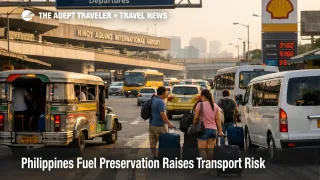
The Philippines has moved from fuel price pain into fuel preservation mode, and that changes the travel problem. On March 22, 2026, the Department of Energy said it would allow temporary, limited use of Euro II fuel for older vehicles, traditional jeepneys, power plants, generators, and marine and shipping sectors to help maintain fuel supply. For travelers, the immediate issue is not a nationwide shutdown. It is that the government is now protecting transport continuity with a lower fuel standard, which signals that domestic mobility and backup systems are under more strain than normal.
Philippines Fuel Transport Risk: What Changed
What changed is the threshold of the response. Governments can absorb higher fuel prices for a while through subsidies, tax relief, and political pressure management. Allowing temporary use of dirtier Euro II fuel is different. It is a supply preservation measure meant to keep enough fuel moving through parts of the transport system that matter for daily mobility and core services. Reuters reported that the DOE limited the measure to model year 2015 and older vehicles, traditional jeepneys, power plants and generators, and the marine and shipping sectors, while requiring segregation from cleaner Euro IV fuel across storage, transport, and retail systems.
That matters because the pressure point in the Philippines is rarely just the flight. It is the chain around the flight, the road transfer to the airport, the van to the port, the ferry between islands, or the hotel and airport operating on backup power when conditions deteriorate. A transport system can keep functioning on paper while still becoming less reliable for visitors trying to move on fixed timelines. The change here is not only higher cost. It is a public signal that the government wants more flexibility to keep essential movement going under fuel stress.
The move also lands after visible stress in the road transport sector. Reuters reported that thousands of jeepney drivers protested last week as local diesel prices more than doubled, cutting daily earnings sharply and forcing Manila to use measures such as fuel subsidies, shorter work weeks, and emergency tax relief powers. In an earlier Adept Traveler article, Philippines Transport Strike Hits Manila Airport Access tracked how that pressure had already started spilling into airport access and surface transfer reliability.
Which Travelers and Routes Are Most Exposed
The most exposed travelers are the ones stacking domestic segments with little slack. That includes visitors flying into Manila, Cebu, or other gateways and then continuing by jeepney, van, bus, or ferry on the same day. It also includes travelers heading to islands where marine transport and local generators are part of the normal operating environment, because those are now among the sectors explicitly covered by the preservation measure. If a trip depends on several low margin handoffs instead of one clean airport to hotel transfer, the risk rises first there.
Urban travelers are exposed differently from island travelers. In Metro Manila, the weak link is still surface movement, especially when higher diesel prices squeeze jeepney operations and push more travelers into buses, private transfers, and other road options. Outside the capital, the bigger issue is whether domestic transport and hospitality systems can keep normal timing when marine sectors and generators are being brought under a fuel flexibility regime. That does not confirm ferry cancellations or fuel rationing for tourists. It does mean travelers should stop assuming that domestic connections will recover as smoothly as international arrivals.
Island itineraries deserve the most caution. The Philippines is an archipelago, so a fuel stress story spreads through boats, feeder roads, resort transfers, and backup power more easily than in a single corridor destination. First order, operators face a harder fuel environment. Second order, transfer timing gets shakier, especially where travelers are trying to connect an airport arrival to a same day port departure or a late evening hotel check in. In an earlier Adept Traveler article, China Fuel Export Ban Raises Asia Travel Risk the Philippines was already on the regional watchlist because of fuel supply dependence and rising pressure before this latest DOE step.
What Travelers Should Do Now
The immediate move is to simplify domestic connections, not just to leave a little earlier. If you are arriving internationally and continuing onward inside the Philippines, avoid thin same day links between airport, ferry terminal, and final island destination. An overnight near the gateway is now a stronger choice than a tightly stacked transfer chain, especially when the trip depends on surface transport you do not control.
The rebook versus wait threshold is fairly clear. Rework the itinerary now if a missed road or ferry segment would cause you to lose a high value booking, such as a liveaboard departure, fixed resort check in on a remote island, or a multi island route with no late backup sailing. Wait, but monitor closely, if your trip is centered on one major city with flexible hotel timing and no same day sea crossing. The right tradeoff is no longer just price. It is whether one delayed domestic segment breaks the whole trip.
Over the next 24 to 72 hours, watch for three signals. The first is any broader government or operator language about preserving fuel for priority sectors. The second is fresh transport action from jeepney or other driver groups if diesel costs keep rising. The third is evidence that marine schedules, local transfers, or generator dependent operations are being adjusted rather than merely priced higher. If those signals multiply, Philippines fuel transport risk becomes less about inflation and more about whether domestic timing can still be trusted.
Why the Philippines Is Preserving Fuel Supply
The mechanism is straightforward. The Philippines relies heavily on Middle Eastern oil, and Reuters reported that the current shock has already pushed Manila into mitigation mode through subsidies, tax relief powers, and talks with other Asian countries over possible supply arrangements. When a country that depends on imported fuel starts widening technical flexibility for parts of its transport system, it is trying to preserve continuity before shortages or operating cuts become harder to manage.
Euro II itself is not the traveler story. What it represents is the traveler story. The cleaner Euro IV standard remains in force, but Manila is now making room for specific sectors to use a more accessible fallback option. That helps explain why the risk is uneven rather than absolute. Major airports can remain open while local mobility grows patchier around them. Ferries can keep sailing while schedules become less forgiving. Hotels can stay operational while backup systems become more expensive or harder to run.
What happens next depends on whether the government can stabilize supply faster than price and logistics stress spread through domestic transport. President Ferdinand Marcos said on March 22 that the government was in talks with several Asian countries about supply arrangements, while Reuters also reported the Philippines is set to import Russian oil this month for the first time in five years. That means the next phase is not only about pump prices. It is about whether those supply efforts reduce Philippines fuel transport risk before domestic operators start cutting reliability in ways travelers can feel.