

Poland Border Checks Extend Through October 2026
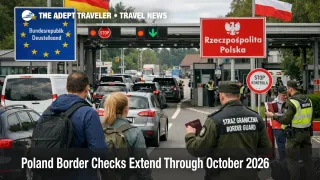
Poland border checks are now a practical autumn planning issue for central Europe trips, not just another migration policy headline. The European Commission's Schengen portal now lists Poland's temporary internal border controls with Germany and Lithuania from April 5, 2026, through October 1, 2026, and Reuters reported the extension on March 28. For travelers, the direct consequence is simple: road, coach, and some rail journeys that depend on fast cross border movement need more slack, especially when they connect to airport departures, fixed hotel check in windows, or same day onward transport.
Poland Border Checks: What Changed
The concrete change is the duration. Poland's controls were already in place, but the new notification keeps them active for another six months at the land borders with Germany and Lithuania, carrying them through the main spring, summer, and early autumn travel window rather than ending in early April. The European Commission lists the stated reason as continued threats to public security and order linked to persistent migratory pressure on those routes.
For travelers moving overland inside Schengen, that means the old assumption of frictionless crossings is less reliable on these corridors. Not every car, bus, or train will be held, and the likely effect is usually delay rather than denial, but the operational risk is the small stop that breaks the rest of the day. A coach arriving 20 or 30 minutes late can be the difference between making a low cost flight, a non refundable rail connection, or a last hotel check in window.
Which Central Europe Trips Face the Most Friction
The most exposed travelers are people crossing by rental car, private car, long distance coach, or international rail on Poland Germany and Poland Lithuania routes, especially when the border crossing is only one piece of a tighter itinerary. Same day airport transfers, self drive loops, budget airline departures from a neighboring country, and multi country rail trips are the weak points because they have the least recovery room if a routine stop stretches longer than expected.
Document risk matters too. Under normal Schengen conditions, many travelers get used to treating internal borders as invisible. But the EU's Your Europe guidance says that when a Schengen country applies temporary internal border controls, EU nationals must be able to show a valid passport or national ID card. Non EU travelers still need their valid passport and any status documents relevant to their stay. In practice, that means documents should stay accessible in your day bag or car, not buried in checked luggage or packed deep in the trunk.
This change also matters for travelers who think the pressure point is only the border itself. First order, checks can add delay at the crossing. Second order, that delay spreads into missed bus connections, later hotel arrivals, disrupted airport handoffs, and thinner rebooking options when the trip was built around tight timing. In an earlier Adept Traveler article, Germany Border Checks Extend, Hit Rail and Road Buffers, Adept flagged the same timing problem from the German side of the border. The extension by Poland now reinforces that risk from both directions on one of central Europe's busiest overland corridors.
What Travelers Should Do Before Crossing
Travelers should treat these crossings as buffer zones through October 1, 2026. For airport runs, same day international rail connections, and fixed time tours, build margin into the segment before the border, not after it. On low slack itineraries, an extra hour is a reasonable baseline starting point for road or coach transfers that depend on crossing from Germany or Lithuania into Poland, or the reverse, because the cost of missing the next leg is usually much higher than the cost of arriving early.
Carry the documents that match your status, and keep them immediately reachable. EU and Schengen nationals should have a valid passport or national ID card. Non EU travelers should have a valid passport, and where relevant, proof of lawful stay or onward travel that supports their Schengen position. Families should make sure children have their own valid documents as well. This is not new immigration law, but it does restore the practical need to prove identity at an internal border that many travelers no longer expect.
The decision threshold is straightforward. If your itinerary depends on a tight same day airport departure, a fixed coach to another country, or a rail segment with poor reaccommodation options, rework the day now rather than hoping the crossing is smooth. If your schedule is flexible, the better move is to keep the plan but avoid stacking the border with other no slack commitments. For wider regional planning context, Schengen Internal Border Checks Widespread In Late 2025 remains useful because Poland is part of a broader pattern, not a one off exception.
Why Poland Is Extending Checks, and What Happens Next
The underlying mechanism is the Schengen Borders Code. The European Commission says member states can temporarily reintroduce internal border controls when they argue there is a serious threat to public policy or internal security, and Poland's new notification explicitly cites continued migratory pressure on the Germany and Lithuania land borders. That makes this a legal continuation of an already active regime, not a sudden collapse of Schengen free movement. But for travelers, the lived effect is still the same: crossings that are usually routine become conditional on spot enforcement.
The near term outlook is that this friction stays embedded in central Europe trip planning through the summer peak and into early fall unless Poland withdraws the controls sooner. That overlaps with a period when overland demand is typically strong and when border timing can matter more because travelers are linking open jaw flights, road trips, festivals, and multi country rail or coach itineraries. It also lands just before Europe's Entry Exit System finishes its full external rollout on April 10, 2026, a separate process that affects non EU travelers at the external Schengen border, not these internal Poland checks, but one that adds to the wider sense that Europe's border experience is becoming less friction free than many travelers remember.
Sources
- Temporary Reintroduction of Border Control, European Commission
- Poland Temporarily Reinstates Border Controls with Germany and Lithuania, Chancellery of the Prime Minister of Poland
- Travel Documents for EU Nationals, Your Europe
- Travel Documents for Non-EU Nationals, Your Europe
- Poland Extends Checks on Borders With Germany, Lithuania, Reuters